How did a fashion magazine and a plan to save local shops turn Yokohama’s Motomachi into a stage for European elegance?
Abstract
Motomachi, a small shopping street on the outskirts of Yokohama’s old town, is architecturally designed with a European aesthetic and caters primarily to a clientele of women in their early twenties. This article traces the history of Motomachi’s construction as a site for feminine consumption. It identifies its origins in the late 1970s with three principal actors: the readers of a new genre of magazines targeting young and highly-educated women; economic planners in Yokohama concerned with preserving the traditional civic functions of shopping streets; and the businessmen in Motomachi’s shopping street association interested in remaining economically competitive. Through the pages of the magazine JJ, young women discovered in Motomachi traditional Japanese craftsmanship and “Yokohama traditional” (Hamatra) style. Concurrently, city bureaucrats encouraged Motomachi and other shopping streets to revitalize themselves by capitalizing on their heritage, prompting Motomachi’s savvy businessmen to project this demographic’s fantasies onto urban space. Through archival study of planning documents and fashion magazines combined with aesthetic analyses of Hamatra fashion and Motomachi’s architecture, this article shows how urban space can be impregnated with particular gendered and subcultural forms. It also interrogates the political, economic, and gendered origins of local history and how Occidentalism persists despite a discursive rejection of Western norms in favor of Japanese tradition. Lastly, the article argues that Motomachi’s history is also one of the development of neoliberalism in contemporary Japan, and that future research ought not to overlook neoliberalism’s gendered aspects.
Keywords
- subculture
- machizukuri
- neoliberalism
- women’s liberation
- Yokohama
Full text
Scott Ma, “Western Elegance, Yokohama Style: College Fashion, Urban Redevelopment, and the Rise of Feminine Motomachi in Post-1970 Japan,” U.S.-Japan Women’s Journal, no. 65 (2024): 25–55, https://doi.org/10.1353/jwj.2024.a922154.
Introduction
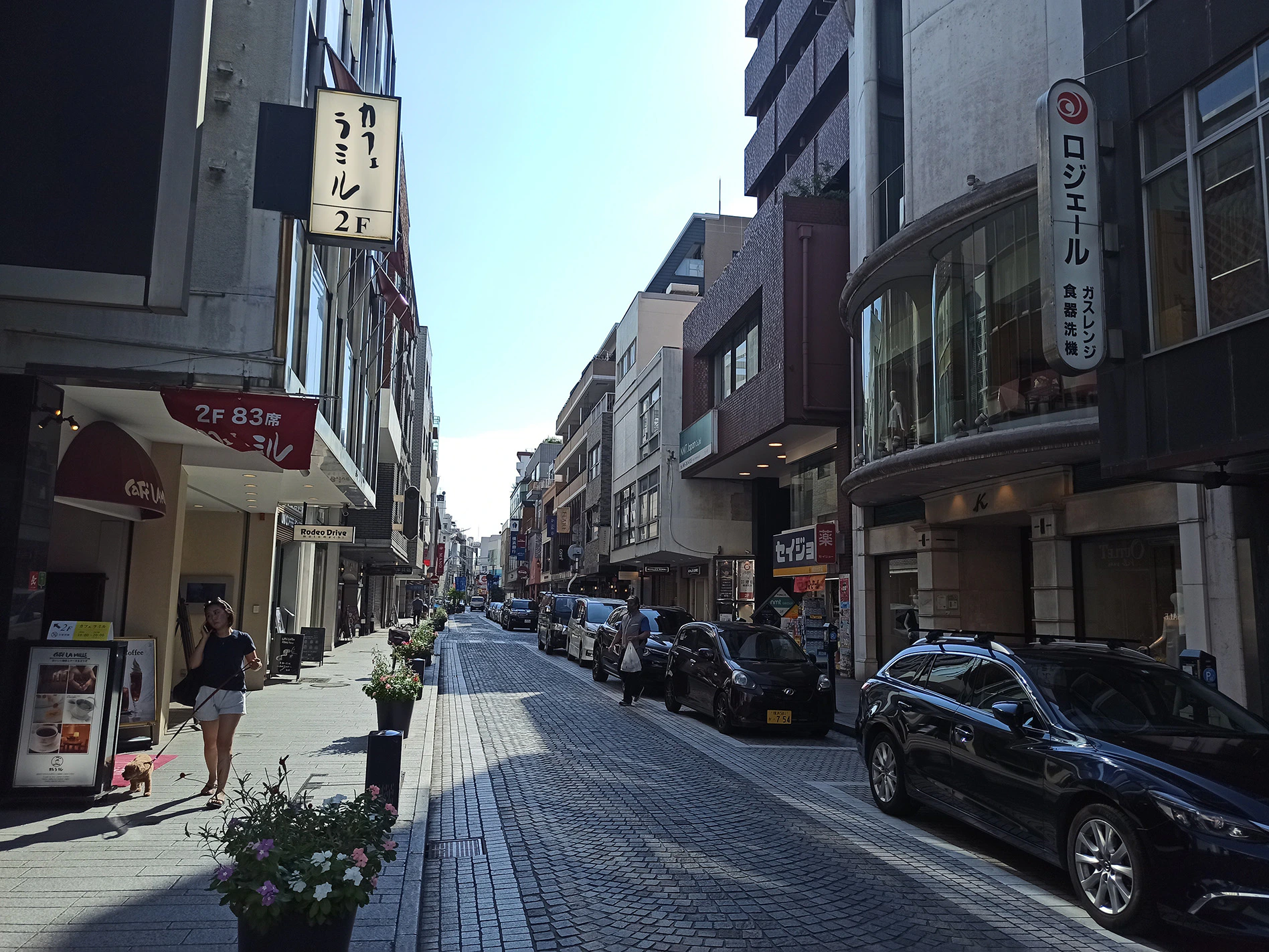
Motomachi, Yokohama is a single narrow street of roughly seven minutes walking distance on the southern outskirts of Yokohama’s city center. To its northern side it is bordered by the Horikawa canal, an extension of the Nakamura River, which separates it from the better-known Chinatown; to its south lie the hilly bluffs of Yamate. Motomachi is tiny and its location limits outward expansion, and yet, the visitor entering the street is suddenly thrust into an elegant European aesthetic with brick streets, arcades, and cheery background music (Figure 1). The stores match this aesthetic, with many selling coffee, jewelry, and made-to-order clothing. The music video of a recent song advertising the street produced by the local Crazy Ken Band gives us an idea of the intended Motomachi experience. This video features the artist strolling down evening-light Motomachi while waving to young women laden with shopping bags. After a short ride in a retro convertible laden with pink-boxed presents, he sings the refrain, which ends with “if blown upon by Yokohama’s wind / women are all, all, charming.”1 The video encapsulates many curious tensions inherent in Motomachi. Motomachi has become positioned as a metonym for Yokohama as a whole; young women are the main public visiting it; these women become charming there; and they are implicitly expected to not only wander around, but also purchase goods at Motomachi, as shown by the wrapped presents.
This article contextualizes the history behind the assumptions implicit in the music video and the contemporary discourse surrounding Motomachi. Why is Motomachi, a shopping street outfitted with Western architecture and selling Western clothing, described as eponymous with Yokohama, Japan? What is Motomachi’s aesthetic, and why is it so closely associated with a specific demographic of fashion-conscious women in their twenties? What do these characteristics tell us about the changing nature of capitalist accumulation and Japanese local society? As Okamura Keiko writes, globalization and localization feed into each other, such that even if globalization causes a homogenization of social structures and discursive symbols, identity still needs to be understood through claims of local difference (Okamura 2003). Roland Robertson has similarly argued for the analytical concept of “glocalization” to reflect how “what is called local is in large degree constructed on a trans-or super-local basis” (Robertson 1995, 26). Responding to the same problematic as these theorists, my study examines the structural and historical causes of the cultural phenomenon of locality.
In unpacking the historical origins of Motomachi’s current material and ideological form, I identify three important actors operating at three different levels: national, local, and regional. The first is a group of highly-educated female consumers who developed a class consciousness in the late 1970s. This growing body of women received college educations and worked in low-paying office jobs after graduation. With the help of a new category of “red-letter” magazines explicitly marketed towards their demographic, they dressed in a conservative fashion to distinguish themselves, a style that became advertised as Nyūtra (“New Traditional”) and later Hamatra (“Yokohama Traditional”). The second party is the local shopping street association (SSA) in Motomachi. These astute businessmen organized themselves soon after the end of World War II to capitalize upon the neighborhood’s historical relationship with first the foreign settlement, and then Japan’s postwar American occupiers by marketing their neighborhood’s relationship with the exotic West. The third body is the city of Yokohama, which, in the 1970s, began to find traces of local community within its economically declining shopping streets. The city therefore encouraged these streets to become financially sustainable by reviving its civic community both architecturally and spiritually. These three actors are discussed successively in the first three body sections. The skeins come together in the fourth, which discusses the planning and architectural aesthetics of Motomachi’s 1984 revitalization project (machizukuri). Though often uncoordinated, these three parties collaborated in reinventing Motomachi as a site for gendered consumption. The conclusion summarizes the article’s findings and suggests that the origins of Japanese neoliberalism exist within this gendered history.
Through the case study of Motomachi, this article brings together two bodies of literature that heretofore have had limited overlap. The first surrounds the concept of the shōjo, or young girl, in modern Japan. In her monograph on the Takarazuka Revue, Makiko Yamanashi describes the troupe as epitomizing the “modern girl” (moga) that entered national attention during the Taisho period. Unlike the moga’s more controversial headlines, though, Takarazuka was socially conservative, “always [claiming] moral rectitude by living according to the doctrine of ‘purity, integrity, and grace’” (Yamanashi 2012, 130). In her Passionate Friendship, Deborah Shamoon similarly identifies a continuity between prewar and postwar shōjo culture in its gender neutrality while also noting that, following the student movements of the New Left in the 1960s, 1970s shōjo manga began marketing to an older demographic of women with more mature themes like sexuality and politics (Shamoon 2012, 101–36). Nyūtra fashion, and by extension, Motomachi’s post-1980 aesthetic are both situated within this longer history of how young Japanese women negotiated distinctly female identities within a society with patriarchal social norms. As a form of “traditional” fashion, Nyūtra absorbed masculine elements representing women’s entrance into the workforce while also highlighting the wearer’s demure personality as a debutante (ojōsama).
The second body of literature concerns the history of contemporary Japanese urbanism. Where William Gardner’s(2020) monograph on metabolism and science fiction reveals a penchant for the liquid and gigantesque in postwar Japanese cities, Jordan Sand (2013) and Heide Imai (2018) find the exact opposite after 1980 in a revalorization of architecture both local and in the process of disappearing. Within this scholarship, substantial attention has also been paid to machizukuri, or grassroots urban planning endeavors that have come to play a determinate role in how cities are experienced by inhabitants and visitors alike (Satoh 2020; Sorensen and Carolin 2007). While these local efforts play a part in the invention of heritage in an economy increasingly reliant upon tourism (Reiher 2014), limited attention thus far has been given to the implicitly gendered dimension of many of these revitalization projects. As Marilyn Ivy wrote, travel promotion campaigns in the 1970s and 1980s aiming to boost the number of solo travelers on national railways primarily targeted young women, promising them exoticism and self-discovery (Ivy 1995, 29–65), and as Karen Kelsky writes, young women at the turn of the new millennium expressed themselves through “a program of intensive consumption of foreign goods, food, and travel,” becoming “the most thoroughly ‘cosmopolitan’ population in Japan” (Kelsky 2001, 85). Motomachi is one place imprinted with the legacy of this demographic. To understand Motomachi’s architecture, we must first return to its origins.
Hamatra’s Soaring Woman: Debutante (ojōsama) Aesthetics
Hamatra’s style: Between elegance and Ivy
Motomachi’s present-day architecture originates from a fashion boom that occurred among college-age girls around the turn of the 1980s called Hamatra, short for “Yokohama Traditional.” Hamatra developed as an offshoot of Nyūtra, or “New Traditional.” Situated within the history of Japanese fashion, Hamatra is located at the intersection of two stylistic trends. The first is Western haute couture, introduced to Japan through a combination of Hollywood films, Crown Princess Michiko Shōda’s largely Parisian wardrobe, and Japanese successes in international beauty pageants (Bardsley 2013; Furmanovsky 2012). The second is American Ivy style, imported by the Japanese clothing company VAN Jacket, Inc. and its founder Ichizu Kensuke. Through articles and photos placed in fashion magazines, Ichizu marketed the lifestyles of East Coast elites as models for young Japanese men (Marx 2015,34–43). Earning followers among wealthier clients, Ishizu’s company caused controversy for its popularity within the “Miyuki-zoku,” a disorganized collection of posh young men and women who strolled around Miyuki Street, Ginza. The media labeled these youth as promiscuous, delinquent, and effeminate (Tachi 2013, 445). As Ivy style lost popularity to the countercultural fashions of the 1960s, its American origins were gradually forgotten as it dissolved into a vaguer concept of “trad” or “traditional” fashion that Nyūtra and Hamatra referenced (Marx 2015, 71). Hamatra inherited the essence of Parisian elegance while absorbing the rough, old-money lustiness that young Japanese saw in Ivy. The style also took in more recent innovations like the short-sleeved polo, which was quickly available to Japanese through improved shipping and communication networks (English 2013,76–80).
Though Hamatra cannot be limited to an exclusive definition, there was nevertheless a standard outfit with a number of set elements to which variants made reference (Figure 2). This included:
- Upper Body: A conservatively buttoned shirt, preferably a polo from Motomachi’s tailor Fukuzō. This would be paired with either a blazer or a coat, preferably from the Motomachi order-made store Kayo. The choice of vertically-buttoned garments that did not accentuate the bust exuded a sense of masculine flatness and height.
- Lower Body: A knee-length wrap-around skirt, occasionally substitutable with chinos or a knee-length dress, that maintained a columnar silhouette. The medium length contrasted with mini and maxi skirts, and the form neither billowed like the pleated skirts of high school uniforms nor structured the body like “body conscious” pencil skirts that would gain popularity in the 1980s.
- Footwear: “Cutter shoes” purchased from the Motomachi shoemaker Mihama. Cutter shoes were a type of pumps with extremely low heels and a feminine ornament on the vamp. The low heels made walking comfortable for the young women who had to climb up and down the slopes of Yamate between Motomachi and Ferris University, a local women’s college where Hamatra’s originators studied. These shoes were paired with conspicuous, knee-reaching “high socks,” which differed from the ankle-length socks and tights typically worn by high school students at the time.
- Accessories: A handbag from the Motomachi atelier Kitamura or a high-end foreign brand like courrèges or Chanel.
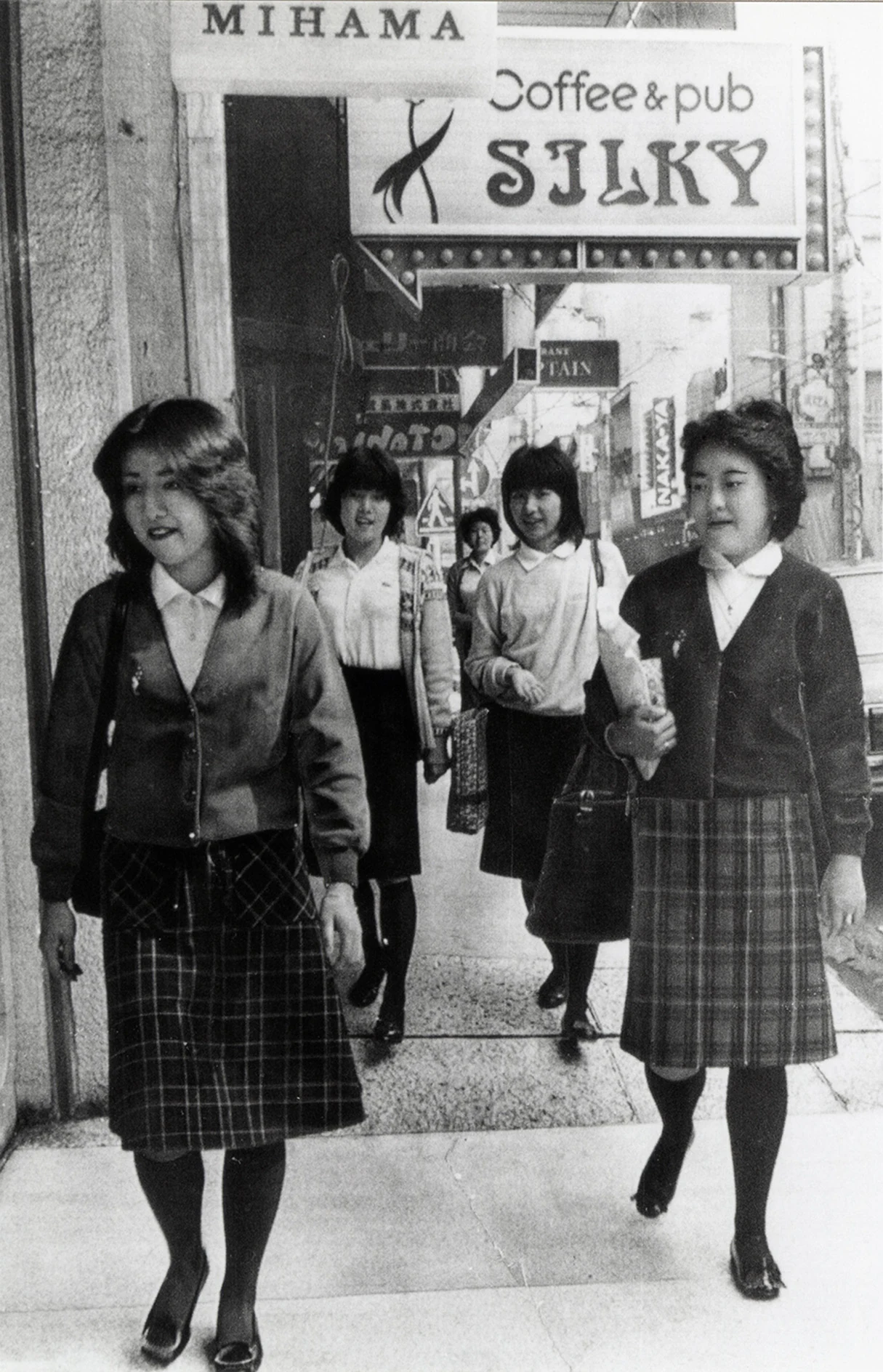
Put together, Hamatra embodied the middling role between demure femininity and the masculine, professional world into which college-educated women would be socialized. Hamatra was more practical than Parisian fashion, readily incorporating heelless shoes and chino pants, letting women maneuver with equal dexterity to men. This activeness was further underlined by the addition of sporty polo shirts and other masculine articles like blazers and buttoned shirts. As an ensemble, the outfit gave a clean, vertical impression that differed from the flowery, baroque style typical of young women’s(shōjo) literature (Monden 2019) as well as Christian Dior’s French “new style,” which accentuated feminine elements like the bust and waist (Bardsley 2002). While incorporating masculine elements, however, Hamatra still sought to preserve a modest femininity by wearing skirts rather than pants and pumps rather than dress shoes. The curious addition of high socks may represent the underlying pertness of a childish scamp, who had only recently been liberated from the strictures of high school.
Hamatra in context: Feminism, consumerism, and magazines
Who were these young women wearing Hamatra? Many were readers of a new genre of women’s magazines established in the 1970s that catered to a demographic of young, highly-educated women. The earliest and most well-known of these magazines are An-an (est. 1970) and Non-no (est. 1971). These magazines advertised a new lifestyle for these women and filled their pages with color visuals exhibiting fashion, travel, and interior design (Sakamoto 1999). They represent a turning point away from the postwar idealization of Western lifestyles. Though An-an began as ELLEjapon, or the Japanese print of the French fashion magazine ELLE, and Non-no contracted with the American magazine Glamour (Yonezawa 2014, 13), they began foregrounding half-Japanese rather than white models during the magazines’ first decade (Ochiai 1997, 160–1).
This localization of Western fashion would be furthered by a new category of magazines, colloquially known as the Akamoji-kei (“Red-letter”) for the color of their logos. Spearheaded by JJ (est. 1975), these magazines specifically targeted a subset of An-an and Non-no’s readers, namely, women attending college interested in conservative fashion (Yonezawa 2014, 39). As Suzuki Suzumi describes, JJ’s imagined readers were born into wealthy families with the latitude to allow their daughters to attend private women’s universities and purchase brand fashions (Suzuki 2021,82–3). “New Traditional” would be the principal fashion of this Japanese debutante (ojōsama): as Suzuki counts, the word “Nyūtra” appears on the front covers of 53 of JJ’s first 74 issues (Suzuki 2021, 177). Indeed, Kittredge Cherry witnessed an “ojōsama boom” in the mid-1980s during which girls’ magazines instructed young women to act like demure, well-heeled maidens “intelligent, yet devoid of street smarts” (Cherry 1987, 48). Such ojōsama would have attended women’s schools (colloquially, ojōsama gakkō) like Ferris University in Yokohama, and JJ undoubtedly played no small part in popularizing its figure within the national imagination.
JJ was able to capitalize upon the market for young women’s fashion not only because more women were receiving college educations, but also because of the socially liberal spirit in the wake of the women’s liberation movement and second-wave feminism (Shigematsu 2012, 171–7).2 The 1970s in Japan saw the influence of books like Erica Jong’s Fear of Flying and events like the United Nations Decade for Women (1975–1985), which created images of powerful women embarking on quests of self-discovery while nevertheless preserving a fundamental femininity (Napier 1998, 100–3). This belies the entrenched sexism that continues to exist in Japanese society, as a wide body of sociological literature has noted (Brinton 1993; McVeigh 1997). Though more women received tertiary educations after World War II, most attended two-year junior colleges preparing them for menial clerical work as “office ladies” (OL). Often hired as part-time labor, OLs had limited opportunities for career advancement and were expected to retire upon marriage (Carter and Dilatush 1976). Despite these barriers, JJ and Nyūtra fashion optimistically celebrated the “flying women” entering the masculine sphere of adulthood.
The discovery of the collegiate woman market was not JJ’s only contribution to the magazine industry. JJ also introduced “reader models” (dokusha moderu, shortened as doku-mo). Instead of hiring professional models, JJ discovered new styles by either scouting them out on college campuses or inviting readers to submit their own wardrobes. This attribution of fashion’s origins to grassroots readers rather than haute couture caused a number of important changes. It heralded, firstly, the shift from high fashion to streetwear, attaching style to place, which has become commonsense in Japanese fashion today (Kawamura 2012). This method also, however, gave Nyūtra a certain slipperiness. If Yonezawa is right to describing Nyūtra as a college girl’s “uniform” (Yonezawa 2014,56–7), because Nyūtra was whatever college girls wore, there was no way to determine authenticity. Nyūtra was as much a uniform as a general attitude towards dress that often coalesced around the use of similar apparel. Precisely because Nyūtra had no clear rules, women could stylistically experiment to match the situation, ranging from business meetings to social events.
JJ would nevertheless spend issue after issue fruitlessly trying to determine a code of wear for Nyūtra. One way to create difference was by dividing Nyūtra into subcategories based on its origin, often situated around some local women’s university. In a long feature in its very first issue, for example, JJ’s editors distinguished between Nyūtra styles in Yokohama, Tokyo, Kobe, and Osaka (JJ, June 1, 1975). They explain why each region’s style differs and support their arguments with photos of local women from these cities. This feature already notes that Motomachi is “the heart of the Kanto region’sNyūtra,” developed by the students at Ferris University, who bought goods from Motomachi stores like Fukuzō and Mihama. Compared to other modes of Nyūtra, Yokohama’s arrangement was particularly “elegant (jōhin)andlikeadebutante(ojōsan).” This trope of Yokohama being particularly elegant even among Nyūtra would be repeated in a panel discussion where the editorial board invited five readers from around the country to discuss the nature and evolution of Nyūtra. According to Yokohama OL Taguchi Yōko, Yokohama girls “are proud of their elegance (oshare),” for “they feel as if [their elegance] is like an originality that they themselves invented.” Despite being close to Tokyo, Yokohama girls hesitate to follow Tokyo’sexample,being“surprisingly stubborn about [their fashion] in spite of being women” (JJ, October 1, 1976). By creating regional styles like Yokohama’s, JJ’seditors turned previous unremarkable cities into differentiable fashion destinations and obtained a bottomless source for fashion ideas and promotional content.
Localizing fashion
As a variant of Nyūtra, which in turn descended from Ivy and Parisian style, Hamatra lay at the intersection of two style fashions originating from the West and represented a model of Western bourgeois elegance. JJ nevertheless marketed it as an authentically Japanese phenomenon. JJ published its first feature on Hamatra in its December 1979 issue, writing that “among people living in Yokohama (hamakko), many still wear ten-year old Kayo coats passed down to them from their older sisters,” and that the designs of products by Kayo, Fukuzō, and Mihama have remained consistent for over a decade (JJ, December 1, 1979). This coverage peaked in JJ’s October 1980 issue, which featured a twenty-six page feature entitled “Extensive Research on Hamatra.” This report’s front page summarizes Hamatra as follows:
Hamatra, beginning from Yokohama Motomachi. Japanese differ in aspects like lifestyle and physiology, and it’s impossible for foreign fashions to fit them as they are. Japanese girls need fashion that fits Japanese girls. This boom is one answer to this dilemma. 1980s Hamatra will, as Japanese casual, conquer the entire country. (JJ, October 1, 1980)
The report goes on to describe Hamatra as “the first original fashion born in Japan . . . naturally born from the arrangement of Motomachi’s famous products,” placing it in contrast with foreign fashionable styles “growing rampant” (habikoru) in the country. If Hamatra was composed of Western-style garments, these articles nevertheless came from local stores like Fukuzō that tailored with Japanese bodies in mind, making clothes that “while born in Japan, give off the strong scent of America” (Ibid.). JJ’s discovery of Hamatra turned a Western style with Japanese variants into a Japanese style that acknowledged its borrowing from the West, but was unique to a specific region of the country and the specific stores in this region. Hamatra self-consciously domesticated fashion for a “lifestyle and physiology [. . .] that fits Japanese girls.” Where Nyūtra’s name did not reference locality, Hamatra spatialized its style, limiting it to college girls in Yokohama, a metonym for Japan. In localizing Hamatra, JJ also brought business to local stores, for if Nyūtra could be arranged from clothing purchased anywhere, Hamatra needed to be bought from Motomachi, the town most loyal to traditions of Japanese couture. Buyers would need to come shop in Yokohama to buy brands that were modern, feminine, and Japanese.
Hamatra’s denomination shows the uncomfortable negotiation Japanese women experienced at the intersection of gender and racial difference. To resolve the problematic of being both female and Japanese, Hamatra employed tactics of place-making and consumption. They recognized port cities like Yokohama as the premier sites of Western modernity’s translation into Japan. By dressing themselves like the students at Ferris University, or at least those selectively photographed by JJ, Hamatra’s fans could both become Western and remain Japanese. This costuming, in turn, required consumption at Motomachi’s apparel stores. For the first time, Yokohama in general and Motomachi in particular had commercial brand value that could be described as localized. If, as we shall see, Motomachi’s shopping street before 1980 created an exotic atmosphere by tying the community to the West, Motomachi after 1980 became more distinctly Japanese, advertised not as an entryway to the West, but rather as a discovery of quintessential Japan. Critical to this transformation was a culturally-motivated evolution of consumer desires, of a desire to break away from the West while simultaneously sublimating its fashions.
By 1981, the Hamatra boom had largely passed. A feature in JJ from April 1981 surveyed Hamatra fashion in campuses across Japan, writing that as the boom had “overheated” and “calmed down,”“a fashion that was originally born in the single city of Yokohama has rooted itself across the country and gradually changed its appearance” (JJ, April 1, 1981). Per the report, even girls at Yokohama’s Ferris University had changed their style, strengthening the “marine traditional” core of their local identity and wearing clothes that gave off a stronger “atmosphere of the sea” (Ibid.). This is unsurprising given how the very notion of “traditional” fashion conflicted with JJ’s need to cultivate consumerist desire among its readers. JJ’s editorial board created and categorized local “traditions” to market these sites as having intangible value, value that could be appropriated as an identity by purchasing and wearing the right brands. This idea of Motomachi or Yokohama as being a place with its own unique culture, one conducive to capitalist profits, formed the heart of Yokohama’s “mini-redevelopment,” as well as Motomachi’s second machizukuri in the 1980s. To appreciate the gendered nature of this neighborhood’s development, however, we must take detours: first through Motomachi’s postwar history, and then through the politics of its revitalization.
The Shopping Street: Motomachi and the Market for Western Exoticism
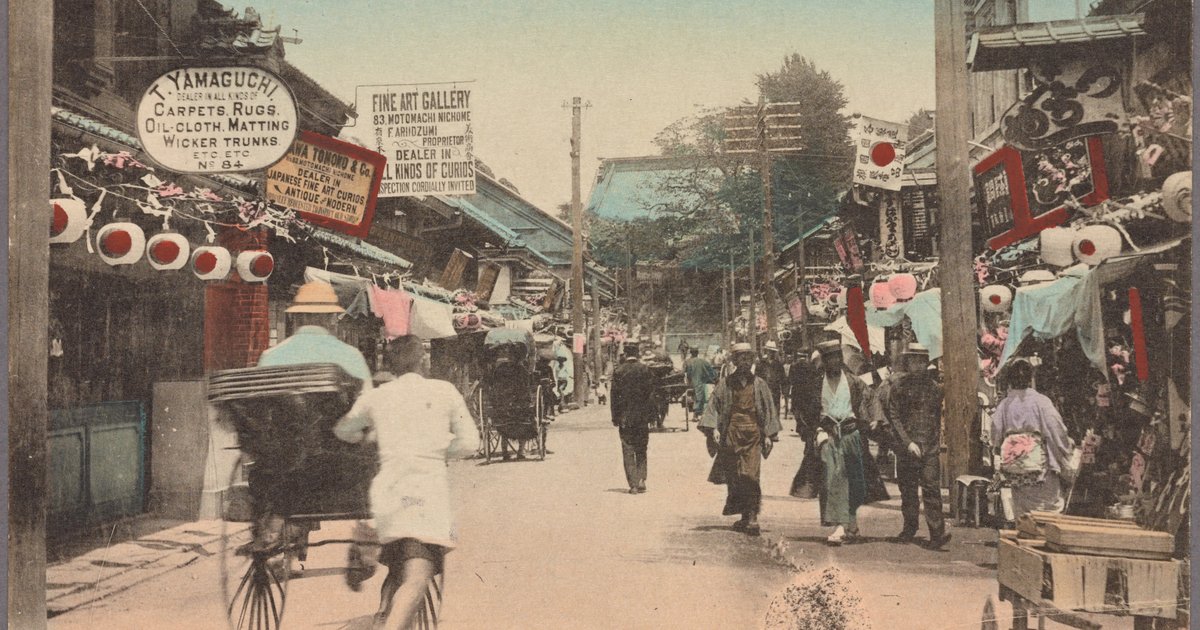
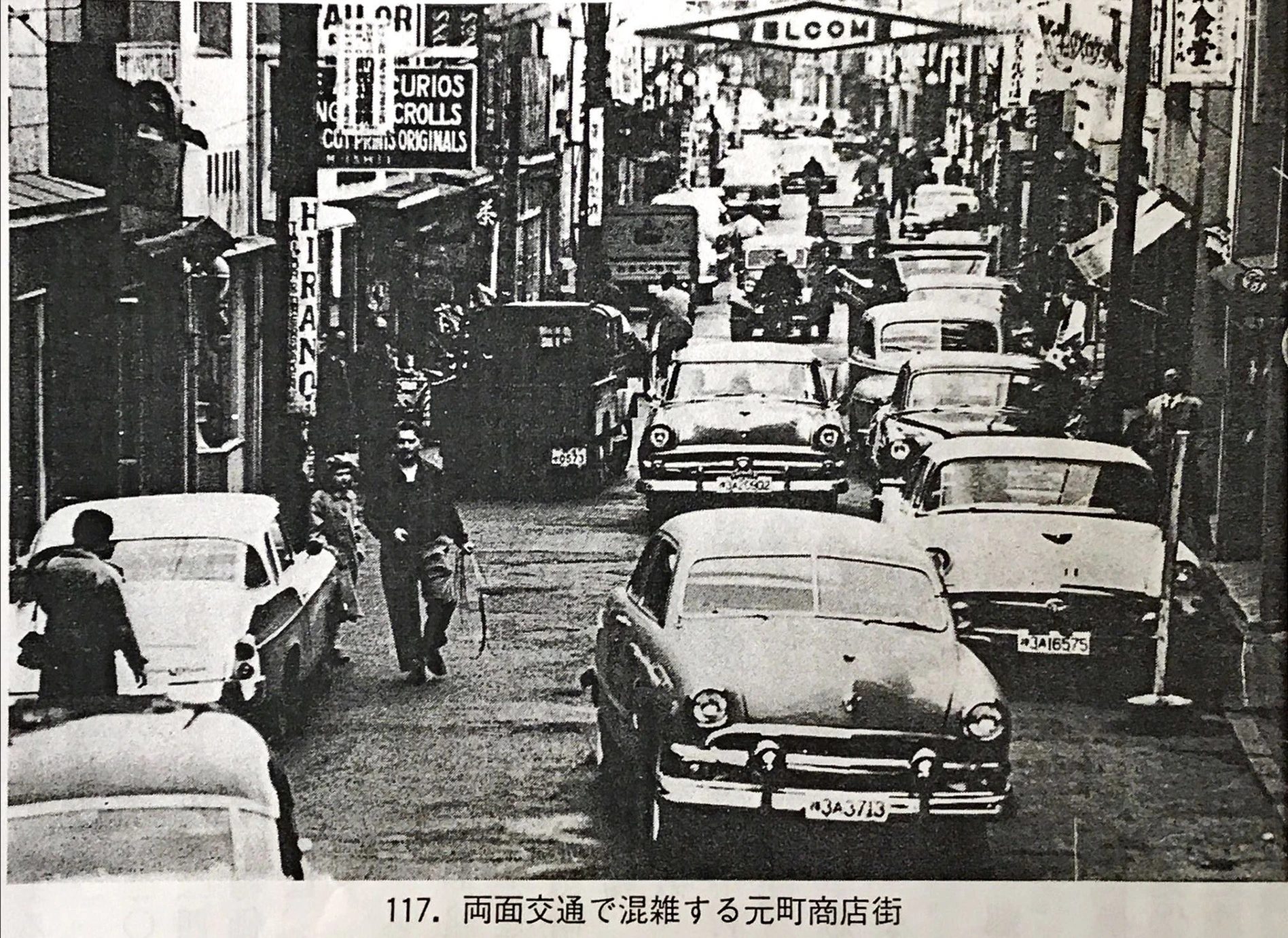
JJ’s fixation on Motomachi was anything but arbitrary. Well before Hamatra style became associated with them, Motomachi’s astute shopkeepers, organized within a local shopping street association (SSA) called the SS-kai, had done their best to profitfromthe neighborhood’s historical relationship with the West. Thrust between two Meiji-period (1868–1912) foreign settlements in Kannai and Yamate, Motomachi once introduced to Japan elements of Western culture like furniture and the bread loaf (shoku-pan). Though burned to the ground in the fires of World War II, Motomachi found new life during the American occupation as Allied forces requisitioned much of the city, stifling Yokohama’s economic activity yet creating a market selling clothes, jewelry, and souvenirs to the occupiers (MRHI 2002,151–152, 156–157). A photo from this period shows Motomachi’s narrow streets with English-language signage and packed with automobiles, a luxury unavailable to Japanese at the time (Figure 3).
The departure of the Americans at the end of the Korean War in 1953, however, did not end Motomachi’s identity as a shopping street for foreigners; if anything, it caused the neighborhood to double down. Reflecting their Western orientation, the SS-kai, incorporated in 1952, chose the English term “shopping street” (SS) rather than the Japanese shōtengai, normally used by SSAs. In competing for Japanese customers after the American departure, the SS-kai’s close relationship with the exotic West now set it apart from its neighbors. One way that Motomachi concretized this affiliation was by adapting the street to the age of motorization that its business leaders believed would soon come (MRHI 2002, 200–201). In 1955, the SS-kai convinced the municipality of Yokohama to mandate buildings on their street to retire their rez-de-chaussée to at least 1.8 meters from the road.3 At the time, Motomachi’s road, like many other narrow streets in Japan, did not distinguish between pedestrian and automobile zones, making it hard for passersby to observe storefronts while dodging vehicles. Many storeowners nevertheless opposed the idea and dragged their feet. Retiring their properties meant not just a loss of retail space, but also a significant expense. The undertaking would be meaningless, moreover, if some refused. Construction did not even begin until 1964, nine years after the ordinance passed (Yomiuri Shimbun, December 5, 1968). Even the chary fell in line, however, after the street started seeing their profits increase by a third annually.
The SS-kai did not stop at storefront retirement to attract Japanese customers. Ozawa Midori, whose family business specializes in order-made dresses, remembers Motomachi’s remarkable 1954 sale, when the SS-kai had someone dress up as Santa Claus and ride a sleigh down the street while selling fukubukuro to passerby. The 1956 Christmas sale was even more sensational, when the SS-kai held a lottery with the grand prize of a luxurious Datsun car (Shimaoka 2009,86–87). Over the following decades, Motomachi strengthened its association with Western cities and modern fashion. In 1967, the street sent a delegation of forty-seven members to sign seven sister street agreements with shopping streets in six European countries (MRHI 2002, 234). This was followed in 1973 and 1974 with agreements with streets in Madrid and San Francisco. In addition to providing Motomachi with symbolic legitimacy, these agreements allowed Motomachi’s retailers to import goods directly from the source. By cutting out middlemen, Motomachi merchants could offer competitive prices on Western luxury fashion and respond more quickly to changing demands from their buyers (Yomiuri Shimbun, December 5, 1968).
With the SS-kai’s memorable advertising, Motomachi’s association with Western fashion and luxury made national headlines. In 1968, the SS-kai ran a “Foreigner Model Training Program” with fifteen students from the nearby American School that culminated in parading these models down Motomachi dressed in ethnic bridal outfits (MRHI 2002, 237). The street also organized an increasing number of Western-themed annual festivities. Motomachi’s clothing boutiques held the neighborhood’s first Charming Sale in 1961, a popular annual event that the SS-kai took over starting in 1970 (MRHI 2002, 218, 239). That same year, the SS-kai also held the street’s first annual Europe Fair. rd For eleven days beginning October 3, Motomachi’s streets were decorated with flags of Western European countries, cars were barred from entering, and cafe terraces were set up in the streets. During this fair, the SS-kai organized an auction, a parade, a fashion show, and national days for each country with which Motomachi had a sister street agreement. With the support of local authorities and the embassies of the Western European countries represented, the Europe Fair met with great success, attracting over 200,000 visitors daily (MRHI 2002, 242-5). Thereafter, the SS-kai continued to regularly hold Western-themed events. During the 1976 Golden Week vacation, Motomachi held an “America Fair” featuring the flags and apparel of colonial America, and in the 1978 Golden Week, Motomachi held a “German Week” featuring a parade thematized around the Pied Piper (MRHI 2002, 260-1, 267).
The 1970s, however, were also a turning point in Motomachi’s business strategy. Customers visited early postwar Motomachi because there they could stroll around leisurely, savor the latest Western fashions, and buy them for affordable prices. The SS-kai signed sister street agreements to import luxury goods, and the SS-kai’s members described themselves as competing with Ginza’s Miyuki Street, another site that sold imported, high-end clothing. An article from the Yomiuri Shimbun on December 5, 1968 described the typical visitor as follows: on a sunny Sunday, a Tokyo family drives to Kanagawa prefecture, strolls along the bay and in Yamashita Park, enjoys some shopping in Motomachi, and then has dinner in Chinatown before returning home. This imagined visitor was by no means the majority of the over 100,000 shoppers visiting Motomachi on weekends: a survey by the SS-kai in 1967 showed that only a quarter of visitors came from Tokyo, and only a third by car (Ibid.). This wealthy, bourgeois family living a Western lifestyle, though, was the visitor to whom Motomachi catered. This image differs substantially from how JJ and its readers saw Motomachi, that is, as a site for locally made Japanese fashion. JJ focused its spotlight not on the items Motomachi imported, but rather the articles of clothing that Motomachi’s artisans made themselves. Over time, this perspective would come to replace the former one, even in the SS-kai’s own advertising rhetoric.
JJ was not the only party that saw Motomachi’s essence not in its economic connections with the West, but rather in how it represented local Japanese tradition. Starting in the 1970s, economic planners in the city of Yokohama began to fret about the increasing economic heft of department stores and shopping centers, which threatened the city’s traditional shopping streets. In their eyes, the quiddity of Motomachi’s advantage over these department stores did not lie in its skillful importation of Western goods (which was increasingly irrelevant with improvements in trade networks and the normalization of Western fashion), but rather in its local character. Unlike department stores, Motomachi also doubled as a community that could justifiably claim an extended history of trade with Western settlers and occupiers in Yokohama. A department store may well plaster itself with Western architecture and comparative national fairs, but it can only with difficulty claim to be a historical community rather than a collection of self-interested shopkeepers. The bureaucrats of Yokohama transformed the very notion of a shopping street from a collection of economic actors to the traditional core of local society. This new mode of thinking would have implications for how the merchants of Motomachi saw their place in community life. It is to these economic planners that we now turn.
The State: Civic Life, Monetized
Mini-redevelopment: Shopping streets and the economics of civic life
A Japanese shopping street association (SSA) is a voluntary association composed of a small number of usually local, family-owned businesses. Legally, they can be incorporated under one of two laws, one from 1949 permitting the formation of “cooperatives” (kyōdō kumiai) joining together members of the same industry, and another from 1962 permitting “promotion associations” (shinkō kumiai) targeting regional rather than industry-specific development (Hama 2008). Though incorporation lets SSAs borrow money and benefit from government subsidies, not all SSAs are incorporated, and even incorporated SSAs cannot coerce businesses to join or members to follow their rules. Despite the SSA’s politically weak nature, Japanese politicians since the 1970s have seen them as allies against the encroachment of large retailers. 1973 saw the passing of two laws intending to promote the economic survivability of small businesses while also making it harder to establish stores with large retail space. Though more well-organized SSAs like Motomachi’s could compete with department stores in the 1960s, most experienced increasing difficulty in the competition for both clients and employees (Yanagisawa 2021). With private automobiles, people wanted to shop at stores with parking spaces, and with trains and subways, people could work and shop further from where they lived. Between 1982 and 2014, the number of retailers in Japan decreased by more than 40 percent, even as the amount of retail space increased by 39.3 percent (Dolezal 2018, 31-32).
This impending decline was not assumed, however, by the Yokohama city government when, following the central government’s example, it began to proactively combat the decline of traditional shopping streets. In 1977, its Economic Bureau published a 126-page guide encouraging the some 350 shopping streets in Yokohama to begin “mini-redevelopment” projects, promising the city’s support (YK 1977). The bureau followed the 1977 guide with several other volumes in 1979 and 1980 that gave examples of successful development projects for SSAs to reference and taught readers how to attract customers with public events (YK 1979a; YK 1979b; YK 1980). Economic Bureau chief Yamamoto Isao wrote the 1977 document’s opening remarks, which explains the dilemma city planners faced. With the increasing importance of private cars and big stores, Yokohama’s traditional small retailers could not compete with large retailers. As in Motomachi’s case, small retailers are generally inefficient, inconvenient, not easily accessible by car, and without enough parking spaces. The Bureau promised that through mini-redevelopment, shopping streets could nevertheless win back local customers while incurring little upfront cost to shopkeepers.
What is most notable about mini-redevelopment is the importance attributed to shopping streets’ social function. Yamamoto and his Bureau saw shopping streets as a Japanese form of the public plaza, or hiroba. A mini-redevelopment does not, then, principally try to compete with big businesses in terms of price, efficiency, or variety, nor does it try to attract tourists to the shopping street. A redevelopment rather capitalizes upon the shopping street’s essence, which is community identity. Yamamoto explains in his opening remarks that
From the perspective that “shopping streets were originally ‘management institutions’ (keiei shisetsu) while simultaneously also being local citizens’ ‘lifestyle institutions’ (seikatsu shisetsu),” we offer models in which shopping street redevelopment (shōtengai machizukuri) supported by its local consumers made the street flourish. (YK 1977)
By “models,” Yamamoto refers to a 1973 program that invited shopping streets to volunteer to redevelop according to the municipality’s advice. “Model streets” would hold redevelopment study groups and receive consultants and funding from the city, to which they were obligated to report on progress annually. By 1977, four shopping streets had been designated as models, and each were in different stages of redevelopment (YK 1977, 19-21). SSAs that wanted to participate would need to have their members’ consent and send the city a special application form. Though this program called the chosen streets “models,” the Economic Bureau’s guide underlined that no single path to revitalization existed, for each revitalization responded to the needs of different local consumers. Revitalization would therefore simultaneously “individualize” (koseika) and “modernize” (kindaika) shopping streets, making SSAs profitable by capitalizing on their local character. The Bureau’s report notes that earlier versions of machizukuri failed in “creating an image of that which is the special property (tokuyū) of the street,” thereby constructing “streets that could be found anywhere” (YK 1977, 9). Mini-revitalization, according to the guide, was founded upon an entirely different philosophy that required “voluntary redevelopment” (tenpo kaihatsu nin’i) that would “create unending change within the process of developing [the shopping street’s] architecture (kankyō seibi)” (YK 1977, 11). In other words, where previous revitalizations were one-time endeavors, this new revitalization would be a process of creating unending change itself. This unending architectural change in response to circumstances would furthermore need to be voluntary on the part of shopping streets.
Mini-redevelopment, then, meant two principal changes for shopping streets. Firstly, it meant more state involvement in local planning. Yokohama City developed a systematic state support network in which the municipality used financial carrots to goad shopping streets into following its advice. The concrete techniques actually applied during these revitalizations nevertheless followed old patterns, such as holding bargain sales, establishing pedestrian-only zones, and building arcade overhangs. What changed, however, was the assumption that city consultants have a duty to help shopping streets economically succeed, causing an expansion of the state’s interference in local life. Secondly, and just as importantly, it meant the proliferation of the bureaucrats’ ideological belief that economic prosperity would naturally result from a correct molding of local society. Mini-revitalization introduced the idea that for a shopping street revitalization to be successful, it must first produce a community space (hiroba). By helping locals appreciate their own shopping streets’ communal character, revitalization would convince locals to reject glitzier urban shopping centers and return as loyal customers of their community stores.
Herein lies mini-redevelopment’s ideological core. As the Economics Bureau argues, through government inference in molding local society, social welfare in the form of economic wealth would be naturally redistributed through the free market. Rather contradictorily, however, the Bureau would create this desired local society not through education or moral persuasion, but rather through market forces, convincing Japanese consumers to buy local, whether through advertising, comfort, exoticism, or price. In this dual application of pure market logics presumed to exist in state decisions and the state’s own subservience to propagating or correcting this same free market, it is impossible not to see hints of neoliberal thought. Motomachi’s connections with neoliberalism will be further ventured in the Conclusion; for now, I wish to focus only on the relationship the Economic Bureau saw between consumerism and local community. While this logic that architectural revitalization would lead to local culture, which would lead to profits for small businesses is dubious, its appreciation for locality was congenial with the spirit of the times. Business associations like Motomachi’s SS-kai have since come to see themselves as marketing not only commercial products, but also local flair.
Motomachi’s diagnosis: A feminine hiroba
Sometime after the 1977 mini-redevelopment guide was published, the businessmen in Motomachi commissioned the city to survey their shopping street and tell them how they might improve. The Yokohama Medium and Small-Scale Enterprise Direction Center (MSDC) then spent 1979 conducting pedestrian and business surveys in the neighborhood, compiling their results in a 1980 document entitled “Diagnosis Report on the Motomachi Shopping Street: Machizukuri Masterplan” (MSDC 1980). This document warned the SS-kai that though Motomachi had become one of Japan’s few successful fashion streets, it risked losing this position in the future in light of greater competition and a stagnating economy. The MSDC therefore advised that the SS-kai adjust themselves to their primary customer base, namely, women in their twenties, as local businesses that targeted this demographic tended to be more profitable than those which did not.
From their pedestrian surveys, the MSDC found that in 1979, 82.4 percent of Motomachi’s visitors were women, and 78.1 percent were under the age of thirty (MSDC 1980, 8). Roughly one-fourth of visitors came from the Tokyo metropolitan area, with almost all of the remaining three-fourths from within Kanagawa Prefecture (MSDC 1980, 4). Only roughly 10 percent came from the immediate environs of Kannai, Motomachi, and Ishikawa-chō (MSDC 1980, 1). When asked why they came, the majority of visitors said they were there to shop (57.2%), with a substantial minority responding that they simply happened to be there (nanto naku, 16.2%) (MSDC 1980, 12). These statistics paint a picture of late 1970s Motomachi as a place where a mostly local crowd of young women spent their leisure time either shopping or strolling about with friends. Indeed, visiting Motomachi was usually a conscious choice. The MSDC’s report distinguished between “competition in quantity” (ryōteki) and “competition in quality” (shitsuteki). They noted that consumers visited some shopping streets like Yokohama Station because of its convenience, whereas they visited peripheral ones like Motomachi because they enjoyed the ambiance. The most important competition for Motomachi was therefore not Yokohama Station, which the MSDC argued was frequented but not loved, but rather Shibuya, Tokyo, another shopping street known for its fashion (MSDC 1980, 5).
That far-away Shibuya could even be considered within the geographic realm of competition for Motomachi reflects changing norms of transportation. Compared with previous decades, customers in the 1970s became more willing and more able to travel great distances by train and car for their envisioned shopping experience. By 1980, one-half of visitors came to Motomachi by train and another 30 percent by private automobile, often arriving from places more than an hour away (MSDC 1980, 11). A combination of the SS-kai’s relentless advertising and the popularity of Nyūtra fashion meant Motomachi had developed a brand value for those who may never have had the chance to visit, but who had heard of the street’s existence. Motomachi found a new identity thrust upon itself as a distinctly feminine site, one where many visitors came from relatively far places to enjoy a particular atmosphere that they imagined would be worth their journey. To satisfy these customers, the SS-kai would need to build parking spaces for their cars and redesign its storefronts for their fantasies. It would not be enough to suit Motomachi to have women’s clothing stores; it would need to redesign itself as afemininesite.
The MSDC’s consultants were unambiguous that the most profitable clients were the “army” (MSDC 1980, 55) of students and OLs attending nearby schools and working in Kannai. To attract this demographic, many of whom would be readers of magazines like JJ, the consultants recommended that Motomachi transform from a “fashion leader” to a “fashion creator.” The consultants advised that by attracting more fashionable women to Motomachi, the SS-kai could facilitate the invention of new “fashion cultures” like Hamatra (MSDC 1980, 20-21). Methods for attracting young, fashionable women included making more comfortable architectural spaces and selling more original brand products. The difference here is nuanced. As in the earlier discourse by Yokohama’s Economic Bureau, the MSDC does not simply advise the SS-kai to renew its architecture and invent new products to attract more customers; it argues, instead, that these aforementioned means should be taken to attract more women who would create cultures that would then attract more customers, similar to what happened with Hamatra’s boom. In reimagining Motomachi as a site for fashionable ladies, the MSDC recreated it as a hiroba, a human space for community interaction, that would serve as a mediating point to solidify its economic sustainability. This humanism, however, sat uncomfortably with economic motives, such as when the MSDC writes that Motomachi “harbors within it the potential to develop original products that can constantly emphasize the confirmatory nature of its existence (sonzai no kakuninsei) “ (MSDC 1980, 20). That is to say that in its reliance on young women bringing about the latest modes, Motomachi’s very existence is permanently imperiled and relies on the street’s ability to ceaselessly create new merchandise that will attract these same women who will give Motomachi’s locale cachet. Here, one clearly sees afterimages of JJ’s star-crossed search to define and localize Nyūtra.
In localizing Motomachi, the Masterplan also argued that Motomachi was a crystallization of what is unique to Yokohama (Yokohama rashisa), and that when people visited Motomachi, they should feel this authenticity. In addition to shopping at Motomachi, visitors should also take walks in the nearby Foreigner Cemetery and the Harbor View Hill to appreciate how Motomachi is “the entryway to ‘port Yokohama’” (MSDC 1980, 21). When elaborating what this essence consists of, though, the MSDC lists neoliberal characteristics like being self-supporting, responsive to changing situations, and knowledgeable about economic circumstances. Only with such flexibility could the farmers and fishermen in late Tokugawa Motomachi have learned to stand among Japan’s foremost merchants. As the Masterplan explains,
Refusing to distort [market principles] by saying that the demands of consumers “could not be fulfilled” because of inconvenience to the producers, [the merchants of Motomachi] dealt with [the market demands] of the entire country. . . . It is meaningful that [Motomachi’s shopkeepers] learned here the know-how to establish the great principle of responding to demand. (MSDC 1980, 24)
There was therefore no contradiction between inheriting Motomachi’s tradition and marketing Motomachi to customers, for the ability to respond to market demand was precisely the tradition to be protected. In the pattern of the Economic Bureau’s guides, economic principles are both assumed to be “fundamental” and believed to need recognition and protection. Motomachi’s shopkeepers not only operate according to the principles of supply and demand, but also actively strive to fulfill customers’ wishes to the letter, such as by hiring municipal consultants. If customers wanted to experience an “atmosphere” of authenticity in Motomachi, this meta-enactment of authenticity would thereby not contract authenticity; rather, the pursuit of capitalist profits would ensure the consistency of Motomachi’s identity itself. This overt drive for profit is the repressed underside of the discourse of public community in the Economic Bureau’s theory of mini-redevelopment. The 1980 Diagnosis Report advocated for a simulacrum of a community that would preserve the community itself, that would create a “public” space where young women could compete in individualistic fashion, an apolitical, consumerist arena.
A Phoenix, Rising from the Ashes: Motomachi’s Second Revitalization
The path to revitalization
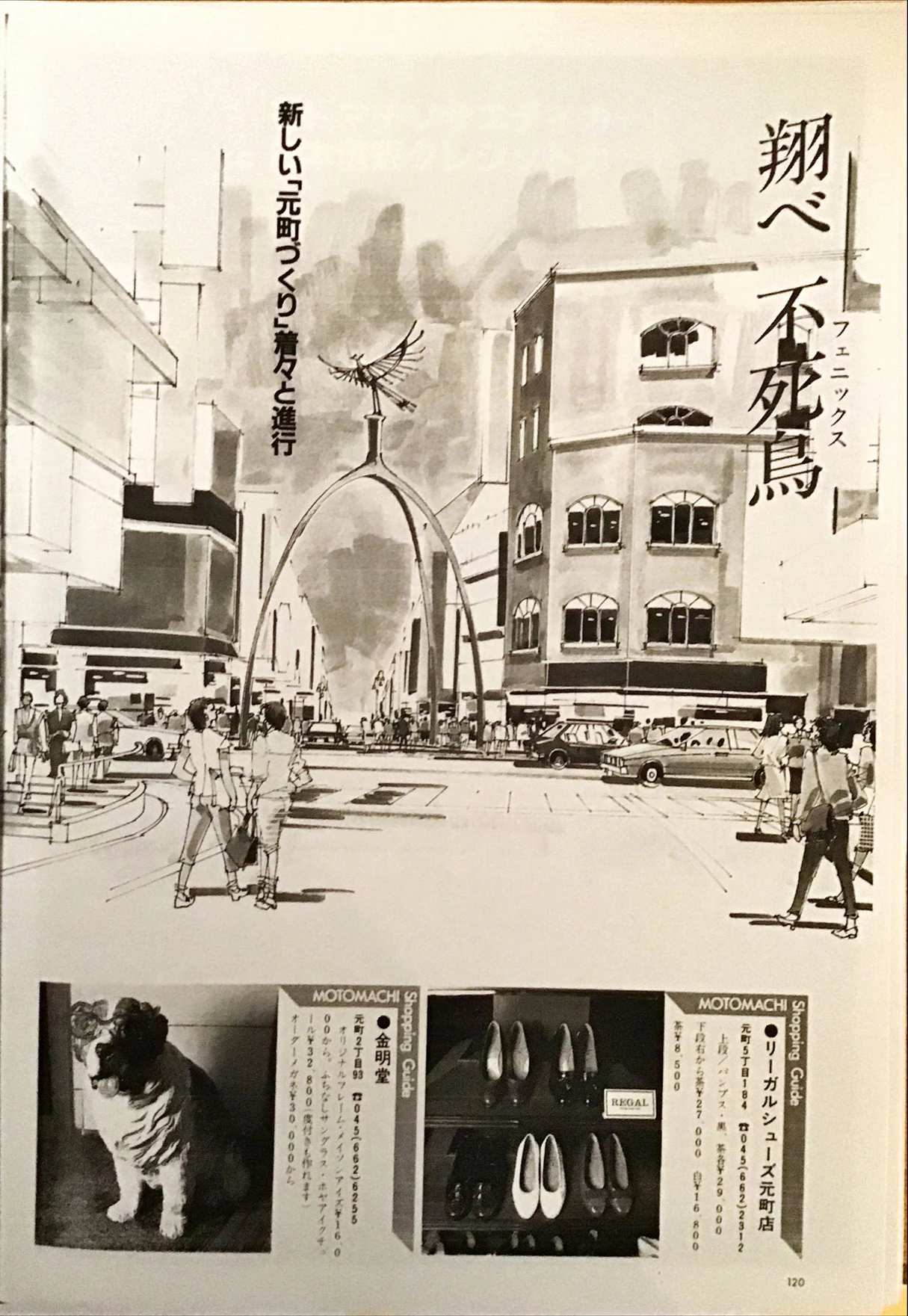
The SS-kai acted quickly to respond to the city officials’ advice. In 1983, the SSA published a “basic plan” for the architectural revitalization they would undertake starting autumn 1984. This plan was titled “Soar, into the light,” and declared Motomachi’s symbol to be the phoenix, which periodically underwent rebirth to continue surviving in the future (SS-kai 1983). Like a phoenix, this machizukuri would be an “image up” for Motomachi that would allow the street to survive more intense competition and economic stagnation. In the document’s opening remarks, SS-kai chairman Mori Motohiro remarked that the Japanese economy had slowed down after the first oil shock of 1973 and that changes in consumer preferences had accompanied it. The nearby Isezaki-chō and Bashamichi shopping streets had also undergone renewals, and the area around Yokohama Station to the north had shown an astonishing growth in business. Lastly, the municipality was finally beginning their project to redevelop the city center, named “Minato Mirai 21,” a grand endeavor by which many were enthralled. To ensure that Motomachi continued to exist in the future, the SS-kai would need to “reconstruct the role of Motomachi Shopping Street within its regional society” by doing such things as listening to the voices of customers and prioritizing its “harmonization with the bordering regions.” Mori describes the symbolism of the phoenix as representative of Motomachi’s previous rebirths, namely the town’s rebuildings after the Great Kanto Earthquake and the Second World War. The town would today rise up once again from the ashes, born anew while still preserving its “feeling of high sense” and its “high-level technology” (SS-kai 1983, 2).
Various bureaus in the municipality of Yokohama were closely involved in the trajectory of Motomachi’s 1985 revitalization. The SS-kai first asked the mayor of Yokohama to help them create a “Machizukuri concept” for their shopping street, and the mayor responded by organizing a “project team” with staff from several of the municipality’s bureaus including urban design, roadways, and economics (SS-kai 1983, 3). In 1982, the municipality announced a “Project to Advance the Revitalization Plans of Shopping Streets” (SS-kai 1983, 16). The SS-kai was recognized as a participant and subsidized with public funds. Numerous other groups were also consulted, including representatives from Kanagawa Prefecture and the local Motomachi neighborhood association.
Motomachi’s new aesthetic
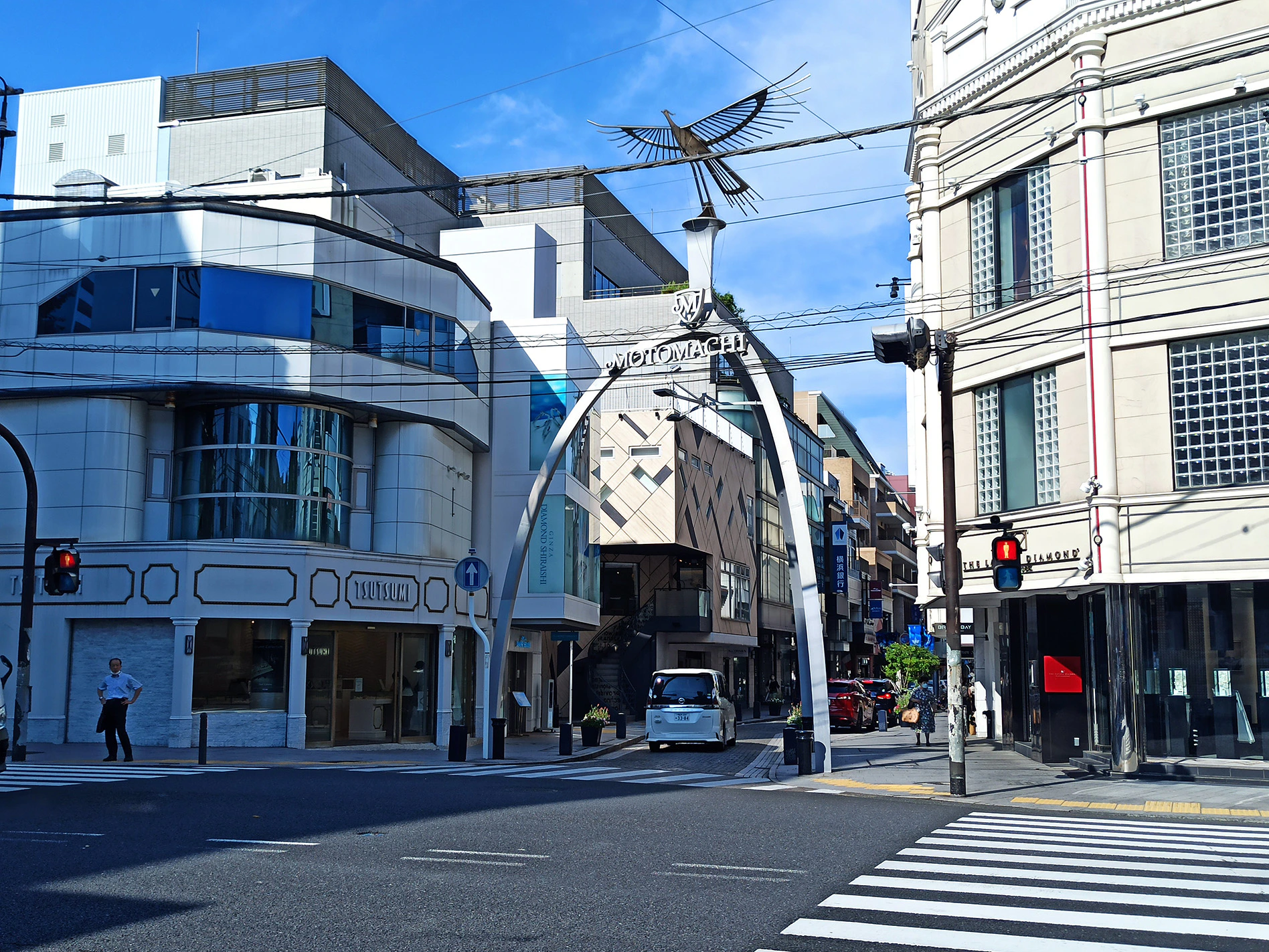
The revitalization theme that the SS-kai decided upon after deliberation was “Nice Day Motomachi,” which was first announced in the December 1982 edition of the local fashion magazine Motomachian. This announcement wrote that the revitalization would preserve the spirit of “civilization and enlightenment” (bunmei kaika), which was described as Motomachi’s essence (Motomachi rashisa). To preserve this identity for future generations, Motomachi’s appearance would need to adapt to new customer needs. Concretely, this meant importing not just European goods, but also European architectural styles in order to, curiously, make Motomachi more Japanese (Figure 4). Perhaps unbeknownst to themselves, both urban planners and shopping street leaders found themselves speaking the same discourse as the readers of JJ. Motomachi’s new facade would come to match the “soaring woman” of Nyūtra and Hamatra fashion: someone quiet and graceful, yet strong. It involved the following architectural changes:
- Symbol arches: Two identical three-pronged, semi-oval arches, each topped with a phoenix motif, were built on each entrance to Motomachi (Figure 5). The arches’ elegant curvature brings the viewer’s eyes to the phoenix, whose outstretched wings give a sentiment of soaring.
- Pedestrian comfort: Motomachi’s two automobile lanes were reduced to a single one, with the economized space divided between pedestrian space and parking places. In the new pedestrian space, the SS-kai installed benches, plants, and European-style street lamps. The new automobile lane was also curved to buffer its speed.
- Paved streets: The sidewalks were paved with granite and the road with natural stone (Motomachian, Jan. 1984). Nagai Yoshimasa, vice-chairman of the SS-kai, explained the decision to use expensive stone as follows: “Since all of the stores in Motomachi use good materials, we are thinking of placing the stores at the fulcrum of our planning, using materials that do not stand out too much, but are still high quality” (Ibid.). Such an anodyne yet elegant style matches Hamatra’s conservative fashion.
- Removal of power poles: Compared to other rich countries, where urban electric cables are virtually all underground, the vast majority of Japan’s telecommunications lines are hung on visible power poles (Chikamori 2021, 58). To follow Europe’s example, the SS-kai paid to have Motomachi’s lines stashed underground.
The revitalization’s explicit borrowing from Europe, as well as its aesthetic commonalities with the young women wearing Hamatra, are nevertheless largely ignored within the discourse with which the revitalization’s leaders now describe their town. Instead, Motomachi’s current countenance is described as the inheritance of a century-long history of adapting and improving upon imported Western goods. This citation of historical “tradition” both elides over the important ways that Motomachi has changed over time and overlooks how, for two decades, the neighborhood preferred to identify itself with the West rather than with Japan. One example of this obliviousness can be seen in the recently published video commemorating the hundredth anniversary of the shoemaker Mihama. In this video, company president Mori Yukihiro describes Motomachi as a “town of artisans” with a tradition of Japanese craftsmanship (monozukuri).4 While acknowledging that Mihama and other stores in Motomachi initially borrowed ideas from the West, the video argues that Mihama’s products are not merely derivative, but also innovative and carry a human touch. A 2021 video created by the SS-kai narrates similarly, describing Motomachi as “a town where history dissolves into everyday life.”5 Though Motomachi’s clientele and aesthetics all cater to young women’s fantasies, the gendered origins of this invention of local tradition seem to have been largely forgotten.
The SS-kai also set about convincing its members to act in accordance with the revitalization theme, a difficult operation given the SSA’s weak political force. In 1985, the SS-kai produced a Machizukuri Agreement that goes into minute detail about what members of the SS-kai could and could not do (SS-kai 1985). This Agreement writes that the shopping street should, by encouraging stores to “pay attention to facades” and sell “authentic products,”“take advantage of the connections between stores that are charming and have individuality” (SS-kai 1985). In other words, Motomachi’s stores should pay attention to exterior appearances and sell high-end products in order to create a collectively “charming” aesthetic similar to that of Hamatra. The Agreement goes on to outline the precise architectural features such a charming street should have, requiring that no building changes be done without prior consultation with the SS-kai. As a “street for fashion culture,” Motomachi needed individual stores to present a cohesive image of a Western shopping street; only after this unity had been achieved could individual stores exhibit their “individuality.”
Architecture was not the only topic that the Machizukuri Agreement regulated. To ensure the correct atmosphere for visitors, member stores should strive to close shop no earlier than 8 pm, and those who do must keep on in-store lighting until 8 pm. Lighting in show windows is to be kept on until 10 pm, and stores are only to take Mondays off, and absolutely not weekends and holidays. The 1983 Masterplan gives more context on these decisions. Stores were closing too early for late-working OLs to come shop, and the lights were turned off too early to make window shopping pleasurable on rest days (SS-kai 1983, 9). That such measures needed to be outlined suggests that at least some SS-kai members wanted to close early and take weekends off, and that the SS-kai had been unable to compel them to act otherwise. Such casual practices would no longer be acceptable within a more competitive economic situation. Motomachi would need to be fully authentic all of the time to satisfy their customers’ tastes. Individuality would, ironically, need to first be suppressed in order for each store’s individuality to then be advertised as part of Motomachi’s local, “charming,” theme.
Authenticity’s simulacra
There is, therefore, a sizable gap between Motomachi as it is imagined by the state, tourists, and even its businessmen and Motomachi as contextualized within structural economic change. This difference was the product of a misguided imagination of the municipality towards their local business associations, who they saw as guardians of local community, an illusion that has become commonplace in Japanese-language discourse today. This brazen faith in capitalism, however, leads to curious results that cannot be reduced to simple economics. Motomachi was and remains a shopping street where locals own many of the stores, and over the course of over half a century as an unlikely city center, the street has earned many loyal followers. What are we to say when the performance of authenticity is mistaken for authenticity itself? The Motomachian (est. 1978) was a magazine printed by the SS-kai that advertised the retailers’ merchandise as well as the town’s local history. Each issue, the editors printed letters from their readers, and many readers wrote to the magazine inspired primarily by nostalgia. Nemoto Jun, a woman in her twenties, wrote in one issue that
Since the more than twenty years after my birth, I have lived right by Motomachi. Though some might say that the times have changed, I think it would be troubling if every [shopping street] becomes like places like Ginza and Shinjuku. I want you to preserve the good aspects of Motomachi. I, who live in this area, am the third generation in my family to do so. Just like my father did, I own poppy-decorated neckties and accessories from Shinano-ya. (Motomachian, June 15, 1982)
For readers like Nemoto, the commercial aspects of Motomachi are inseparable from her nostalgia for the place, for her memories of Motomachi are closely tied to the stores her family members used to frequent. Nemoto would likely see no inherent contradiction between the profit-motivated machizukuri upon which the SS-kai was about to embark and the preservation of identity. Another letter was written in June 1985 by a woman on the other side of the age spectrum. Kishi Kyōko had grown up in Motomachi before World War II, writing to Motomachian that
In my home, my aunts graduated from Yokohama Women’s School, so from the past, they had loved Motomachi [. . .] When I was a student in a women’s high school, my aunt often brought me along to Motomachi to walk around, and we looked for things like modern hats and clothing, Western fabrics, as well as accessories. If one wanted to get stylish (haikara) goods, there was only Motomachi. [. . .] Today, Motomachi is different from the past, and it has become so wonderful that I misrecognize it. I am excited for its future. (Motomachian, June 15, 1985)
In some regards, Motomachi today has not changed. It remains a leading site for Japanese women’s fashion, and it remains known for its references to the exotic West. Many of its old stores continue to dot its streets, some with over half a century of history behind them. Motomachi’s merchants have always had a keen sense for what profited, and the 1985 revitalization represented only its latest update. And yet, this very recognition that Motomachi has a heritage that needs to be preserved changes the very nature of capitalism itself. Motomachi could no longer simply be Motomachi; its authenticity needed to be repeatedly staged and confirmed by its viewers. Capital accumulation would occur first through this staging and only secondarily through the selling of commodity goods. The enactment of community becomes incorporated within capitalism, but to what extent does this reenactment preserve what was at risk of loss?
Conclusion: Neoliberalism’s Origins
In probing Motomachi’s origins, this article discovers a host of colorful actors. First, there were fashionable and highly-educated women enthralled by the possibilities of soaring, yet conservative in their unwillingness to rock the boat. These young women were joined by innovative magazine editors who found new ways to cut costs from research and hiring professional models by heading to college campuses and inviting their readers to send in photos of themselves. Secondly, there were astute local businessmen in Motomachi’s shopping street who recognized opportunities to capitalize on postwar demand for high-end Western goods and the lifestyle that accompanied them. Third on stage were the technocratic bureaucrats, hired by the City of Yokohama to find ways to salvage such shopping streets at risk of irreparably losing their competitive edge to downtown shopping centers. These bureaucrats joined the college girls wearing Hamatra in discovering Motomachi’s sheen not in its importation of Western goods, but rather its history of innovating Japanese ones, which took on all the forms and styles of Western merchandise, but were imbued with the historical legacy of local craftsmanship. The municipality encouraged the shopping street to revitalize its architecture to better cater to the demands of their largely feminine consumers, in the process transforming Motomachi into the mirror of a pristine European street while also supposedly returning the neighborhood to its traditional Japanese origins in the process. In the production of Motomachi, conservative femininity and systematic changes to product distribution networks play a determinate role in inventing Motomachi’s “heritage,” yet these causes are often obscured under the banner of local history. Also unquestioned is a third subcutaneous factor, namely the implicit centrality of the West. Even if Hamatra girls and Motomachi’s revitalization claim to be discarding Western vogues and returning to Japanese “tradition,” what they do in practice—wearing Western fashions and recreating European streets—can only with some incredulity be described as “Japanese.” There is, as it were, a disconnect between what is being said and what is being done.
This leads to a final underlying theme that pervades this narrative of Motomachi’s revitalization, which is the history of neoliberalism in Japan, in all of its economic, cultural, and political forms. The glibly optimistic discourse of local heritage omnipresent in Motomachi’s advertising belies the hard reality of retailers’ adaptation to the impersonal forces of market capitalism, as well as the state’s complicity in encouraging local business associations to embrace a destiny supposedly predetermined by economics. As Jamie Peck writes, neoliberal ideology, despite its repeated permutations in the face of successive crises, relies upon “the pristine clarity of its ideological apparition, the free market” (Peck 2010, 7). State institutions like the City of Yokohama and private actors like members of the SS-kai are called on to, in the words of the MSDC, “make stand the great principle of responding to demand, all at the behest of serving a pure, functional Market presumed to exist.”
Even before neoliberalism entered Motomachi through the state and its business association, however, its ideology already pervaded the logic of JJ’s readers. Wendy Brown describes the mindset of the homo oeconomicus in which individuals are “tethered” to “the project of macroeconomic growth and credit enhancement” (Brown 2015, 84). Brown contrasts this with the homo politicus of traditional liberalism, built upon assumptions of legislation and justice that are collective, reasoned, and democratic—but also masculine (Brown 2015, 99). In entering the masculine space of work while desiring to preserve both individuality and femininity, conservative feminists like those who styled themselves in Hamatra helped introduce neoliberalism to Japan twofold: first by entering the workforce as a poorly-compensated reserve labor force after the end of the high-growth period, and secondly by renouncing their participation in their polity as (masculine) citizens, rather preferring to express feminine individuality through conspicuous consumption. Both of these trends would only increase in the following decades, with more and more Japanese women entering higher education and the labor force in spite of still-entrenched gender discrimination in the workplace. As Adam Kotsko writes, neoliberalism operates on a political theology in which one is “forced to be free” (Kotsko 2018, 37). Indeed, the irony of the “soaring woman” that finds its eerie echoes in Motomachi’s phoenix is that, after 1980, women had no choice other than to soar, just as Motomachi had no choice besides rebirth under the Economic Bureau’s logic of “voluntary redevelopment.” Both were, in their optimism, subsumed to the abstract forces of capital.
The history of neoliberalism in Japan is a project that deserves much greater attention. When it is written, its gendered origins must not be ignored.
Acknowledgments
For their advice, I thank Ichikawa Chihiro, Gracia Liu-Farrer, Seio Nakajima, and the members of David Leheny’s seminar at Waseda. Comments from the two anonymous reviewers significantly improved my argumentation. Jennifer Cullen patiently shepherded the manuscript through review, for which I am ever so grateful.
Works Cited
Bardsley, Jan. 2002. “Fashioning the people’s princess: Women’s magazines, Shōda Michiko, and the royal wedding of 1959.” US-Japan Women’s Journal. English Supplement:57–91.
————. 2013. “Miss Japan on the global stage: The journey of Itō Kinuko.” In Modern Girls on the Go: Gender, Mobility, and Labor in Japan, edited by Alisa Freedman, Laura Miller and Christine R. Yano, 169–192. Stanford: Stanford University Press.
Brinton, Mary C. 1993. Women and the economic miracle: Gender and work in postwar Japan. Oakland: University of California Press.
Brown, Wendy. 2015. Undoing the demos: Neoliberalism’s stealth revolution. New York: Zone Books.
Carter, Rose, and Lois Dilatush. 1976. “Office ladies.” In Women in changing Japan, edited by Joyce Lebra, Joy Paulson and Elizabeth Powers, 75–87. Boulder: Westview Press.
Cherry, Kittredge. 1987. Womansword: What Japanese words say about women. Tokyo: Kodansha International.
Chikamori, Takaaki. 2021. “Perpetuating the Temporal: Power Poles and the Urban Space in Japan.” Keiō gijuku daigaku daigakuin shakaigaku kenkyūka kiyō (92):57–63.
Dolezal, Sascha. 2018. “Traditionelle Einkaufspassagen in Japans Einzelhandelslandschaft: Räumliche Strukturen, Prozesse und Konsequenzen.” Ph.D, Universität Würzberg.
English, Bonnie. 2013. A cultural history of fashion in the 20th and 21st centuries: From catwalk to sidewalk. 2nd ed. London: Bloomsbury.
Furmanovsky, Michael. 2012. “A Complex Fit: The Remaking of Japanese Femininity and Fashion, 1945-65.” Kokusai bunka kenkyū (16):43–65.
Gardner, William O. 2020. The metabolist imagination: Visions of the city in postwar Japanese architecture and science fiction. Minneapolis: University of Minnesota Press.
Hama, Mitsuhisa. 2008. “Shōtengai shinkō kumiai hō no seiritsu katei to sono igi.” (The process of the establishment of the Shopping Street Promotion Cooperative Act and its significance). Discussion Paper No. 78 at the University Research Institute at Nagoya Gakuin University.
Imai, Heide. 2018. Tokyo Roji: The Diversity and Vitality of Alleys in a City in Transition. London: Routledge.
Ivy, Marilyn. 1995. Discourses of the vanishing : modernity, phantasm, Japan. Chicago: University of Chicago Press.
Kawamura, Yuniya. 2012. Fashioning Japanese Subcultures. London: Berg.
Kelsky, Karen. 2001. Women on the Verge: Japanese Women, Western Dreams. Durham: Duke University Press.
Kotsko, Adam. 2018. Neoliberalism’s Demons: On the Political Theology of Late Capital. Stanford: Stanford University Press.
Marx, W David. 2015. Ametora: How Japan Saved American Style. New York: Basic Books.
McVeigh, Brian J. 1997. Life in a Japanese women’s college: Learning to be ladylike. London: Routledge.
Monden, Masafumi. 2019. “A dream dress for girls: Milk, fashion and Shōjo identity.” In Shōjo Across Media: Exploring “Girl” Practices in Contemporary Japan, edited by Jaqueline Berndt, Kazumi Nagaike and Fusami Ogi, 209–231. Cham: Palgrave Macmillan.
MRHI (Motomachi no rekishi hensan iinkai). 2002. Perī raikō: Yokohama Motomachi 140-nen shi (Perry arrives: History of Yokohama Motomachi, 140 years). Yokohama: Motomachi jichi un’eikai Yokohama Motomachi shiryōkan.
MSDC (Yokohama Chūshō Kigyō Sentā). 1980. Motomachi shōtengai shindan hōkokusho (Diagnosis report on the Motomachi Shopping Street). Yokohama: Yokohama chūshō kigyō sentā.
Namba, Tomoko. 2018. “School Uniform Reforms in Modern Japan.” In Fashion, Identity, and Power in Modern Asia, edited by Kyunghee Pyun and Aida Yuen Wong, 91–113. Cham: Palgrave Macmillan.
Napier, Susan. 1998. “Vampires, psychic girls, flying women and sailor scouts: Four faces of the young female in Japanese popular culture.” In The worlds of Japanese popular culture: Gender, shifting boundaries and global cultures, edited by D. P. Martinez, 91–109. Cambridge, UK: Cambridge University Press.
Ochiai, Emiko. 1997. “Decent housewives and sensual white women: Representations of women in postwar Japanese magazines.” Nichibunken Japan Review (9):151–169.
Okamura, Keiko. 2003. Gurōbaru shakai no ibunkaron: Kigō no nagare to bunka tan’i (A cross-cultural theory for global society: Symbolic flows and cultural units). Kyoto: Sekai shisōsha.
Peck, Jamie. 2010. Constructions of Neoliberal Reason. Oxford: Oxford University Press.
Reiher, Cornelia. 2014. Lokale Identität und ländliche Revitalisierung: Die japanische Keramikstadt Arita und die Grenzen der Globalisierung. Bielefeld: transcript Verlag.
Robertson, Roland. 1995. “Glocalization: Time-space and homogeneity-heterogeneity.” In Global modernities, edited by Mike Featherstone, Scott Lash and Roland Robertson, 25–44. London: Sage.
Sakamoto, Kazue. 1999. “Reading Japanese women’s magazines: the construction of new identities in the 1970s and 1980s.” Media, Culture & Society 21 (2):173–193.
Sand, Jordan. 2013. Tokyo vernacular : common spaces, local histories, found objects. Berkeley: University of California Press.
Satoh, Shigeru. 2020. Japanese Machizukuri and Community Engagement: History, Method and Practice. Abingdon: Routledge.
Shamoon, Deborah. 2012. Passionate Friendship: The Aesthetics of Girls’ Culture in Japan. Honolulu: University of Hawai’i Press.
Shigematsu, Setsu. 2012. Scream from the shadows: The women’s liberation movement in Japan. Minneapolis: University of Minnesota Press.
Shimaoka, Keiko. 2009. Yokohama Motomachi Ozawa Yōsōten monogatari (Story of Yokohama Motomachi’s Ozawa Western Apparel). Tokyo: Shisō no kagaku sha.
Sorensen, André, and Funck Carolin, eds. 2007. Living Cities in Japan: Citizens’ movements, machi-zukuri and local environments. Abingdon: Routledge.
SS-kai (Kyōdō Kumiai Motomachi Eses-kai). 1983. Tobe, Hikari no naka e: Motomachi machizukuri kihon keikaku (an) kaisetsuhen (Soar, into the light: Motomachi town planning, basic plan (proposal) with explanation). Yokohama: Kyōdō Kumiai Motomachi Eses-kai.
————. 1985. Motomachi machizukuri kyōtei: Miryoku aru machinami zukuri (Motomachi town planning agreement: Creating an attractive streetscape). Yokohama: Yokohama-shi toshi keika-kukyoku toshi dezain-shitsu.
Suzuki, Suzumi. 2021. JJ to sono jidai: Onna no ko wa zasshi ni nani o mita no ka (JJ and its generation: What did girls see in their magazines?). Tokyo: Kōbunsha.
Tachi, Mikiko. 2013. “Ivy fashion, folk music and the Japanese perception of American college culture in the 1960s.” Australasian Journal of Popular Culture 2 (3):439–456.
Yamanashi, Makiko. 2012. A History of the Takarazuka Revue Since 1914: Modernity, Girls’ Culture, Japan Pop. Leiden: Brill.
Yanagisawa, Asobu. 2021. “Kōdo seichōki no daitoshi shōtengai no hatten (The development of shopping street associations in large cities during the high growth era).” In Kōseichōki Nihon no sangyō hatten (Industrial development in high-growth Japan), edited by Takeda Haruhito, 127–165. Tokyo: University of Tokyo Press.
YK (Yokohama-shi Keizaikyoku). 1977. Shōtengai mini saikaihatsu manyuaru: Yokohama hōshiki no shōtengai machizukuri 1976 (Manual for mini redevelopments in shopping streets: A Yokohama-style shopping street planning 1976). Yokohama: Yokohama-shi.
————. 1979a. Shōtengai mini saikaihatsu manyuaru II: Jirei kenkyū hen (Manual for the mini redevelopment of shopping streets II: Volume of case study research). Yokohama: Yokohama-shi Keizaikyoku.
————. 1979b. Chiiki shōtengai kasseika manyuaru: Shōtengai saiji jirei shū (Manual for the revitalization of regional shopping streets: Collection of examples of shopping street festivities). Yokohama: Yokohama-shi keizaikyoku.
————. 1980. Chiiki shōtengai kasseika manyuaru: Shōtengai saiji jirei shū (Manual for the revitalization of regional shopping streets: Collection of examples of shopping street festivities). Yokohama: Yokohama-shi keizaikyoku.
Yonezawa, Izumi. 2014. “Joshi” no tanjō (The birth of the “girl”). Tokyo: Keisō shobō.
Notes
- UNIVERSAL MUSIC JAPAN, “Crazy Ken Band / Motomachi burabura,” uploaded August 31, 2016, https://youtu.be/Jnndll0-sIM. Back to text
- Nyūtra was certainly not the first time that young and highly-educated Japanese women developed a fashion style. Japanese schoolgirls began wearing sailor uniforms both because they found it fashionable and because the government wanted to mold these women into patriotic citizens (Namba 2018, 96-103). Back to text
- City of Yokohama, “Hekimensen no shitei” (Designations of wall lines). https://bit.ly/3Qv3pHy. Back to text
- “Mihama 100th Anniversary Movie,” Mihama, 2023, https://bit.ly/3MdYGYi. Back to text
- Yokohama Motomachi Shopping Street, “Yokohama Motomachi History,” YouTube, March 21, 2023, https://youtu.be/mwiubifcMRY. Back to text
