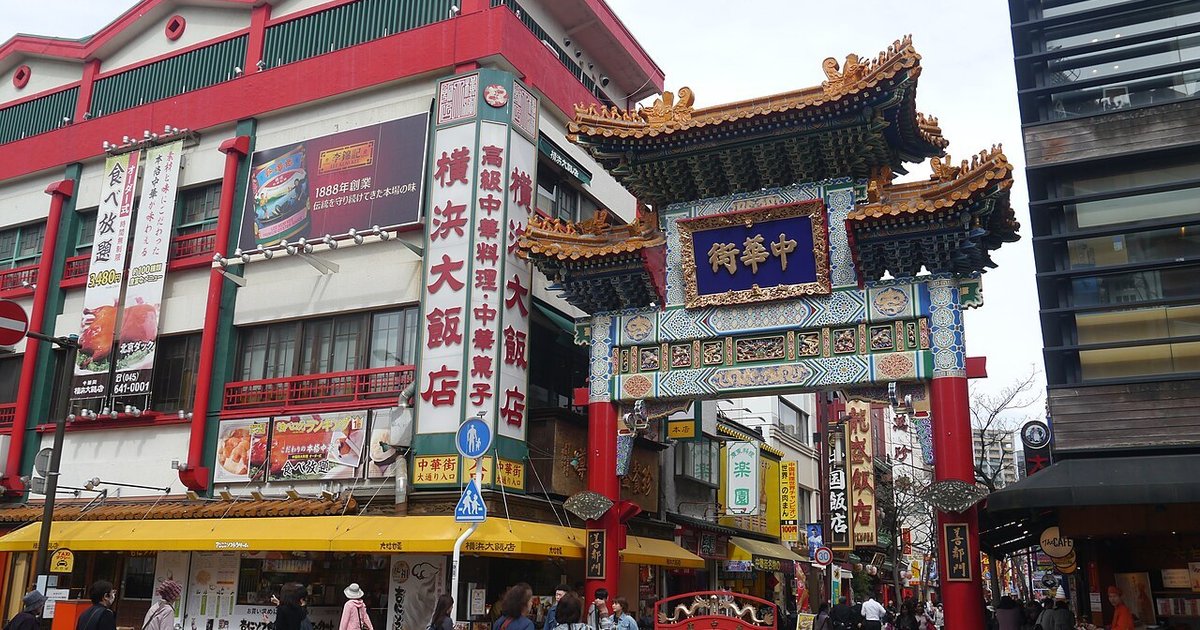
Why do celebrating Chinese difference and judging its authenticity serve the same tourist economy in Yokohama’s Chinatown?
Abstract
The contemporary discourse surrounding the Japanese “Chinatown” relies on the “antinomy of Chinese humanity.” This antinomy holds together two individually reasonable statements: first, that a Chinatown houses Chinese inhabitants, and second, that no essential characteristic of Chinese people or Chinatowns exists. Interpreting Jacques Lacan’s theory of discourse, the article distinguishes two main sub-discourses that revolve around this antinomy in different ways. Whereas the activist discourse identifies with this Chinese community and argues that the Japanese public should recognize its difference, the academic discourse views Chinatowns from above to categorize them on the basis of their supposed authenticity. Using concrete examples of these discourses, this article performs close readings of the works of two influential actors in the construction of Chinatown: Yokohama Chinatown leader Hayashi Kensei, and cultural geographer Yamashita Kiyomi, respectively. The article specifically notes the operation of enjoyment in the repetition of their discourses and the implicit economic complicity in their explicitly cultural or scholastic speech. It also compares these thinkers with other influential participants in the discourse and contextualizes them within the history of Chinatown’s postwar touristification. A psychoanalytic critique of Chinatown allows us to recognize the limits of humanistic ideologies and imagine new modes of seeing Chinatown.
Keywords
- psychoanalysis
- capitalism
- discourse analysis
- overseas Chinese
- race
Full text
Scott Ma, “The Limits of Humanism: On the Discursive Construction of the Japanese ‘Chinatown’,” positions: asia critique 33, no. 4 (2025): 815–840, https://doi.org/10.1215/10679847-11924334.
Introduction
This article distinguishes two complementary discourses formative in the social construction of the Japanese Chinatown, one common among ethnic activists and the second common among Japanese academics. Although Chinese communities have settled in Japan’s port cities for centuries, the conceptual understanding of Chinatown is much more recent. This conceptual evolution reflects how, since the late 1970s, Chinatown has undergone a substantial reinvention and commodification as a combination of local ethnic activists and municipal authorities have rebuilt these sites into popular tourist destinations. An often cited statistic notes that with twenty million annual visitors, Yokohama Chinatown is a “theme park” more popular than Tokyo Disneyland (Nagahama 2006). This description of Chinatown as a theme park, however, is not acceptable to everyone, as many point to the community’s history and heritage to argue that the site is more than just a tourist destination for Japanese customers.
My study does not ask if Chinatown is authentic but rather why the participants in this debate determine a Chinatown’s authenticity based on whether “authentic” Chinese people live there. The assumption that a Chinatown is where Chinese live is tendentious because if some Chinatowns have few Chinese residents, then not all overseas Chinese communities can be called “Chinatown.” This oversight leads to what I call the “antinomy of Chinese humanity.” As an antinomy, it simultaneously holds two contradictory but independently reasonable statements: (1) Chinese people have no essential characteristic, and (2) Chinatowns house Chinese inhabitants, such that Chinese people are therefore somehow distinguishable. The ground zero of this debate concerns the racializing and interminable question of whether a category of “Chinese humans” exists. Why is it that minority activists, academic researchers, and the public often fail to recognize such a glaring contradiction?
To explain this, I use the epistemic perspective of Lacanian discourse theory (Lacan 2006). Psychoanalysis differs from other methodologies because it focuses on the unconscious aspects of discourse, such as the pleasures we derive from communicating and the knowledge we would prefer to hide.
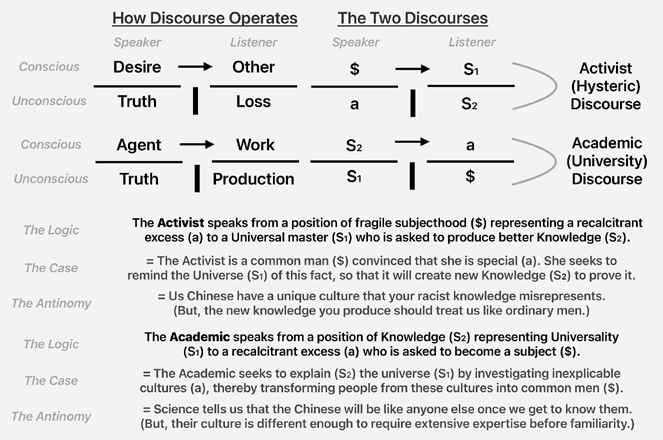
I argue that two distinct but complementary discourses apply to the Japanese Chinatown: the “activist” discourse and the “academic” discourse. I perform close readings of the oeuvres of two exemplars of these discourses who have played significant roles in constructing the Japanese Chinatown, activist Hayashi Kensei 林兼正 (b. 1941) and cultural geographer Yamashita Kiyomi 山下清海 (b. 1951). Where Hayashi’s activist discourse convinces the reader of Chinatown’s uniqueness while concealing the source of ethnic difference, Yamashita’s academic discourse convinces the reader of Chinatown’s intelligibility while glossing over his complicities with systematic ethnic discrimination under multiculturalism and capitalism. Performing a symptomatic reading that attends to the contradictions in each text, I show how both discourses reproduce themselves through the repetition of enjoyment in a way that not only revolves around the antinomy of Chinese humanity, but also substantiates the continued commodification of Chinese ethnicity. Figure 1 summarizes this argument while also contextualizing it in Lacanian theory. For brevity, this article focuses on identifying the antinomy’s operation and showing its complicities with racial capitalism, rather than discussing Lacan in depth. For readers curious about Lacanian discourse theory, Lundberg (2012) is an excellent resource.
This critique intends to help social science scholars of Japanese multiculturalism and global Chinatowns make sense of the paradoxical stubbornness and slipperiness of ethnic identity. New ideologies like multiculturalism (Hankins 2014) and global human rights (Tsutsui 2018) have changed the framing through which Japanese minority identity is elaborated, even as persistent ethnonationalism belies the reality of substantial immigration (Liu-Farrer 2020). Reiterating this ideology, scholarship on Yokohama Chinatown describes it as potentially a “harmoniously multicultural community showcase” (Wong and Lim 2021: 257) or as an “enclave” with “a shared past of conflict and cooperation with their Japanese neighbors” (Han 2014: 1). Indeed, scholarship on Chinatown often repeats the antinomy of Chinese humanity, treating Chinatown as “a place with complex social and cultural histories involving a multiplicity of Chinese and non-Chinese actors” (Anderson et al. 2019: 2 – 3) and with “no one clear and distinct universal definition of ‘Chinatown’ ” (Wong and Tan 2013: 4). Chinatown is thus treated as uncategorizable and as a site for intercultural exchange, thereby implying the presence of Chinese people doing the exchanging. I argue that this antinomy not only reifies the ethnonationalism that is so often criticized by scholarship on Japanese multiculturalism, but also plays partner to the capitalist commodification of minority identity. I address concerns similar to those raised by theorists like Rey Chow (2002: 48) about the complicity of ethnic protest and global capitalism, as well as Allen Chun (2017: x) about the need to “transcend literal discussions of Chineseness” in the social sciences.
The structure of the argument is as follows: I briefly outline the postwar history of the Japanese Chinatown in the first section, focusing on Yokohama and Ikebukuro. I then analyze Hayashi’s and Yamashita’s writings in turn. Each analytical section is divided similarly: I introduce the thinker, identify the internal antinomy in their work, show their complicity with ethnic capitalism, and compare their writing with that of other thinkers. The conclusion summarizes the findings and underscores the relevance of psychoanalytic method to sociological critique.
A Brief History of Chinatowns
Japanese Chinatowns are ethnic communities as well as tourist destinations copied from the United States; they are intended to turn profits and internationalize the cities. In 1953, Yokohama mayor Hiranuma Ryō zō 平沼亮三 (1879 – 1959) went to the United States to attend the Japan-American Pacific Coast Mayors’ Conference. Visiting Chinatowns in different US cities, Hiranuma saw the potential in revitalizing Yokohama by turning its Chinatown into a tourist site. Two years later, he led the construction of a pailou (traditional Chinese arch) to welcome visitors (Yokohama-shi sōmukyoku shishi henshūshitsu 2000: 290). Controversy arose, however, when he suggested changing the Chinatown’s name from Nankinmachi 南京町 to Chūkagai 中華街, the name by which Chinatowns in Japan are best known today. Chūkagai is a calque for the English word Chinatown, and using it reflected the desire to align Yokohama’s Chinatown with those in the United States by changing the reference from the city of Nanking to the country of China (Suehiro and Itō 2020: 686 – 87). In the following decades, the city continued to advance various projects to promote tourism in the area, including an “international promenade” that would guide visitors through Chinatown and nearby Motomachi (688).
This conceptualization of Chinatown as a tourist site mirroring its Western cousins differs from its prewar reputation as a hazardous area because an area hazardous for the violent sailors who frequented it. Writing immediately after the Great Kantō Earthquake in 1923, American expatriate Otis Manchester Poole described Yokohama Chinatown as “the haunt of beachcombers and carousing seamen whose savage brawls made the neighborhood notorious as ‘Blood Town’ ” (Poole 1968: 20). This reputation survived into the 1960s, while the number of Chinese gradually declined with the slowing of new immigration (Tsu 2011: 140 – 41). Though Hiranuma had laid the groundwork much earlier, it was not until the 1980s that these sleepy Chinatowns transformed into tourist hotspots through a combination of internationalization efforts by city politicians, adjustment to economic difficulties by local shopping street associations (SSAs), and popular interest in Chinese culture (see Ma 2024).
Today, Yokohama Chinatown is led by the Yokohama Chūkagai hattenkai kyōdō kumiai 横浜中華街発展会協同組合 (Yokohama Chinatown Development Association, YCDA), incorporated in 1970. The YCDA was responsible for advancing Yokohama’s transformation into a tourist destination by building nine of the city’s ten pailou, renaming their streets with “exotic” titles like “Hong Kong Street,” and erecting Chinese-style infrastructure like the Mazu temple (Suehiro and Itō 2020: 688 – 89). Although the YCDA presents itself as the representative of Chinatown as a community, its principal goal is promoting business. One section of its Machizukuri (Town-Building) Agreement stipulates that new Chinese restaurants must “contribute to Yokohama Chinatown’s brand value and increase its charm,” whereas another limits the construction and renovation of buildings to ensure the area’s coherency as a tourist district.1 A similar pattern occurred in Kobe, where the Nankinmachi shōtengai shinkō kumiai 南京町商店街振興組合 (Nankinmachi Shopping Street Promotion Association), established in 1977, received municipal help to “restore” the town from a nightlife district to a tourist destination after an economic recession (Tsu 1999: 22).2 In Nagasaki, the area known as Chinatown had few ethnic markers and did not even have “Chinatown” appended to its name until the mid- 1980s, after Japanese and Chinese storeowners formed the Shinchi chūkagai shōtengai shinkō kumiai 新地中華街商店街振興組合 (Shinchi Chinatown Shopping Street Promotion Association; Wang 2001: 117 – 19; 2003: 22 – 23). Every year the Nagasaki SSA hosts a popular Lantern Festival, for which in the early 2000s, the majority of funds was subsidized by the city, with contributions from private enterprises (Wang 2003: 24). The replacement of traditional ethnic associations with Japanese-style business associations marks a substantial shift in the nature of recent Chinatowns from immigrant communities to theme parks.
In academic and popular discourse, these touristic “old Chinatowns” are today contrasted with the “new Chinatowns” that developed from more recent immigration after the liberalization of cross-straits immigration policy in the late 1970s. Unlike older immigrants who worked primarily in retail and catering, most new Chinese immigrants arrived as students and obtained white-collar jobs after graduation, integrating well into Japanese society (Bail 2005). The best-known Chinese space in Japan is Ikebukuro, Tokyo, where new immigrants have gathered thanks to its cheap rent, work opportunities, and easy access to language schools (Yamashita 2011: 118). These new Chinatowns, too, are characterized by an uncomfortable alliance between culture and economics. In 2008, a collective of Chinese businesses near Ikebukuro led by publicist Hu Yifei 胡逸飞 proposed founding an organization called the Tōkyō Chūkagai 東京中華街 (Tokyo Chinatown), provoking media hysteria. Similar to Chinatown SSAs, in response to declining profits, this new Chinatown would link China-themed businesses in Ikebukuro under a single banner to attract more visitors (Zhongxinshe 2008). Unlike the YCDA, if Tokyo Chinatown originally made no pretense of representing some ethnic community (Zhongxinshe 2009), those critical of its existence nevertheless framed their disapproval in cultural terms. Miyake Mitsuru 三宅満, chair of the Ikebukuro nishiguchi shōtengai rengōkai 池袋西口商店街連合会 (Ikebukuro West Gate SSA Federation), for instance, argued that unlike traditional immigration sites like Okubo and Yokohama, Ikebukuro had little history of dealing with foreigners. Referring to Ikebukuro as a “Chinatown” would be disrespectful to its identity (Zhongxinshe 2008).
Although the names and details of the old and new Chinatowns differ, they are understood through the same framework, that is, as an ethnocultural association that attracts tourists by imbuing ethnic authenticity onto a plot of land. Herein lies the antinomy of Chinese humanity: a belief that the presence of authentic Chinese people would render a place a “Chinatown.” As the following sections show, this assumption motivates the discourses of both those who produce knowledge of Chinatown and those who materially construct them.
Hayashi Kensei and the Activist Discourse
Hayashi Kensei (b. 1941) was born Pang Guozhong 龐國忠, the eldest son of Pang Zhuchen 龐柱琛 (1902 – 76), who was born in Gaoming, Guangdong, China. The elder Pang arrived in Yokohama at the age of eighteen and ran its two oldest restaurants, the Manchinrō 萬珍樓 and the Heichinrō 聘珍樓. The Pangs naturalized, taking the names Hayashi Tatsuo 林達雄 and Hayashi Kensei 林兼正 in 1972, three years after Zhuchen received the Order of the Sacred Treasure, Gold and Silver Rays from the Japanese emperor, the first foreign civilian to do so (Hayashi 2014: 114 – 20, 126). The younger Hayashi followed his father’s footsteps as a Yokohama community leader, chairing the YCDA from 1993 to 2012, during which time he steered Chinatown’s businesses through Japan’s “Lost Decade” after the collapse of the asset bubble in 1991 (Hayashi 2014: 49 – 50). Hayashi has narrated his experiences in two memoirs from 2010 and 2014 and in an extended interview printed in book form. His long tenure of Japan’s most popular Chinatown offered him a podium to popularize his views on immigrant Chinese identity and materialize his philosophy in Chinatown’s very architecture.
Chinatown as Sublime Object
The antinomy of Chinese humanity appears in Hayashi’s arguments. First, Yokohama Chinatown differs from all other Japanese neighborhoods for its transhistorical Chinese community; second, this Chinatown is home to average people with dreams comparable to those of their Japanese neighbors. He overcomes this contradiction by repeatedly suggesting the existence of arcane knowledge privy only to the Chinese, accentuating the misunderstanding of the Chinese by his Japanese interlocutors. As Lacan writes, the hysteric “goes on a kind of strike” in which she refuses to “give up her knowledge,” instead unmasking “the master’s function... which she evades in her capacity as object of his desire” (Lacan 2006: 94). In other words, the Activist wants to become the Other’s object of desire and achieves this by claiming to have what this Other lacks. She achieves this by pointing out the Other’s shortcomings, claiming to have the solution, yet refusing to deliver these answers to the Other. Hayashi’s discourse reveals his desire for the Japanese public to recognize an ethnic minority for their difference while also acknowledging the principle of human equality. The result is the appearance of ethnicity as a symptom, an inextricable knot that obscures the reality that nothing grounded it from the start.
An excerpt from Hayashi’s 2010 memoir exemplifies this internal tension. In the introduction, Hayashi explains why tourists gather in Yokohama Chinatown, dispelling some stereotypes he perceives as common among the Japanese. Using the metaphor of a cluster of grapes, he writes that each individual grape represents a part of traditional Chinese culture, and, like a cluster of grapes, in Chinatown “many elements of Chinese culture are connected within a single neighborhood. Isn’t it for this reason that people who come to play here can enjoy all types of non-everyday, foreign atmospheres?” (Hayashi 2010: 3). Hayashi contrasts Yokohama Chinatown with Sapporo’s Ramen Alley, writing that “Yokohama Chinatown is not just a street for eating food” (3). He continues to explain why people visit Chinatown:
It is because Yokohama Chinatown is a unique neighborhood that gives off the aroma of “China,” and [visitors] think that they can enjoy the foreign atmosphere called China, here, even without going to Hong Kong or Shanghai.
However, our neighborhood, actually, is not just that.
It is also a street where we who live here learn and enjoy ourselves.
[We in] Yokohama Chinatown not only want visitors to feel the Chinese traditions and culture, but [we] also want it to be a neighborhood for the people who live here, and one that [we] hope will allow them to absolutely understand that China, their motherland, has such wonderful festivals, events, and customs. [We want them] to have pride [in these traditions], and transmit them to their children and grandchildren. (4)
Hayashi defines Yokohama Chinatown on several levels. He notes that in contrast with other Japanese neighborhoods, Chinatown, like a grape, accumulates elements of Chinese culture in the same place. This accumulation of Chinese culture creates a “foreign atmosphere,” and this is what attracts tourists. Through a comparison with Sapporo, Hayashi then suggests that this atmosphere is the product of not only material Chinese culture like food, but also of a local community that “lives and enjoys itself” in the neighborhood. These community members seek to transmit Chinese culture from China, their motherland, to their posterity. This fidelity in preserving pride in Chinese culture produces its authenticity, which is what creates the Chinese tradition that visitors will “feel.”
With this, Hayashi lodges a form of protest against the Japanese host society. He tells Japanese readers that they have failed to properly understand why Yokohama Chinatown is different, mistakenly attributing its popularity only to the commodified, material elements of culture. He argues instead that Chinatown’s difference originates from the presence of an authentic Chinese community that lives and works on the soil, and the use of “we” implies the exclusion of non-Chinese, providing Hayashi with the enjoyment of the knowledge of ethnic difference. Hayashi therefore finds himself in a contradiction: On one hand, he asserts that the Chinese are merely living ordinary, everyday lives in Chinatown, and on the other, he asserts that Chinatown has a “foreign atmosphere” produced by these same Chinese, which in turn conveniently attracts tourists to its precincts. Ethnicity, here, acts as a convenient barrier against arguments of Chinatown’s sameness. How could Chinatown be the same, Hayashi argues, if its members all act as good Chinese by preserving the heritage of their ancestors?
Capitalism and the Activist
As the previous section hinted, the antinomy of Chinese humanity that claims both Chinese sameness and difference is complicit with the commodification of Chinese identity. As the leader of Yokohama’s SSA, Hayashi needed to reconcile the promotion of a tourist destination with the building of a community heritage site for the overseas Chinese diaspora. In his machizukuri (community-led town development), developing Chinatown economically was inseparable from preserving ethnic community, a guardianship made difficult by regular vagaries in the restaurant sector and tourist economy. This section considers the relationship between the activist discourse and capitalism by examining sections in Hayashi’s memoir where he, the chair of the YCDA, describes his utopian vision for Chinatown. This vision is repeatedly characterized by an overcoming of capitalism, suggesting an unconscious awareness that economic commodification acts as a barrier to social justice.
One section in which Hayashi describes his utopian vision is titled “I Want to Create a Real Chinatown.” He narrates Yokohama Chinatown’s history, dating back to the original community during the Meiji period (1868 – 1912). He likens this past Chinatown to his ideal vision of a kokyō 故郷 (hometown), which is his goal for the machizukuri. He concludes the passage by arguing that the preservation of this hometown ought to be undertaken not just in Yokohama but in local communities throughout Japan:
If we look at this Chinatown from the standpoint of the Chinese, this was clearly their “hometown” [kokyō]. There, there were people who spoke the same language, and many people with the same way of thinking. If you were in trouble, others would support you or help you find work . . .
If for some reason urban life reaches a dead end, you return to the hometown. There, there are the smiles of people with familiar faces, there is at least “employment,” people will kindly give advice on anything, and you can leave again feeling at ease. For this purpose, it is also the people of the neighborhood who take care of you. If that is so, one does not need particularly new facilities. The nature of the hometown and the smiling faces of its people is its wealth. (Hayashi 2010: 61)
In this excerpt, Hayashi writes that in the Meiji-era Chinatown, Chinese immigrants found a community whose members spoke the same language, thought the same way, and helped each other. This community is implicitly contrasted with life in the city. If the hometown has natural beauty, smiling faces, employment, and friendliness, the implication is that the city is dirty, unfriendly, and without employment prospects. Chinatown thereby negates contradictions in capitalist production: In Chinatown, unemployment disappears and people treat each other as human beings rather than as fetishized commodities. At the same time, Hayashi closes off this rather generic utopia to the Japanese, for whom Chinatown’s community is inaccessible because of their lack of ethnic roots. He thereby repeats the antinomy of Chinese humanity, portraying Chinatown as both universally desirable and a fantasy specific to ethnically Chinese humans. Furthermore, Hayashi’s nostalgia is historically inaccurate. Not only did Chinatown develop in the middle of Yokohama’s bustling port district, but Chinatowns in Japan have never been exclusive ethnic communities. According to the reminiscences of one person who grew up in Yokohama Chinatown, roughly half of its population in the 1970s and 1980s was Japanese and Korean (Chin 2018: 199). This ethnicization of Chinatown involves a forgetting and the omission of historical complexity and the non-Chinese.
A similar appropriation of universal fantasy for the ethnic minority can be found in an excerpt where Hayashi (2010: 180) describes another vision of this “real Chinatown”:
[It is] a town where Chinese products from around the world are sold, and from which they are transmitted to the world. For this purpose, we must raise the quality in all of its meanings. A town where specifically selected, high-class Chinese products are sold — this is precisely the future Yokohama Chinatown I desire.
If the eaves of internationally famous stores representing China and Taiwan were to line [the streets] in this town, the principle of competition would operate, and low-quality goods would be driven out. The same goes for restaurants.
The unconscious repression of disenchantment with capitalism beneath his public discourse of ethnic pride is even more evident in this passage, where Hayashi distinguishes a “real Chinatown” from its current, imperfect form. He describes this “real Chinatown” as being like Ginza. Chinatowns should also sell high-quality goods for elite clients, with the only difference being that Chinatown’s goods must be “Chinese” and sold by Chinese franchises. Herein is a repetition of the antinomy in which a kernel of racial difference excludes non-Chinese from a universal fantasy. Moreover, this fantasy again involves an imagined overcoming of capitalism. In the fantasy Chinatown, “the principle of competition will operate,” even as it is this exact principle that causes the businesspeople in the real Chinatown to sell cheaper merchandise than their Japanese neighbors. Experiencing a dissociation between his imagined homeland and an imperfect reality, Hayashi convinces himself that the root cause of his ills is not capitalism as an economic system, but rather a lack of effort on the part of Chinatown’s community and a misrecognition by the Japanese public. Hayashi’s fantasies of ethnic community thereby meld into his fantasies of functional capitalism, such that the reason for Chinatown’s backwardness is not capitalism but its lack thereof. Hayashi’s unconscious disillusionment with capitalism is thereby repressed and replaced with its inverse, on the logic that proper capitalism has simply not yet existed. The attainment of functional capitalism, furthermore, requires the attainment of Chinatown’s authenticity, which in turn entails preserving its ethnic residents’ living heritage. No contradiction would therefore exist between YCDA’s mixed status as an economic and community association.
Culinary Authenticity and Overseas Chinese Identity
Among the overseas Chinese whose families immigrated prior to the normalization of Sino-Japanese relations, the most prominent worked in the restaurant industry. This reflects historical barriers to career choices as well as the immense popularity of “Chinese” cuisine in Japan, cooked by Japanese chefs and adapted to Japanese tastes (Farrer 2018). The most well-known of these figures gained prominence through television programs in the 1990s. Like Hayashi, these chefs presented themselves to Japanese audiences, explaining their cultural authenticity as derived from a permanently adapting Chineseness nevertheless true to the original.
Chef Shū Tomitoku 周富徳 (1943 – 2014), for example, frequently used his ethnic inheritance to advertise himself. In the first chapter of his memoir, for instance, he writes, “Although I am seen as someone who has succeeded in life, without my history up to today, I wouldn’t have been able to succeed” (Shū 1994: 33). Shū then discusses his family lineage back to Guangdong’s Shunde district, the circumstances of his birth, and so on, culminating in cooking his first dish, fried rice, which he identifei s as the starting point of his career as a chef. Shū’s authenticity as a Chinese chef lies in his familial origins in Guangdong and his upbringing in Yokohama. His younger brother, Shū Tomiteru 周富輝 (b. 1950), who inherited their father’s restaurant Seikōen 生香園, similarly identifies with Yokohama Chinatown as a source of authenticity. In a cookbook titled Yokohama chūka no aji 横浜中華の味 (The Flavor of Yokohama Chinatown), Tomiteru writes, “My cuisine is the flavor of my father’s ancestral home in Guangdong, the flavor of Yokohama, where I was born and raised and which I love, and furthermore, my own flavor” (Shū 1996: 7).
This identification with Chinese roots is problematic because it repeats the antinomy of Chinese humanity — simultaneously claiming that there is no essential quality in Chinese cuisine and maintaining its inheritance through the blood of overseas Chinese descendants. It rationalizes the racial othering of Chinese immigrants and the integration of their cultures into capitalist markets. It pressures Chinese minorities to be both loyal to their ancestors and complaisant with regard to their Japanese “hosts,” while also offering members of this marginalized group the enjoyment of an illusion of collective identity. The instability of this identity, however, requires outward markers as evidence, whether these outward markers be Chinatowns, the Chinese language, or Chinese temples and rituals. These very markers are excessive: They are not for the Chinese themselves, who know they are Chinese by blood, but for the Japanese to see and thus recognize them as Chinese, such that the Chinese can be reassured that their original ethnic identity exists. This double identification is also dangerous in light of Japan’s increasing distrust of China and Chinese food products (O’Shea 2015). The next section switches to the standpoint of this Japanese majority, showing how their fascination with these identity markers substantiates the same racist and capitalist ideologies that underpin the activism of the overseas Chinese minority.
Yamashita Kiyomi and the Academic Discourse
Yamashita Kiyomi (b. 1951) is a cultural geographer and arguably the most important scholar of the Chinese diaspora in Japan today. Over a career spanning four decades, Yamashita has taught at Akita, Tōyō, Tsukuba, and, finally, Risshō University, from which he retired in 2022.3 He has played a definitive role in advancing the study of overseas Chinese in Japan. He was a founding member of the Nihon kakyō kajin gakkai 日本華僑華人学会 (Japan Society for the Study of Overseas Chinese) when the organization was established in 2003, serving initially on its board of directors and eventually becoming its president from 2009 to 2011 (Yamashita 2022: 5). Yamashita is also a prolific writer, having produced ten monographs about the Chinese diaspora around the world and countless more edited volumes, articles, media appearances, and so on.4
Yamashita is an inventor, promoter, and defender of Ikebukuro Chinatown. He first proposed designating Ikebukuro a Chinatown in 2003; in 2007, he helped create a guide map that listed different Chinese businesses in the area, ranging from restaurants to real estate. The map’s authors explained that in contrast to Japan’s old Chinatowns, this one would be a “new Chinatown like those seen in the West.”5 After the media controversy surrounding Hu Yifei’s Tokyo Chinatown project, Yamashita emerged as a defender of cultural reconciliation, which he frequently discusses in his books.
The Antinomy of Chinese Humanity
The antinomy of Chinese humanity also appears in Yamashita’s discourse, although in a different form. Both thinkers agree that (1) Chinese are different, (2) Chinese are the same, and (3) a Chinatown would be inhabited by authentic Chinese people. Where Hayashi prioritizes difference over similarity, though, Yamashita does the opposite. Where Hayashi identifei s himself with the ethnic community and argues for Chinatown’s uniqueness in the eyes of external observers, Yamashita situates himself as an outsider observing and dissecting Yokohama Chinatown, contextualizing its presence and thereby relativizing its difference. Where Hayashi is only interested in Yokohama Chinatown, Yamashita expands his scope of interest to categorize and compare Chinatowns around the world to discover contextual patterns. Hayashi assumes Chineseness and then proves it to viewers; Yamashita sees Chineseness as being discoverable only after an intelligent search. While both Hayashi and Yamashita speak to Japanese audiences, who they think misunderstand Chinatowns, their symbols of authenticity differ. If Hayashi bases his claims on blood and culture, Yamashita bases his claims on his tenured university chair, evidence of his proximity to universal knowledge. As Lacan writes, the university is tasked with the “elucidation” of ideology, producing students who are “subject” to its discourse (Lacan 2006: 148). Thus, Yamashita’s discourse principally revolves around imposing his knowledge on less well-read subjects in a way that obscures the ideological grounding of his methodology.
Despite Yamashita’s universalistic pretensions, in repeating the antinomy of Chinese humanity, his epistemological assumptions racially essentialize his research subjects while simultaneously claiming to humanize them. This contradiction reveals itself on the few occasions when Yamashita has defined “Chinatown,” his object of study. In each instance, he repeats the same obscurantist romanticism as Hayashi:
Chinatown is not simply a “town of Chinese food and ingredients.” Chinatown is a stage for people from China to take on new challenges as they venture abroad with a variety of feelings. While maintaining the traditional Chinese lifestyle to a certain extent [aru teido], these towns were created by adapting to the local society. Chinatowns all over the world have different “faces” depending on where they are located. (Yamashita 2016a: 5)
Yamashita argues that Chinatown encompasses more than just restaurants and has hidden aspects not immediately apparent to a casual visitor. He highlights two aspects, the first being the particular “face” it develops from the ecological conditions of its location. This diversity exists simultaneously with “a certain extent” of maintaining tradition that is necessary for a Chinatown to remain true to its essence. This definition culminates in a contradiction, for Yamashita claims that Chinatowns are infinitely diverse while maintaining that all Chinatowns are essentially Chinese. As in Hayashi’s case, the meaning of Chineseness is never defined, but unlike Hayashi, Yamashita does not take its existence for granted. Instead, he tries to sort Chinese identity down to its lowest common denominator. The limit of this infinite work of sorting reflects the perpetual displacement and disavowal required of an ideological system to hold itself together.
The second hidden aspect of Chinatown that Yamashita identifies is its role as a “stage for people from China to take on new challenges.” His Chinatown is a stage for the Japanese voyeur, who can witness the romantic stories of the Chinese as they stake their lives abroad “with a variety of feelings.” Like the “certain extent” of Chineseness, this affective “variety of feelings” is excessive, yet Yamashita clearly includes it as an important aspect in his definition of Chinatown. He could well have written, straightforwardly, that a Chinatown is a place where Chinese people live, but he does not. Just as Yamashita contradicts himself by arguing for both relativism and essentialism in his “faces” of Chinatown, when speaking of Chinatown as a stage, he argues that it must be a place not just for the Chinese but for the romantic stories of the Chinese. This is, perhaps, the closest Yamashita gets to defining the Chinese: They are the protagonists of dramatic struggles through which the Japanese observer lives vicariously, with the power of narrative curation, of course, privy to the Japanese.
The Ideological Unconscious
Where Hayashi obtains pleasure from positioning Yokohama’s ethnic Chinese as the object of Japanese desire, Yamashita derives pleasure from his authority as the representative of objective knowledge. This implicit claim to omnipotence manifests itself in his method, which principally involves the impossible task of curating “Chinatown.” This is exemplifei d by a graph in Yamashita’s 2019 monograph that differentiates types of Chinatowns. He divides them into two broad categories, “Old Chinatowns” and “New China towns.” New Chinatowns are subdivided into the “downtown model,” the “residential and commercial model,” the “high-end residential model,” and the “shopping mall model.” Many (but not all) New Chinatowns are located in the suburbs; some (but not all) house new Chinese immigrants (Yamashita 2019: 307). This excessive categorization brings the ideological entanglement of his method to its logical conclusion. The categorization is, after all, empirically justifai ble, as long as we define a Chinatown as a place with Chinese residents as opposed to a postal code and defer to the scholar’s judgment of what makes a person “Chinese.” The labor of distinguishing what is and is not Chinese is evident in Yamashita’s 2010 book, Ikebukuro Chinatown, in which he invites the reader to pay a visit to Ikebukuro to experience Chinatown’s authentic form:
Many Japanese, through the media, see Chinese by lumping them together as a group. It is true that there are wealthy people who are Chinese and who come to Japan and spend lots of money buying goods. And, there are those who are arrested for committing crimes who are Chinese. The Chinese who are spotlighted in the media are only a small portion of Chinese society, but they stand out. The majority of Chinese are “common folk” [laobaixing 老百姓], or average people. To understand China, one must understand these laobaixing. Almost none of the Chinese who have gathered near the North Gate of Ikebukuro Station to do business and live their lives are elites or criminals. They are laobaixing. Depending on their place of origin and their generation, they have many different ways of life and ways of thinking; the differences between the dialects they use in their everyday lives are as large as if they were foreign languages, and often speakers of two different dialects cannot understand each other. (Yamashita 2010: 3 – 4)
Here Yamashita criticizes the representation of Chinese in the media, writing that these representations distort the truth by focusing on Chinese society’s extreme elements, such as the rich and the criminal. He repeats the antinomy of Chinese humanity, arguing that Chinese cannot be “lumped together,” but that the majority can be generalized as “common folk” who nonetheless, owing to their authenticity, make Ikebukuro authentic. This mirrors Hayashi’s dilemma between wanting the Chinese to be treated both as ordinary and as an ethnic Other. Where Yamashita differs from Hayashi is in his self-appointed role as a tour guide, helping the uninformed Japanese identify which Chinese are ordinary and which are extraordinary, why Chinatown developed in different ways, and why the Chinese are so exotic. As an authority figure, Yamashita claims to be the one who knows. While he, like Hayashi, does not explicitly acknowledge this desire, it is within reason to conclude that its pleasure is a motivating factor in repeating his antinomy.
Yamashita’s desire for the Japanese to have a correct image of Chinatown reflects a combination of conscious and unconscious elements. Consciously, he wants to teach the Japanese that ordinary Chinese are just like them — generally decent people with whom intercultural communication is possible. He thinks the media is to blame for the bungled image the public receives and that he himself is the source of truth, the expert. In this way, he expresses an unconscious desire to control the knowledge of the media and the public and a belief in his own superiority, at least in the realm of Chinese immigrant communities. Yamashita takes himself to be the source of correct knowledge and action; his frustration at the minority of Chinese spotlighted by the media stems not just from the media’s purported deception but also from their refusal to accept his interpretation of events. Yamashita’s interpretation, though, is hardly any less ideological. Even as he claims that his end goal is to strip the Chinese of ethnic specificity, he only achieves this through a preliminary scientific differentiation that is seen through racial categories. These categories are furthermore grounded on the same irrational kernel of romantic, racially entangled pleasure similar to Hayashi’s love for Chinatown. This pleasure lends itself conveniently to capitalist accumulation.
Capitalism and the University
Yamashita’s methodology and discourse are complicit with capitalism. Although he frames his connoisseurship in terms of knowledge rather than economics, like Hayashi, Yamashita never problematizes Chinatown’s ethnic commodification. Instead, agreeing with Hayashi, he argues that a Chinatown, if authentic, would naturally market itself to the Japanese public. For instance, in one book chapter, Yamashita argues that proper employment of immigrants’ “ethnic resources” will prevent outbursts of ethnic violence that would otherwise naturally take place. Ethnic resources, he writes, should manifest in the form of touristic attractions that nevertheless preserve the interest of the host society. This is a difficult balance to maintain.
Yamashita gives the example of indoor Chinatowns, tourist sites planned by local authorities that collect Chinese restaurants and China-themed businesses into a single aggregated space. He explains that these theme parks tend to go out of business because of their inauthenticity:
All of the indoor Chinatowns attracted a large number of visitors when they first opened, but they were forced to close due to the difficulty of maintaining repeat customers. What visitors are looking for in a true Chinatown is not only Chinese food and products, but also a sense of realism and a sense of life in the area where Chinese people live. These cases show that not only Chinatowns, but also other ethnic towns with a façade and without actual living conditions will have difficulty in maintaining the interest of the host society for very long. (Yamashita 2016b: 315)
As in his other work, Yamashita defines an authentic Chinatown through the presence of Chinese people giving off “a sense of realism and a sense of life.” If the first part is an obscurantist tautology arguing that real Chinatowns feel real, the second part requiring a “sense of life” is similar to Yamashita’s requirement that authentic Chinese stage a romantic immigrant narrative. Rather than portraying the “false image” common in media representations, a Chinatown should display the “actual living conditions” of the Chinese, an anthropological zoo the Japanese explorer can enter. Indeed, Yamashita’s unidirectional gaze is similar to the gaze found at a zoo. While his authentic Chinatown must be a stage to attract the attention of the Japanese host society, there is no discussion of the possibility of the inverse — that is, of a daring Chinese immigrant diving into the darkness of Japanese society to discover romantic stories of everyday struggle and a “sense of life.” Yamashita’s requirement that the Chinese stage romantic authenticity, coupled with the enjoyment the Japanese viewer receives from it, sustains postcolonial logics treating minorities as lacking agency.
As with Hayashi, Yamashita’s slipperiness around the antinomy of Chinese humanity leads to a complaisance regarding commodification. Yamashita treats the economic character of Chinatown as secondary to its cultural one. Chinatown is more than its external trappings of “food and products,” he writes, for what is more important is the authentic community of the Chinese living there. As long as this authentic community remains present, the degree to which Chinatown becomes commodifei d is irrelevant. In demanding the Chinese to be authentic, Yamashita manufactures the “ethnic conflict” he seeks to forestall. Having declared real Chinatowns as having Chinese residents, and places like Ikebukuro as real Chinatowns, all that is left is for Yamashita himself, by reminding all sides of their shared humanity, to resolve the ethnic conflicts that would otherwise occur. But what if all this is built on a misconception — what if Chinatown has been a business association all along?
Parallels Beyond Yamashita
Yamashita’s academic discourse is the dominant one through which Japanese Chinatowns are understood today. Its assumptions and methods are prevalent in the vast academic corpus written in English, Chinese, and Japanese. It also manifests itself outside the ivory tower in polemics and literature. The novel series Ikebukuro West Gate Park, for example, recounts the escapades of a young man named Makoto who works as an informal “troubleshooter” in his hometown of Ikebukuro. In a short story called “Dragon Tears,” Makoto is approached by Lin Gaotai, an adviser to some Chinese technical trainees working illegally in Ibaraki prefecture. A trainee named Guo Shungui has escaped from the factory to Ikebukuro, and if she is not found within a week, all 250 trainees in Ibaraki will be deported back to China. It turns out Guo is under the protection of Donglong, a Chinese underground association; Makoto and his friends pressure Yang, Donglong’s leader, to release her from their protection, after which Makoto convinces her to return to the factory. The surprise at the end is when Makoto’s mother decides to adopt Guo to offer her Japanese citizenship, thereby freeing her from her trainee contract (Ishida 2011). In this story about Ikebukuro Chinatown, the fictional Makoto is akin to the real-life Yamashita, discovering a community of innocent, hard-working Chinese in the initially terrifying Chinese underworld. Even Yang turns out to be sympathetic, harboring illegal workers only because their treatment under Japanese law is even more unjust. The story ends with ethnic reconciliation rather than a problematization of systematic issues like labor laws and racism. Indeed, it is odd that for both Yamashita and Makoto, the resolution to Ikebukuro’s “danger” is interpersonal reconciliation, because Ikebukuro, a transportation hub and the site of postwar black markets, has always had a reputation for youth culture and for being a dangerous place (Coates 2018). In framing the discourse around interpersonal ethnic reconciliation, both overlook structural problems.
Conclusion
This article distinguishes two different but complementary discourses used when speaking of the Japanese Chinatown today. It shows how these discourses circulate around the antinomy of Chinese humanity, that is, the simultaneously held beliefs that Chinatowns house Chinese people and that Chinatowns cannot be essentialized. The activist and the academic discourses both revolve around the refusal to address this antinomy, although their refusals operate through different means. The activist identifies with Chinese ethnicity, demanding the Japanese public recognize the difference as spectacular. In contrast, the academic identifies with ideology, asking the Japanese public to open itself up to the rectifying power of knowledge. These dramatic, repetitive gestures often culminate in failures of recognition or respect and allow a continued avoidance of the basic epistemological premises of its discourse, namely, how it is possible for us to know the Chinese to be Chinese or the Chinatown to be a Chinatown. After all, understanding the Japanese Chinatown as a business association is as reasonable as understanding it as an ethnic one.
A psychoanalytic perspective is useful for how it addresses the lapses in reason that litter everyday speech. If the tautology that a Chinatown houses Chinese subjects is senseless, psychoanalysis goes further than just criticizing this assumption for providing an incorrect or ethnicized version of Chinatown. Lacan criticizes this tautology not for being irrational but precisely the opposite — for being the symptom of the impossibility that holds together rationality itself. This impossibility legitimates itself through the circular operation of pleasure. If the pleasure for the academic lies in the position of superiority vis- à- vis their students, whom they teach to be obedient subjects, the pleasure for the activist, in turn, lies in the position of inferiority vis- à- vis the Japanese public, from whom they frequently hide their ethnic identity while flickering it suggestively. The critique of ideology can only begin once we have addressed the unconscious logic behind our enjoyment that motivates our desires to normalize them as reasonable. A psychoanalytic lens reveals unintended complicities between scholar, activist, and capitalist that must be addressed when staging a successful politics of equality.
If this article has argued that we should dispense with the antinomy of Chinese humanity, it is not because its use of race as a category of analysis is self-contradictory, for as Lacan argues, all discourses are inherently contradictory. The issue, rather, is threefold. First, the exclusive focus on race sidelines other possible explanations for the Japanese Chinatown, notably tourism promotion by local governments aligned with Japanese-style business associations. Second, its obsession with morally rectifying the present ironically causes activism and scholarship to be decoupled from concrete political change. More recognition for minorities or more knowledge about them in scholarly monographs is an endless process destined to fail that allows racial discourses to repeat themselves. Third, it ignores the irrational kernel driving discourse. By refusing to acknowledge the contradictions in their discourses, Hayashi rationalizes a belief in a racial superiority that would entitle the Chinese to an arcadian ethnic homeland, and Yamashita vindicates his conviction that academic elite like himself are the moral and intellectual leaders of society. It is not merely an issue of refining our categories; it is a matter of recognizing that our categories have consequences on the world that we perceive, and more often than not, the most appealing ones reflect our own unconscious desires. Proper scholarship and ethical activism can only begin after we have come to terms with these disavowed enjoyments that inhibit the clarity of our vision.
Notes
I have been writing this article for so long that I have forgotten most of the people I should thank. Nathan Hopson, Igor Saveliev, Gracia Liu-Farrer, Marco Di Francesco, Susan Taylor, and Brian Berry have offered comments at one point or another, as have the panelists and audiences at the April 2021 Spring Symposium organized by the Association for Critical Heritage Studies’ ECR Network Association; the July 2022 Asian Studies Conference Japan; and a presentation in February 2023 at the National Yang Ming Chiao Tung University, Taiwan. For the last opportunity, I am grateful to Joyce C. H. Liu and the International Institute for Cultural Studies for inviting me. J. Colleen Berry’s careful editing made the manuscript readable. Last, I thank the reviewers and editors at positions for their comments and suggestions. Each revision improved it substantially.
- Yokohama Chūkagai machizukuri kyōtei (Yokohama Chinatown Machizukuri Agreement), 2011, 2 – 3, https://www.chinatown.or.jp/wp-content/themes/china2/pdf/chinatownagreement2022.pdf. Back to text
- See also “Nankinmachi no rekishi” (“The History of Nankinmachi”), Nankinmachi, https://www.nankinmachi.or.jp/about (accessed March 6, 2023). Back to text
- See the “profile” page of Yamashita’s personal website, at http://qing-hai.org/%E3%83%97%E3%83%AD%E3%83%95%E3%82%A3%E3%83%BC%E3%83%AB/ (accessed November 26, 2022). Back to text
- A list of Yamashita’s publications can be found on his personal website at http://qing-hai.org/%E8%91%97%E6%9B%B8%E3%83%BB%E8%AB%96%E6%96%87%E7%AD%89%E3% 83%AA%E3%82%B9%E3%83%88/ (accessed August 2, 2024). Back to text
- Yamashita Kiyomi, Matsumura Kōmei, and Du Guoqing, “Ikbukuro Chainataun gaido” (“Ikebukuro Chinatown Guide”), 2007, https://web.archive.org/web/20230129124543/https://www.geoenv.tsukuba.ac.jp/~yamakiyo/IkebukuroChinatownGuide.pdf. Back to text
References
Anderson, Kay, Ien Ang, Donald McNeill, Alexandra Wong, and Andrea Del Bono. 2019. Chinatown Unbound: Trans-Asian Urbanism in the Age of China. Rowman & Littlefield.
Bail, Hélène Le. 2005. “The New Chinese Immigration to Japan.” China Perspectives, no. 5. https://doi.org/10.4000/chinaperspectives.521.
Chin, Tenji 陳天璽. 2018. “Nagasaki kara Yokohama e, Yokohama Chūkagai no henbō: Kōtō-kei rōkakyō kara Fukken-kei shin kakyō e ” 長崎から横浜へ・横浜中華街の変貌 : 広東系老華僑から福建系新華僑へ (“From Nagasaki to Yokohama, Yokohama Chinatown’s Evolution: From Cantonese Old Overseas Chinese to Fujianese New Chinese”). Tabunka shakai kenkyū, no. 4: 193 – 216.
Chow, Rey. 2002. The Protestant Ethnic and the Spirit of Capitalism. Columbia University Press.
Chun, Allen. 2017. Forget Chineseness: On the Geopolitics of Cultural Identification. State University of New York Press.
Coates, Jamie. 2018. “Ikebukuro In-Between: Mobility and the Formation of the Yamanote’s Heterotopic Borderland.” Japan Forum 30, no. 2: 163 – 85. https://doi.org/10.1080/09555803.2017.1353531.
Farrer, James. 2018. “The Decline of the Neighborhood Chinese Restaurant in Urban Japan.” Jahrbuch für Kulinaristik — The German Journal of Food Studies and Hospitality, no. 2: 197 – 222.
Han, Eric C. 2014. Rise of a Japanese Chinatown: Yokohama, 1894 – 1972. Harvard University Press.
Hankins, Joseph D. 2014. Working Skin: Making Leather, Making a Multicultural Japan, Asia Pacific Modern. University of California Press.
Hayashi, Kensei 林兼正. 2010. Naze Yokohama Chūkagai ni hito ga atsumaru no ka? なぜ, 横浜中華街に人が集まるのか (Why Do People Gather in Yokohama’s Chinatown?). Shōdensha.
Hayashi, Kensei 林兼正. 2014. Yokohama chūkagai machizukuri wa tatakai da 横浜中華街街づくりはたたかいだ (Creating Yokohama Chinatown Is a Battle). Kanagawa shinbunsha.
Ishida, Ira 石田衣良. 2011. Doragon tiāzu: Ryūrui: Ikebukuro uesuto gēto pāku 9 ドラゴン・ティアーズ - 龍涙 : 池袋ウエストゲートパーク 9 (Dragon Tears: Ikebukuro West Gate Park 9). Bungei shunju.
Lacan, Jacques. 2006. Seminar XVII: The Other Side of Psychoanalysis. Translated by Russell Grigg. Norton.
Liu-Farrer, Gracia. 2020. Immigrant Japan: Mobility and Belonging in an Ethno-Nationalist Society. Cornell University Press.
Lundberg, Christian O. 2012. Lacan in Public: Psychoanalysis and the Science of Rhetoric. University of Alabama Press.
Ma, Scott. 2024. “Western Elegance, Yokohama Style: College Fashion, Urban Redevelopment, and the Rise of Feminine Motomachi in Post- 1970 Japan.” US-Japan Women’s Journal 65, no. 1: 25 – 55.
Nagahama, Junnosuke. 2006. “Dentō to kaihō ga yūgō suru zetsumyō na baransu. Saisentan o yuku Yokohama Chūkagai machizukuri” [“A perfect balance of tradition and openness: State-of-the-art development of Yokohama Chinatown”]. Yokohama Keizai Shimbun, January 26. https://www.hamakei.com/special/96/.
O’Shea, Paul. 2015. “Dodgy Dumplings and Lethal Liver: Risk, Food Terrorism, and Sino – Japanese Relations.” Pacific Review 28, no. 2: 303 – 21. https://doi.org/10.1080/095127 48.2014.995128.
Poole, Otis Manchester. 1968. The Death of Old Yokohama in the Great Japanese Earthquake of September 1, 1923. Allen & Unwin.
Shū, Tomitoku 周富徳. 1994. Chāhan jinsei ron: Chotto oishii boku no ikikata チャーハン人生論 : ちょっとおいしい僕の生き方 (A Fried Rice Theory of Life: My Slightly Delicious Way of Living). PHP Kenkyūjo.
Shū, Tomiteru 周富輝. 1996. Yokohama chūka no aji 横浜中華の味 (The Flavor of Yokohama’s Chinese Food). Chūōkōronsha.
Suehiro, Takuto 末廣拓登, and Itō Hiromu 伊藤弘. 2020. “ ‘Yokohama Chūkagai’ no keisei katei to sono yōin ni kansuru kenkyū” 「横浜中華街」の形成過程とその要因に関する研究 (“A Study of the Formation Process of ‘Yokohama Chinatown’ and Its Factors”). Rando-sukēpu kenkyū 83, no. 5: 685 – 90. https://doi.org/10.5632/jila.83.685.
Tsu, Timothy Yun Hui. 1999. “From Ethnic Ghetto to ‘Gourmet Republic’: The Changing Image of Kobe’s Chinatown in Modern Japan.” Japanese Studies 19, no. 1: 17 – 32. https://doi.org/10.1080/10371399908727664.
Tsu, Timothy Yun Hui. 2011. “Black Market, Chinatown, and Kabukicho: Postwar Japanese Constructs of ‘Overseas Chinese.’ ” positions: asia critique 19, no. 1: 133 – 57. https://doi.org/10.1215/10679847 -2010-027.
Tsutsui, Kiyoteru. 2018. Rights Make Might: Global Human Rights and Minority Social Movements in Japan. Oxford University Press.
Wang, Wei 王維. 2001. Nihon kakyō ni okeru dentō no saihen to esunishiti: Saishi to geinō o chūshin ni 日本華僑における伝統の再編とエスニシティ: 祭祀と芸能を中心に (The Reorganization of Tradition and Ethnicity Among Overseas Chinese in Japan: A Focus on Festivals and Arts). Fūkyōsha.
Wang, Wei. 2003. “Revitalization of Local Community and Ethnicity: Nagasaki’s Lantern Festival Among the Immigrant Chinese.” International Journal of Japanese Sociology 12, no. 1: 17 – 32. https://doi.org/10.1111/j.1475-6781.2003.00040.x.
Wong, Bernard P., and Chee-Beng Tan, eds. 2013. “Introduction: Chinatowns Around the World.” Chinatowns Around the World: Gilded Ghetto, Ethnopolis, and Cultural Diaspora. Brill.
Wong, Yee Lam Elim, and Tai Wei Lim. 2021. Contemporary History of Cantonese Migrants in Yokohama Chinatown. Palgrave Macmillan.
Yamashita, Kiyomi 山下清海. 2010. Ikebukuro chainataun: Tonai saidai no shin kakyōgai no jitsuzō ni semaru 池袋チャイナタウン : 都内最大の新華僑街の実像に迫る (Ikebukuro Chinatown: Approaching the True Image of the Largest New Chinese Neighborhood in Tokyo). Yōsensha.
Yamashita, Kiyomi. 2011. “Ikebukuro Chinatown in Tokyo: The First ‘New Chinatown’ in Japan.” Journal of Chinese Overseas 7, no. 1: 114 – 29.
Yamashita, Kiyomi 山下清海. 2016a. Shin chūkagai: Sekai kakuchi de kajin shakai wa henbō suru 新・中華街 : 世界各地で〈華人社会〉は変貌する (New Chinatowns: Chinese Societies Around the World Are Changing Their Face). Kodansha.
Yamashita, Kiyomi 山下清海. 2016b. “Zōka suru zairyū gaikokujin to Nihon shakai: Nihon shakai no taminzokuka ni mukete no kadai” 増加する在留外国人と日本社会 : 日本社会の他民族化に向けての課題 (“The Increasing Number of Foreign Residents and Japanese Society: Challenges for the Multi-Ethnicization of Japanese Society”). In Sekai to nihon no imin, esunikku shūdan to hosuto shakai: Nihon shakai no tabunkaka ni muketa esunikku konfurikuto kenkyū 世界と日本の移民エスニック集団とホスト社会 : 日本社会の多文化化に向けたエスニック・コンフリクト研究 (Immigrants in the World and Japan, Ethnic Groups and Host Societies: Ethnic Conflict Studies for a Multi-Ethnicizing Japanese Society), edited by Yamashita Kiyomi 山下清海. Akashi Shoten.
Yamashita, Kiyomi 山下清海. 2019. Sekai no chainataun no keisei to henyō: Fīrudowāku kara kajin shakai o tankyū suru 世界のチャイナタウンの形成と変容 : フィールドワークから華人社会を探究する (The Formation and Transformation of Chinatowns Around the World: Searching for Chinese Societies Through Fieldwork). Akashi shoten.
Yamashita, Kiyomi. 2022. “Yamashita Kiyomi sensei rireki” 山下清海先生履歴 (“Curriculum Vitae of Mr. Yamashita Kiyomi”). Chikyū kankyō kenkyū 地球環境研究 no. 24: 3 – 11.
Yokohama-shi sōmukyoku shishi henshūshitsu, ed. 2000. Yokohama shishi 2 dai 2 kan ge 横浜市史2第2巻下 (Yokohama Municipal History II, Vol. 2, Part 2). Yokohama-shi.
Zhongxinshe (China News Service). 2008. “Riben chidai ‘Dongjing Zhonghuajie’ mian mian guan: rang ren huanxi rang ren you” (“Japan’s Ikebukuro ‘Tokyo Chinatown Overview’: Causing People Delight, Causing People Worry”). October 23. https://www.chinanews.com.cn/hr/trj/news/2008/10-23/1422931.shtml.
Zhongxinshe (China News Service). 2009. “Jing wai huashang lü peng bi: xin ‘Zhonghua-jie’ neng fou li zu Dongjing jie tou?” (“Overseas Chinese Businessmen Repeatedly Face Obstacles: Can the New ‘Chinatown’ Gain a Foothold on the Streets of Tokyo?”). August 18. https://www.chinanews.com.cn/hr/hr-trj/news/2009/08-18/1822748.shtml.
