
What did Japan stand to gain by presenting prehistoric pottery and contemporary manga as expressions of the same timeless aesthetic at Japonismes 2018?
Abstract
This article studies the Paris exposition Japonismes 2018, organized by the Japanese government to introduce the European public to the profundity of Japanese culture. It examines the organizational deliberations leading up to the exposition; the curation of individual exhibits held within its ambit; and the cultural politics of ‘Japan expositions’ that began with Japonismes and continue to this day. It argues that the organizers and exhibits in Japonismes make political use of the trope of a timeless, mystical, and animistic Japanese sense of beauty that supposedly unites prehistoric pottery and contemporary comics and animation. This Japanese aesthetic vision claims to provide an alternative to Western norms, thereby promising to resolve contemporary problems, such as anthropocentrism, by influencing Western aesthetics as it had in the late nineteenth century. Japonismes exemplifies how Japanese soft power diplomacy can employ Western tropes about Japan, such as Japonisme, for its economic and nation-branding efforts.
Keywords
- animism
- aesthetics
- public diplomacy
- Orientalism
- contemporary art
Full text
Scott Ma, “The Politics of Curating Japonisme: International Art Exhibition and Soft Power in Contemporary Japanese Cultural Diplomacy,” Journal of Japonisme 8, no. 1 (2023): 31–66, https://doi.org/10.1163/24054992-08010001.
Introduction
The fantastical character of the Japan of late nineteenth-century Japonisme, as well as later stereotypes such as that of Japan as a nation of imitators, has become widely recognized within the academic community.1 Such tropes clearly represent a Western gaze upon Japan originating from an unequal power balance. By treating Japan as the West’s antipode, Western thinkers molded ‘Japan’ into a solution to the former’s own existential and artistic crises. Gabriel Weisberg notes, for instance, that “the constructed environment found in Japanese art was essential for many [Westerners] who could not cope with their own existence,”2 and that “because they recognized that Japanese art was characterized by a spirit of liberation, many Western artists were led to study and use Japanese elements to help them move away from restrictions imposed by Western history, conventions and tradition.”3 Similarly, in his recent monograph studying Japonisme from the perspective of gender issues among Western creative elites, Christopher Reed notes that “what these bachelor Japanists had in common was a life experience that provoked them to learn – in contradistinction to what they were authoritatively taught – that conventions are neither immutable nor inevitable, neither natural nor right.”4 In treating Japan as an artistic and civilizational alternative to the West, these thinkers often depicted Japan, or at least the fictional Japan that inspired them, as possessing traits useful for addressing issues prevalent in Western society.
This article studies an exposition organized by the Japanese government in France in 2018, ostensibly to commemorate 160 years of Franco-Japanese relations. It was literally titled Japonismes, in the plural form. Japonismes represents an attempt by Japanese political leaders to profit economically and diplomatically from Western stereotypes about Japan while also appropriating and critiquing them in the process. Japonismes was the largest official exposition of Japanese culture abroad in decades, taking place from July 2018 to February 2019 and attracting over 3.5 million visitors.5 The total cost for the Japanese government amounted to around four billion yen.6 Official projects, all of which took place in Paris, included 17 art exhibits held in some of the city’s most famous museums, 36 different performances ranging from bunraku to Japanese percussion (taiko) and the virtual singer Hatsune Miku, and various festivities and symposia.7 The exposition also included a “participating projects” program that recognized 204 independently-organized events in both Paris and the provinces.8 Japonismes was not held within a central fairground as are traditional expositions like World Expos, but included various events held throughout Paris and France, often organized more or less independently. The limited coherence between different events was part of the organizers’ goal, however, which aimed to inundate France with the plurality of Japanese cultural forms from antiquity to the present day. The organizational principles and themes of the exposition will be discussed in more detail below.
This article is part of the growing body of interdisciplinary literature on the transnational reach of Japanese culture in the twenty-first century, in particular on the post-2004 promotion of ‘Cool Japan’ and the ‘soft power’ of Japanese popular culture such as pop music, manga, and animation. Scholars working in anthropology, sociology, and media studies have examined Japanese culture’s transnational movements and receptions.9 This article identifies with another type of literature, primarily produced by political scientists, that studies Cool Japan under the rubric of ‘public diplomacy’, ‘cultural diplomacy’, or ‘cultural politics’.10 The English-language literature in particular, however, tends to focus on the promotion of Japanese popular culture, which is controversial among many politicians for its perceived baseness.11 The cultural diplomatic promotion of Japanese culture in Japonismes, in contrast, not only extended well beyond popular culture, but also framed popular culture as only one segment of the broader historical sweep of the Japanese artistic tradition. Borrowing stereotypes inherited from Japonisme, organizers presented this artistic tradition as offering an alternative civilizational model of which popular cultural forms, like manga and anime, are merely the latest manifestation. This civilizational model invoked a rhetoric of subliminal Japanese beauty that sublimates obvious contradictions, a strategy physically manifested by the organization and curation of potpourri expositions that aim to overwhelm the visitor rather than offer any valid aesthetic lesson.
What theater scholar Isabelle Barbéris calls “the art of the politically correct,” a contemporary trend in melodramatic, moralistic auto-critiques of Western heritage, is a particularly just description of the phenomenon. As Barbéris writes,
This new moral schema opposes the myth of the noble savage to the grand narrative of the Occidental repulsion to difference. Each manifestation pushes along the project to deconstruct a hegemonic and guilty Occident in favor of the empowerment of minorities and particularisms that would have been the victims […] This double movement – of deconstruction and construction of the new man – fuses the negation of the subject with the utopia of a super-identity […] the idea of an overtaking [dépassement] of humanity in a new civilization purged of the question of evil […]12
Such a narrative pattern – this deconstruction of a guilty West followed by the presentation of a moralistic, primitive, and post-humanist Japan – explains the decisions of politicians behind the elaboration of Japonismes 2018 and the expositions that would follow it. Just as and perhaps even more interesting than this “new moral schema,” however, is the question of why the exhibition and curation of art objects has become, for politicians, a self-evident means of convincing the West of Japan’s post-subjective utopianism. This essay therefore sets as its goal the persuasion of two arguments. It argues, firstly, that key officials in the Japanese government have appropriated and nationalized anti-humanistic trends in contemporary Japanese thought for diplomatic and economic goals; it argues, secondly, that the mode of exhibition practically used to achieve these goals marks a recent and substantive change in the politics of culture in which cultural management principally involves not education, but rather collection, curation, and display. The two arguments join at and advance Barbéris’s concern of the non-politics in contemporary art. If the ‘primitivity’ of contemporary Japanese art must claim to be beyond politics, this very apoliticity allows for its own surreptitious political use.
Through the case of Japonismes 2018, this article investigates how high-level government officials scheme for control of the transnational spread of Japanese culture through the curation and display of Japanese art domestically and abroad, paying attention to both the ideological underpinnings of their decisions and the new political uses of artistic curation. After briefly examining the leadup to Japonismes 2018 as recorded in publicly available reports of its deliberative committees, the article focuses on the curation of three important exhibits held over its duration. The conclusion engages with the continued Japan expositions after Japonismes and summarizes the findings.
The Politics and Economics of Japanese Aesthetics: The Beauty of Japan Comprehensive Project
Japonismes 2018 developed from the meetings of a consultative body organized by the cabinet of Prime Minister Abe Shinzō 安倍晋三 called the ‘Beauty of Japan’ Comprehensive Project Advisory Panel (‘Nihon no bi’ sōgō purojekuto kondankai,「日本の美」総合プロジェクト懇談会, henceforth bjap). The panel’s first meeting took place on October 13, 2015 and was attended by a group of government officials and external specialists. Participants included Abe himself, Minister of Education, Culture, Sports, Science and Technology (mext) Hase Hiroshi 馳浩, and actor Tsugawa Masahiko 津川雅彦, who chaired the panel.13 An introductory document circulated at this meeting explained that the panel aimed to promote Japanese arts and culture, transmit it to future generations, and highlight Japanese values and aesthetic sense domestically and abroad. The preservation and global spread of these values would promote world peace and international amity. Concretely, the panel would discuss the potential use of Japanese cultural objects and practices, including archeological finds such as Jōmon pottery, traditional crafts, tea ceremony, Japanese cuisine, and contemporary media like animation and film – objects and practices which “express Japanese values such as the Japanese people’s sense of beauty, fear of nature, politeness, and endurance.”14 The 2020 Olympics and Paralympics would be a perfect promotion opportunity as the world’s attention would be temporarily focused on Japan. By taking this opportunity to make foreigners more aware of the wonder of Japanese culture, the Japanese would also become more self-aware, which would likewise contribute to the flourishing and preservation of these same traditions.15
Abe set the tone of the meeting with his opening comments, remarking that he believed that Japanese culture should be used for foreign diplomacy, given that it is “the core of our country’s soft power” and a means to “heighten our presence in international society.”16 Following Abe, Tsugawa made his own opening remarks, explaining that Japanese beauty originated in the prehistoric Jōmon period (c. 14,000–300 bce) and reflects the belief that all living beings have intrinsic value as well as a love for nature, within which gods dwell. Instances of this beauty included the endurance of victims of the Tōhoku earthquake and tsunami of 2011, and Mt. Fuji’s designation as a cultural rather than natural world heritage site.17 After a series of presentations by government officials introducing the aims of the panel and Japan’s cultural diplomacy, the group exchanged opinions. Tsugawa endorsed the importance of using culture in foreign diplomacy, explaining that “if the spotlight is shined [on Japanese culture] abroad, then it will also be recognized in a new light domestically, so it will be killing two birds with one stone.”18 As Tsugawa succinctly stated, soft power diplomacy did not distinguish between the domestic and the international promotion of Japanese culture; indeed, promoting Japan’s image abroad would incidentally promote the arts in Japan. Although Tsugawa equated domestic and international cultural politics, he implicitly overlooked the possibility of an inverse flow, that is, that the promotion of Japanese culture domestically would improve the country’s international standing. In Tsugawa’s interpretation, arts promotion is principally a problem of the recognition of culture by foreigners rather than its domestic encouragement.
The various external advisers shared ideas for a number of policies in line with the spirit of the project, such as improving English-language education in Japan, creating archives for traditional crafts, and training Japanese “evangelists” to spread knowledge of their culture abroad. It was Tsugawa, however, who suggested the idea of a “Japan exposition” (Nihon-haku). This exposition would “gather Japanese culture, of which we should be proud, within a single place” and be held within major cities around the world.19 This collection would include all things Japanese from all periods of history, showing that “animation is not something that suddenly appeared, but originated from the Japanese heart that loves nature, which became the Scroll of Frolicking Animals, which became the Hokusai Manga.” The exposition would have corners introducing traditional Japanese cuisine, tea ceremony, pottery-making, and so on. Moreover, it would not be a single exposition, but a “system” where the primary leadership role would be with local Japan advocates from the land where it is held.20 Tsugawa’s encyclopedic vision of the Japan exposition, as well as his hopes that foreign sympathizers would relieve the Japanese of the burden of organizing it, would prove difficult to realize. Its ambition, however, encapsulates the vision that informed the organizers of Japonismes and the expositions that followed it. No longer would a single facet of Japan be exhibited to foreigners, but Japan in its entirety; no longer would the government play the leading role in its organization, but it would support grassroots actors, domestic and abroad, who hold events in their stead.
Writing the history of Japanese foreign cultural policy, international relations scholar Shibasaki Atsushi describes this ‘neoliberalization’ of cultural politics as arising from a desire of the state to protect its right to control the growth and appearance of its national culture.21 In Shibasaki’s view, this ‘support’ for grassroots actors domestically and abroad is no more than the state reasserting its prerogative to manage international cultural relations, sidelining private actors who may disagree with the state ideologically and desire to escape from its nationalist framework. The organization of Japonismes 2018 supports such an interpretation. Though the exposition ultimately cost the Japanese government roughly four billion yen, the event organizers gave substantial leeway to curators and artists to design their exhibits as they pleased. The lack of a central fairground, or centralized ticketing, furthermore, meant that visitors attended exhibits that interested them and were not guided towards those that most strictly followed the government line. Whether this more laissez-faire approach to organizing an exposition brought the organizers’ nationalist message home to the attendees is unclear. The final product simultaneously presented numerous commissioned exhibits that, in reality, had little consistency in theme aside from their origins from the Japanese archipelago. In line with Tsugawa’s vision, what mattered to the organizing committee was not the minutiae of what was shown, but rather that the exhibits in question were collectively framed within the category of Japanese art.
This politicization of art, too, deserves a closer regard. It is odd, after all, that a panel ostensibly seeking to present the Japanese sense of beauty – that is, aesthetics – speaks so extensively of values such as endurance and love for nature. As political scientist Jang In-Sung argues, the use of “beauty” by contemporary Japanese conservatives, best-known from Abe’s own proposal to transform Japan into a “beautiful country,” responds, ironically, to a general decline in ability to judge beauty.22 According to Jang, a return to an ‘aesthetic sense’ has become overlaid with a desire to recuperate what was lost as a result of modernization and Westernization, supported by the belief in an imagined national community that is both morally flawless and existing within the historical past. To have a Japanese aesthetic sense is to share a distinctly Japanese perspective on the world; it is only tangentially about beautiful objects, for all objects that are Japanese are, at least for the Japanese, beautiful. The (re) discovery of one’s Japanese sense of beauty therefore occurs simultaneously to one’s (re-)identification as Japanese, and one’s conviction that all other Japanese must share this same aesthetic judgment. An exhibition of Japanese art thereby becomes less a matter of curation and more an issue of whether the objects make one feel proudly and traditionally Japanese. The surest way to achieve this pride would be through abundance – to overwhelm viewers with a ‘collection’ of all that is Japanese; an open museum whose very purpose is to prove that the Japanese inheritance has depth.
The bjap was originally planned to hold four meetings, which was later extended to a total of seven. From the fourth meeting in November 2016 onwards, bjap meetings doubled as meetings of the Japonismes 2018 General Promotion Committee (Japonizumu 2018 sōgō suishin kaigi ジャポニズム2018総合推進会議), with the seventh and final meeting taking place in 2019 after the exposition had already ended. The number of participants from the government side gradually increased. From the second meeting onwards, Prime Minister Abe and mext Minister Hase Hiroshi were joined by top leaders of the Agency for Cultural Affairs (aca), the Ministry of Foreign Affairs, and the Japan Foundation. Attention quickly focused on the question how Japanese culture expositions should be held. At the second meeting on December 18, 2015, two months after the first, Abe himself, in his opening remarks, described the potential exposition as “having great power in terms of transmitting the marvels of our country’s culture and improving [foreign] understanding and sense of intimacy towards Japan.”23 Participants listened to a presentation by Japan Foundation President Andō Hiroyasu 安藤裕康 about the successful Japan Festival held in England in 1991, as well as another by aca Commissioner Aoyagi Masanori 青柳正規 about a planned exhibition of Buddhist sculpture in Rome in 2016. The third meeting, on April 7, 2016, was entirely dedicated to discussing the exposition, still provisionally titled Nihon-haku. Abe came to an agreement with French President François Hollande at a meeting in May; the fourth bjap meeting would not take place until late November. By that point, the organizers had determined the exposition would be titled Japonismes, and many of the most important exhibits were already in the process of arrangement.24
How influential these meetings were for the coordination of Japonismes is difficult to say. Later panel discussions generally repeated the themes brought up in the first one. This included long-winded discourses reiterating common stereotypes about Japanese culture, such as its openness to foreign influence, its ability to accommodate contradictions, and its spiritual awareness of the nonliving. The contributors were generally unanimous in their input, but often dissatisfied with the existing state of affairs. They lamented a general lack of awareness of their own culture among the Japanese, and wanted advertising for Japonismes to target both the Japanese and the French. They also asserted that Japanese cultural institutions paled in comparison to those in the West, and that the Japanese marketed their culture poorly compared to the Chinese. Although internal documents related to the concrete logistics of how Japonismes was organized are not available for consultation, there is no reason to doubt the authenticity of these often emotional outbursts. In his recent study on the bureaucratic administration of ‘Cool Japan’, anthropologist Daniel White argues that “while many projects feeding Pop-Culture Japan seek to target the affects of overseas publics, in fact, these projects operate more centrally on the anxious affects of administrators at home that arise through geopolitical contests for recognition and soft power.”25 The general anxiety felt by both top government officials and the cultural elites they invited to sit in on the bjap manifested itself in projects such as Japonismes, intended to shore up attention from foreign publics, thus resolving this discomfort.
One particularly controversial topic brought up was the issue of making culture profitable. At the third meeting, panel chair Tsugawa stirred up controversy by stating that culture should be profitable (mōkaru). The larger the international recognition of Japanese aesthetics, the more people would pay for Japanese products, for “the power of culture is the power that becomes the base of all action.” Tsugawa further proposed that outward-facing pr be combined with domestic tourism promotion, arguing that “in the first place, culture is something that exists for the sake of its citizens’ welfare.”26 This utilitarian view of culture met with resistance from actor Kushida Kazuyoshi 串田 和美, who replied that rather than speaking of profit, one should say that culture “enriches” (yutaka ni naru) things, not only economics, but also everyday life and interpersonal relations.27 aca Commissioner Miyata Ryōhei 宮田亮平 responded to both, arguing that there was no reason to feel shame in evaluating culture in economic terms:
Up until now, our way of thinking about Japanese culture has been humble – that we are allowed to go and see it, or receive the pleasure of having it shown to us. The way economics works, however, means that if one doesn’t work oneself into a sweat, no-one will come. […] Many people think that ‘culture has no exchange value,’ but if the idea is that ‘no matter how much money we spend on culture, it is pointless,’ I feel that this is definitely not the right way of thinking.28
Textile artist Moriguchi Kunihiko 森口邦彦 then responded that, given the excessiveness of today’s consumer society, it was inappropriate to speak so vauntingly of profit, adding tartly that “if you ask me what is most characteristic of Japan, ultimately I think it is decency.”29 This debate about the commercialization of culture continued, in a more subdued form, in the fourth bjap meeting, where Miyata and businesswoman Uchinaga Yukako 内永ゆか子 discussed the distinction between ‘crafts’ (kurafuto) and ‘craftsmanship’ (kōgei). Many Japanese failed to understand that their everyday objects were works of art, whereas many Westerners inappropriately categorized these practical objects as non-artistic. Cultivating demand abroad would sustain domestic production, and Japan should self-consciously market their everyday utensils as art objects to foreign consumers.30 As Prime Minister Abe, who agreed with their exchange, summarized, “it is likely that the excellence of Japan is its ability to sublimate [crafts] to the heights of art objects. Truly, it is likely that [Japonismes 2018] will be a big chance to wield Japan’s soft power.”31 This uneasy compromise between commodity and art object formed a consistent undercurrent within the bjap’s debates.
The willingness of Tsugawa, Miyata, and others on the panel to blur or even cancel the distinction between culture and economics represents a new vision of culture that speaks of it in an economic language, one that blurs distinctions between high culture and the culture industry. The investment in tourism and cultural events intends not only to preserve traditional high culture, but also to guarantee its long-term economic sustainability independent of government subvention by transforming it into an industry attractive to the popular masses. This industrialization of high culture is furthermore principally planned via a branding of ‘Japan’ to an international audience that, by recognizing the nation’s brand value, is expected to be willing to pay more for its overlooked but already-existing artistic beauty. Indeed, in a situation where consumers have many alternatives to the Japanese brand, “if one doesn’t work oneself into a sweat,” if one does not make excessive efforts, Japanese and foreign consumers alike will choose cultures other than their own.
According to important members of the bjap, then, the international marketing of Japanese culture should both preserve culture and make the Japanese economically wealthier, for it lets them sell products elevated to the status of ‘culture’ with added value. If Miyata argues in favor of a larger budget for cultural affairs, he rationalizes this investment in quantitative, economic terms. This economic logic is ideologically restrictive, however. Miyata’s vision of supporting the Japanese arts implicitly assumes that the principal way to allow businesses to benefit from the state’s branding efforts is to make them identify themselves as manufacturers of Japanese products. The branding of Japan introduces the fetishization of things Japanese into the realities of economic choice, thereby attempting to reimpose the nation-state’s control over increasingly transnational chains of production and distribution.
Adding Depth to Tradition: Three Exhibits at Japonismes
Japonismes 2018 occurred from July 2018 to February 2019 and was thematized under the banner of “souls in resonance” (fr: âmes en résonance; jp: hibikiau tamashii). As described in official documents, the title held two meanings:
The first is the ‘aesthetics’ of respecting nature and the harmony of different values that lie at the root of various Japanese cultures from the past to the present. The Japanese have always taken in other cultures from outside and created a new culture by resonating and fusing them with their own. Unique to Japanese culture is the ‘aesthetic conscience’ which believes that there is ‘beauty’ that transcends good and evil only in places where diverse values harmonize and coexist. The first meaning of the title is to introduce this aesthetic sense to the world. The second is the resonance of Japanese and French sensibilities. Through culture and art, Japan and France can resonate and collaborate with each other, and by expanding the circle of resonance around the world, we can find solutions to the various issues facing the international community in the 21st century. We hold Japonismes 2018 in anticipation of this.32
The same overview also explained that France is known around the world as an important cultural country, which has, for a long time, understood Japanese culture better than all others. Paris would become a transmission point for Japanese culture to reach the rest of the world in anticipation of the 2020 Olympics; at the same time, through active reporting domestically, the Japanese themselves would have the opportunity to rediscover Japanese culture during Japonismes.33 Indeed, between September 2017 and February 2019 the organizers counted a total of 10,629 items about Japonismes in French and Japanese newspapers, websites, magazines, and on television; among this total, however, 8,881 appeared in Japan.34 This reflects the bjap’s discussions, for sending culture abroad and promoting a new awareness of Japanese culture domestically were intertwined within the exposition’s formation.
The repetition of controversial stereotypes of Japanese tradition, too, reflect the discussions held in the bjap. These presented Japanese culture (or aesthetics – the distinction is unclear) not only as an alternative to Western culture, but also simply as a better society, while at the same time claiming to surpass issues of good and bad. According to the exposition’s very premise, only the Japanese believe that coexistence with others is desirable, and only the Japanese have a long history of respecting nature and being open to integrating foreign cultures. This new Japanese super-identity, as Barbéris writes, would “[overtake] humanity in a new civilization purged of the question of evil.”35 Towards the West, the Japanese are at once benevolent fellow humans and a civilization that has surpassed human problems of morality. Their sympathetic ‘resonance’ with the West rescues the West from its own backwardness.
The following three sections examine the specifics of three important art exhibits held during Japonismes, all of which were part of the official program directly organized by the Japan Foundation. Rather than assuming some distinct ‘French’ or ‘Japanese’ perspective on Japonismes, this article explores how curators commissioned by the Japanese government expected the French to receive their work. Indeed, because the exposition did not take place within a specified area, visitors were relatively free to choose the events they wanted to attend. As the French response to Japonismes is therefore difficult to gauge and the very category of a ‘French’ audience is suspect, what follows brackets the question of actual reception, focusing instead on the message each exhibit intended to convey. Though the topics of these three exhibits differed substantially, each rested on a claim to the historical ‘depth’ of contemporary Japanese art. By framing contemporary art as traditionally Japanese, Japonismes projected a post-humanist, post-moral critique common within contemporary art today into premodern Japanese tradition, such that Japanese culture, premodern and modern alike, becomes a solution to Western ‘moral and social crises’.
Fukami: Curating Japanese Animism
The centerpiece exhibit at Japonismes was held at the Hôtel Salomon de Rothschild from 14 July to 21 August, 2018. Its title differed subtly in French and Japanese. In French, it was titled Fukami: Une plongée dans l’esthétique japonaise (Fukami: A dive into Japanese aesthetics), whereas in Japanese it was titled Towards depth: In search of Japanese aesthetic sense (Fukami e: Nihon no biishiki o motomete). The French title included fukami, the Japanese word for ‘depth’, which gave the title of the exhibit a sense of mystique. Indeed, the exhibit was explicitly created with a Western audience in mind, an audience that would be touched by the exotic depth of ten thousand years of an inherited Japanese aesthetic sense. It was originally conceptualized by Tsugawa Masahiko, who chaired the bjcp, curated by Hasegawa Yūko 長谷川祐子, a prominent curator of contemporary art, and organized by the Japan Foundation.36 Prime Minister Abe Shinzō was scheduled to open Fukami on July 13, 2018 during an official state visit, but he was forced to cancel his visit at the last minute due to torrential rains in West Japan.37 In his place arrived Kōno Tarō 河野 太郎, then Minister of Foreign Affairs, who personally cut the tape officially opening the exhibit on July 13, 2018 next to Andō Hiroyasu, chairman of the Japan Foundation. After the opening ceremony, curator Hasegawa gave a guided tour.38 Abe himself would arrive to visit Japonismes in mid-October after Fukami had already closed; in its stead, he visited an exhibit at the House of the Culture of Japan in Paris titled Jōmon: The birth of beauty in Japan, which shared many of Fukami’s primitivist assumptions about Japanese aesthetics.39 The attention Japanese politicians paid to Fukami suggests that it encapsulated many of the exposition’s intended messages.
Active in curating contemporary Japanese art on the global art festival scene for over two decades, at the time of the exposition, Hasegawa was a specially appointed Artistic Director (sanji) at the Museum of Contemporary Art, Tokyo and a professor at the Tokyo University of the Arts.40 In a statement on the general aim of the exhibit, Hasegawa first claims that:
The arts and culture of Japan, an archipelago situated in the Far East and enriched by a climate stretching from north to south and with four changing seasons, has a rich relationship with nature, and as a result of being isolated from other places, has come to develop unique ways of receiving and developing culture.41
Hasegawa goes on to explain that Japanese aesthetic sense allows for the coexistence of contradictions such as male and female, good and evil, and form and chaos, since it is endlessly “wavering” between these “coexisting” poles, such that the “two become one” (futatsu de hitotsu). This traditional Japanese capacity for harboring contradictions is useful, Hasegawa writes, for resolving the problems of the Anthropocene, such as terrorism, immigration, and environmental destruction, all of which derive from a human desire to control the world. Vis-à-vis the contemporary problems facing the French and other Europeans, the Japanese aesthetic sense may offer lessons in harmony and cooperation. The French, however, do not yet have a correct understanding of the Japanese aesthetics that would help them save the world, which explains the need for Fukami, the exhibit that would “surpass the clichés that have historically been applied to Japanese beauty and have visitors sink into its essence and depths.”42 Hasegawa’s curation is contradictory on several accounts. Her emphasis on Japan’s ‘isolation’ ignores how the country faces unresolved problems similar to those of the rest of the world. If only a worldview steeped in Japanese culture is capable of comprehending genuine humanism, moreover, then how would Westerners be capable of understanding the exhibition? Lastly, though Hasegawa argues that Western audiences’ understanding of Japan is hampered by clichés, she concludes with her own clichéd understanding of a unified Japanese aesthetic, all the while maintaining the immanent diversity of Japanese culture. Only this thematic unity of Japanese aesthetics makes Fukami coherent as an exposition, and its contradiction with diversity is only resolved through the disavowal of critical thought. Hasegawa openly acknowledges this irrationality in the same statement, writing that:
In contrast to the anthropocentrism of the West, which divides the subject from the object and nature from society, [within Japanese aesthetics,] there is an animist thought [that believes that the subject] becomes one with nature and the environment and [where the subject] acknowledges the spirituality of all things. One result of this is the method of ‘Japanization’ in which, when integrating the culture of others, [the Japanese] do not pass it through the filter of criticism, but rather allow a free decision mediated by mimicry and play, curiosity, and so on.
Furthermore, unlike the West, which favors a ‘material [jittaiteki] beauty’ that values order and form within space, [Japanese culture] has the particularity of valuing ‘the beauty of circumstances,’ which has greater emphasis on temporality and relationality [kankeisei]. Valuing the characteristics of a freely incorporated external culture and the relationality opened up to a particular context [ba], Japanese culture has a dynamism and vitality similar to the vital activity and metabolism of cells.43
Though it could perhaps be maintained that Japan’s geographical location caused it to develop differently from more centrally located nations, Hasegawa’s assumption that the best mode of understanding Japanese beauty is without “the filter of criticism” is problematic. If understanding Japanese aesthetics is not a rational experience, displaying ten thousand years of Japanese tradition is less about explaining a consistent aesthetic to the visitor than about overwhelming them with a multitude of different designs. The presence of Japanese aesthetics in this multitude is hidden behind an apparent tautology that claims a uniquely Japanese “emphasis on temporality and relationality” that is “opened up to the particular context.” Hasegawa argues, in other words, that though all art is produced within its own historical conditions, Japanese art is somehow exceptionally open to welcoming foreign influences and respecting inter-human and planetary relationships. The Japanese ‘aesthetic’ that Hasegawa purported to display in Fukami is no aesthetic at all, but rather a moral critique of Western civilizations for lacking a proper understanding of intercultural communication. To cover up her tautological use of historical context, Hasegawa uses an obscurantist flourish where, by denying any rationally comprehensible quality to Japanese tradition, she exoticizes it as something magically undecipherable.
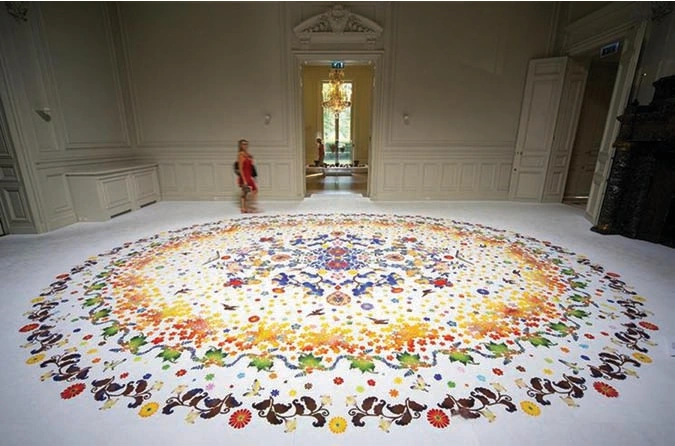
Hasegawa’s belief in the perennially ‘animist’ quality of Japanese culture that will save humanity from the burdens of the Anthropocene belongs to a historical construct dating back to the late twentieth century. It was most notably represented in the writings of philosopher Umehara Takeshi 梅原猛 (1925– 2019), and has since become subjacent within the more general discourse of Japanese culture.44 Hasegawa repeats this belief in animism in Fukami’s exposition catalog, where she describes Japanese art as having an “ecological philosophy” and a “panpsychism” that believes that “all things are ordained with a spirit or even a secret nature.”45 The exposition itself was divided into ten sections bookended by a prologue (‘Duality of echos’) and an epilogue (‘Transformation’). The eight internal sections were divided by theme rather than date, treating Japanese values such as minimalism, diversity, rebirth, and animism. One highlight of the exhibit was sculptor Ohmaki Shinji’s work Echoes-Infinity, which decorated the floor of the entrance to the Hôtel (Fig. 1). The catalog describes a white felt covering the ground, stencilled with designs for which the artist had used mineral pigments derived from traditional Japanese painting. Their vivid colors are “filled with vitality,” and “transform the lighting of the space, causing it to oscillate. Rather than simply regarding this light, the spectators feel it within their body.”46 The designs evoked memories of Ohmaki’s childhood in a village affected by urbanization, and over the course of the exhibition, the footprints of successive visitors would wear away the designs, which would “ultimately [be] disappearing to leave in its place a sea of colors.”47
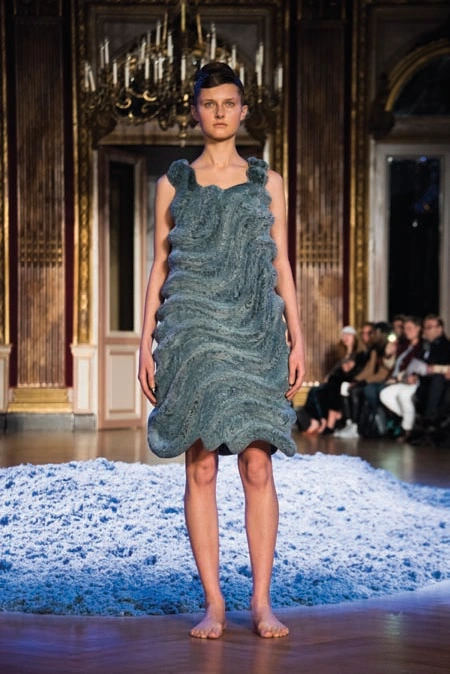
Another exhibit highlight was located in the section ‘Express the origins of life/The deconstruction and transmission of animism.’ Here, Fukami juxtaposed Jōmon-period pottery and a collaboration between contemporary sculptor Nawa Kōhei and the fashion brand anrealage (Fig. 2). Fine examples of Jōmon pottery, designated as National Treasures in Japan, were shipped from Tōkamachi, Niigata; the catalog notes that these pots “served no ritual function: placed in fire, they served to cook food. Through hunting, the people of that time maintained a strong relationship with the animal kingdom and the forest, sources of life and death.”48 The contemporary dress was inspired by this prehistoric pottery and by “elevating the body like vigorous flames, one is reminded of the spirit of the Jōmon period.”49 This same section also included wooden sculptures by the seventeenth-century Japanese monk Enkū 円空 (1632–1695) and the modern artist Pablo Picasso, both of which were framed as evoking a similar respect for the rough materiality of their medium. This comparison between Western and Japanese artworks, which occurred several times within the exhibit, suggested an equivalence between universally recognized great works of the Western canon and lesser-known artwork originating from Japan. Enkū is suggested to have been as profound as a Picasso, but unrecognized due to a Western over-reliance on a clichéd view of Japan.
It is strange that Hasegawa, someone knowledgeable about the history of Japanese art, can so openly make such an ahistorical claim as the transtemporal continuity of a Japanese way of life. An answer may lie in a presentism that makes pragmatic use of Japan’s art history to serve current nation-building needs. Indeed, the different titles in French and Japanese are telling. For the French, Fukami represents a story of Japanese aesthetics that they must plunge into, whereas for the Japanese, the exhibit explains of the need of a move towards a deeper self-understanding. Fukami presents a two-faced image of Japanese aesthetics, a face of confident tradition for the French and of restorationist hope for the Japanese. If the former face represents a millennial tradition of post-humanism to morally backwards Europeans, the latter face represents the rediscovery of this same tradition through a backward glance at Japanese art history. Both involve the projection of concerns driving contemporary Japanese art, like anti-humanism and pure sensuality, onto an identity shared with all prior generations from the Japanese archipelago. If towards the French, the untranslated title of Fukami suggestively presents Japan as the bearer of hidden solutions to contemporary problems, in Japanese, the recommendation of moving Towards Depth suggests that the (re)discovery of this tradition, by Japanese, would resolve these same problems. The esoteric suggestiveness of premodern depth makes it possible to smooth over the overt contradictions in the exhibition, notably its double claim to display both identity essentialism and historical change in Japanese art. It is, lastly, the demiurgical hand of Hasegawa herself that actively projects postmodern Japan into the premodern past, creating a trans-historical identity that contradicts identity itself, critiquing ‘Western’ reason in the process.
teamLab: Technologies of Japanese Cosmopolitanism
The ideological goals of the Japanese government played a direct role in Fukami. This was, however, less the case in most of the other exhibits that constituted Japonismes. Though the main events constituting Japonismes were commissioned by the Japan Foundation, their individual artists and curators had a great deal of flexibility in what they exhibited and how they chose to present it. Most of these other exhibits did not make grandiose claims about a timeless Japanese animist aesthetic, as did Fukami; many of them, however, shared similar themes, such as the critique of anthropocentrism and a belief in an innate Japanese capacity for coexistence. Indeed, from the surprising degree of thematic coordination between the exhibitors, one receives the impression that the Japanese government simply took advantage of a common, existing discourse concerning the character of traditional Japanese aesthetics. Like Hasegawa, the curators and artists in many other expositions projected the problems addressed by contemporary art and aesthetics onto the historical past. The history of Japanese art is interpreted as a prepared solution to contemporary problems that either must be recuperated or already exists in society today. These contemporary problems, furthermore, are always identified with the West, identified in turn through a binary division with Japan, repeating Fukami’s rhetoric in less straightforward terms.
One highly popular exhibit, for instance, was held by the digital art collective teamLab at the Grande Halle de la Villette from 15 May to 9 September, 2018. The exhibit was known by its official title in French, teamLab: Au-delà des limites (teamLab: Beyond boundaries), as well as its organizing theme in Japanese, A world without borders (Kyōkai no nai sekai). teamLab was formed in 2001 by University of Tokyo graduate student Inoko Toshiyuki 猪子寿之 and a group of four friends. Over the following decade, the group created artwork while also accepting commissions for software and application design to make ends meet.50 After having been discovered on the international art scene thanks to the well-known contemporary artist Murakami Takashi, however, the group quickly expanded to have numerous permanent exhibits of their digital art around the world. Their best-known work immerses visitors into a designed space where they are surrounded by ever-changing media projections with which they can interact. Each teamLab exhibit is composed of multiple smaller artworks that interact to form a whole. These individual parts can be taken and rearranged into different spaces in different exhibits. The concept and artwork of Au-delà des limites was originally devised for a 2017 exhibit held in London, titled teamLab: Transcending Boundaries, and has subsequently developed into current and planned exhibits in cities including Tokyo, Shanghai, and Hamburg under the title of teamLab Borderless.51 For a large collective with many annual exhibits like teamLab, Japonismes was only one event out of many.
Along with Fukami, Au-delà des limites was particularly favored by the Japanese government. Prime Minister Abe’s planned two-day inspection, which Foreign Minister Kōno took over for him, included a visit to Au-delà des limites on July 12th with Françoise Nyssen, the French Minister of Culture.52 Over a period of four months, the exhibit registered 300,000 visitors, making it the fourth most attended exhibit held in Paris that year.53 The exhibition introduction on teamLab’s website opens by explaining that humans have the free movement of their bodies and the free use of their brains, and that at times, the boundaries between different ideas become unclear, and at others, these ideas even merge. The introduction then explains that art need not respect borders, relates directly with humans, and can at times influence and mix with other artworks. teamLab’s Au-delà des limites would create this borderless world into which humans can wander. By wandering into this world, humans would alter it by adding in their existence; by adding their individual bodies into the artistic world, furthermore, they would “immerse and meld [themselves] in this unified world” and “explore a new relationship that transcends the boundaries between people, and between people and the world.”54 teamLab can be considered part of a contemporary trend in Japanese media art that blends art, technology, and a claimed Japanese tradition. In her monograph on contemporary media art, Sarah M. Schlachetzki identifies the political and discursive origins of media art in Japan.55 Politically, at the turn of the twenty-first century, both the Japanese government and Japanese businesses began to fund the dissolution of boundaries between art and technology in anticipation of the new Information Age. This promotion of ‘digital contents’ included not only information science, but also popular culture ‘contents’ such as anime and manga. In a country where arts funding has traditionally been limited, artists had the chance to take from the money-pot by framing their artworks as improving social well-being through technological innovation. Discursively, Japanese media art inherits earlier theories of Japaneseness, or nihonjinron, which are now used to claim a distinctly Japanese playfulness towards technology and an ability to relate with robots. The historicization of contemporary art that this ‘tradition’ permits additionally provides a preemptive response to Western ideas of Japanese superficiality.
In an interview with social commentator Uno Tsunehiro 宇野常寛, Inoko offers an artist’s perspective on the Paris exhibit. According to Inoko, Au-delà des limites opened in parallel with a permanent exhibit teamLab opened in the Odaiba district of Tokyo in the same year, titled teamLab Borderless, which shared the concept of a world without borders.56 Inoko compares life in the forest with life in the city. Living in cities, people mistakenly tend to see borders, whereas “when one goes to a rich forest, a variety of individual lives exist in a continuous relationship, and their boundaries are also visually vague.”57 In response to this erroneous condition, teamLab’s world without borders aims to create an artwork that shows the world’s interconnectedness, both between the artwork and among the visitors, who will have the opportunity to reflect upon their own togetherness with the world and each other. Uno contrasts teamLab’s vision of a borderless world with multiculturalism and the Californian ideology. Multiculturalism is an “indulgent ideal” that creates artificial borders between groups in such a way that those feeling vulnerable will lash out against ethnic others; the Californian ideology believes that new information technology will break down borders through global economic interconnectivity.58 What teamLab advocates, in contrast, is that “all the things that we believe we are certainly perceiving, and all the things that we take for granted as universal, are truly fragile and ephemeral in the context of our continuity with the world.”59 Like in Fukami, teamLab responds to crises of value in the West with a critique of universal knowledge and a return to primitive life in the forest. These exhibitions encourage the viewer to come to terms with uncertainty, preaching a quietism that not only unites humans with each other, but also with the non-living and non-human world.
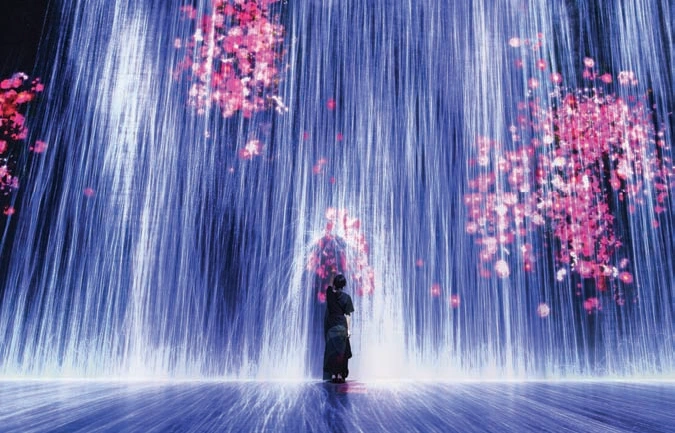
The construction of the exhibit reflected these ideas.60 There were two entryways for visitors, one marked “Exhibition” and another marked “Atelier”. The two routes connected almost immediately, except that the “Atelier” entrance led visitors to a Graffiti Nature section where they could draw pictures of animals and flowers which, scanned, would then become parts of the exhibit.61 Within the animated world to which visitors added their illustrations, animals ate other animals, butterflies became more plentiful in places with flowers, crocodiles died when stepped on, and flowers grew wherever the visitor stood in place for a while.62 The distinction between the Exhibition and the Atelier entrance is a cheeky reference to the distinction between the educational and spectator facilities of the traditional museum. At teamLab’s exhibit, in contrast, visitors simultaneously created and spectated within the built environment, collapsing boundaries between maker and viewer. The exhibition space in La Villette was divided into a series of rooms, but its highlight was towards the very back in Room G (Fig. 3). This room combined several artworks, most spectacularly a digital waterfall titled ‘A Universe of Water Particles’. The positioning of visitors along the waterfall altered the current’s flow, and the particles interacted mutually with other artworks in the proximity.63
Inoko and teamLab describe this feeling of interconnectedness as “Ultra Subjective Space” (chōshukan kūkan), a central pillar of their artistic philosophy. In an essay, Inoko describes how, when he went to Tokyo to attend college, he had more opportunities to see premodern Japanese paintings. He felt there might be similarities between the flatness of premodern Japanese paintings and the immersive visual experiences he had as a child reading manga. He goes on to contrast premodern Japanese two-dimensional perspective with Western two-dimensional perspective. Westerners displayed two-dimensional perspective as if it was cut out of real life by a camera lens, which creates boundaries between the viewer and what they see. This is not the case in pre-modern Japanese art.64 teamLab makes a similar point in a 2015 catalog, which explains that:
For Japanese people of old, their behavior towards nature was not as a target of observation, but as if, ‘we are all a part of nature’ […] If you see the world through Ultra Subjective Space then it is easy to feel that there is no boundary between yourself and the world […] If you have been seeing the world as in the perspectives and photos of the West, then you and the world that you see are completely divided, there is a clear boundary […] The world is something to be observed, and this perhaps is why science evolved in the West.65
Though teamLab does not refer to Japanese animism as does Hasegawa, both share the assumption of ancient Japan’s privileged relationship with nature, one that remains ambiguously conserved within contemporary art such as manga. All of this is much like the lesson of Fukami: the path to understanding the Japanese aesthetic perspective goes beyond logic and demands a feeling of wondrous immersion, which, in this case, is permitted by teamLab’s artwork within an engineered space. The mediation of technology facilitates a (re) discovery of this non-perspectivist perspective. The critique that such a perspective is as self-contradictory as the notion of a timeless Japanese aesthetic of permanent change is parried with the claim that such impossible art was already achieved in premodern Japan, and that contemporary artists merely stage a return to what had already been. The artwork becomes a thoughtless celebration of how machines, virtual characters, and humans are all interconnected; it inherits a supposed Japanese tradition of technological playfulness that ignores questions about truth or the social effects of new media.
MANGA<=>TOKYO: Life to Fiction, Fiction to Life
The exhibit MANGA<=>TOKYO took place from November 29 to December 30, 2018, also at La Villette, welcoming more than 30,000 visitors over only a month. The exhibit’s history dates back to the exhibit MANGA*ANIME*GAMES from JAPAN, which was first shown at the National Art Center, Tokyo (nact) in 2015.66 Foreign museums expressed interest in presenting the exhibit outside of Japan, and Morikawa Kaichirō 森川嘉一郎, a professor at the School of Global Japanese Studies at Meiji University, was tapped to fundamentally reconstruct it for a foreign audience. Around the same time, the Japan Foundation had commissioned the nact to create an exhibit on manga, anime, and games for Japonismes. The project to revise the 2015 exhibit was therefore combined with the planned exhibit in Paris. According to Morikawa, MANGA<=>TOKYO had no relation with the 2015 exhibit and was designed to suit the Paris public and the architecture at La Villette.67 An updated version of the Paris exhibit was afterwards brought back to Tokyo’s National Art Center and ran from August to November 2020.68
A press release in Japanese describes the central argument of the exhibit as follows:
This is an exhibition that proposes a compound experience of the city ‘Tokyo’ as reflected in Japan’s manga, anime, games, and special-effects live-action features, as well as the real ‘Tokyo’ that has been injected with fiction of this kind […] How did the characteristics of the real city give birth to fiction and set a direction for it? Also, what images have these fictions and characters provided, in a multi-layered way, to the real city, and what effects have they caused? […] Just as anime and games are receiving attention as tourist resources, for instance contents tourism (seichi junrei), we will shine light onto the meaning and potential [of the multilayered imaginary of Tokyo].69
If Tokyo is a city composed of both real and fictional elements feeding into the experience of popular culture, this readiness to accept fiction is explained by a theory of history regarding its development. In an interview, curator Morikawa explains that, though cities around the world have been subject to large-scale destruction and redevelopment, compared to European cities, Tokyo was and is less interested in recreating its past urban form. Rather, the metropolis is willing to change its appearance entirely every five to ten years:
In short, for Tokyo, large-scale destruction and rebuilding from it is almost like a destined future. This sort of perspective towards history and the future is to Japan, and in particular to people living in Tokyo, that which builds the foundations of a reality receptive to fiction, and likely also functions like a mold.70
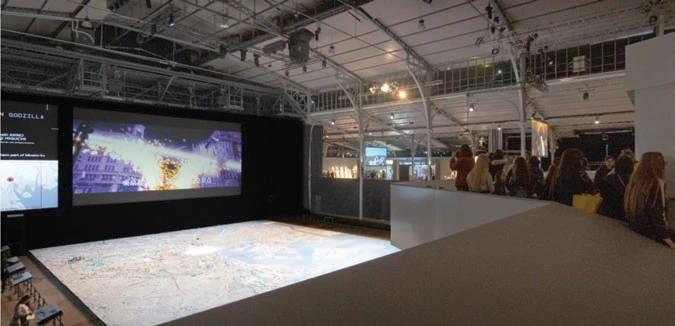
The construction of MANGA<=>TOKYO reflected this basic concept. Visitors to the exhibit first passed through rows of vertical banner advertisements for popular-cultural productions before entering the main room, at the center of which was an immense 1/1000 scale model of Tokyo (Fig. 4).71 Visitors entered and exited through the gift shop, composed of two sets of store aisles modeled after merchandise shops in Ikebukuro’s Otome Road and Akihabara. Behind the scale model was a screen projecting scenes from media productions featuring the metropolis such as Godzilla and Neon Genesis Evangelion; sections of the scale model corresponding to the projected scenes would light up. The main exhibits were located on the second floor, on raised platforms surrounding and overlooking the Tokyo model. There were five of these platforms, connected by bridges and divided between three sections: (1) the repetition of destruction and reconstruction, (2) the history of everyday life in Tokyo, and (3) characters versus the city. Morikawa conceived the third section earliest and used its section title as the provisional title of the exhibit before its current name was decided. Visitors were encouraged to pass through the three sections successively, ascending to and descending from the second floor through stairwells located on both sides of the Tokyo model. At the end of the exhibit was a partial reconstruction of a Shinto shrine where visitors could could hang ema (wooden votive plaques) inscribed with their comments on the exposition and pictures of their favorite characters. The third section on characters versus the city received particular attention from visitors and media for its life-scale models of Tokyo’s trains, convenience stores, and pachinko halls. These models were plastered with images of characters from popular culture to exhibit the latter’s vitality, evidencing the integration of fiction into everyday life.72 In her book Millennial Monsters, anthropologist Anne Allison describes Japanese popular culture goods such as Pokémon as characterized by “techno-animism” and “polymorphous perversity” – on the one hand the return of animist spirituality into the commodified materiality of consumer objects, and on the other the glee consumers feel about the endless reconfigurations these objects can take on.73 Like Fukami, MANGA<=>TOKYO ascribes a distinctly Japanese character to the acknowledgment of the lives of nonhuman beings, whether natural or borne of popular culture. Also similar to both Fukami and teamLab’s Au-delà des limites is the “polymorphous perversity” of delighting in permanent change; it is only that in MANGA<=>TOKYO, the city of Tokyo replaces Japanese culture or the traditional Japanese appreciation of nature. Within the exhibit, fictional characters enter and exit Tokyo as they please. There is no moral judgment; the collapse of boundaries between truth and fiction and Tokyo’s reckless reconstruction are naturalized under the rhetoric of tradition. Indeed, the second section of the exhibit detailing the history of everyday life in Tokyo from Edo to the present is curious, not least because it occupied three of the five platforms. This everyday life is presented as a site for continuity in spite of historical change. Writing about the creation of a ‘vernacular’ sense of Tokyo in late twentieth-century Japan, historian Jordan Sand notes how in critique of the public historiography of national modernization, new museums were established that “located in the home the continuity of everyday life and a common social space shielded from the forces of capitalism and the modernizing state.”74 MANGA<=>TOKYO narrates, in its history of everyday life, the heroic persistence of an everyday Tokyoite who comes to peace with outside-induced political change by preserving a tradition of spirituality.
Although Japanese popular culture is generally recognized to be a postwar phenomenon, MANGA<=>TOKYO, like the other two exhibits examined, projected Japan’s contemporary mode of being into the premodern past. Just as visitors at the end of the exhibit were led from recreations of super-modern convenience stores to a traditional Shinto shrine, the historical section juxtaposed Edo-period maneki-neko statuary with contemporary storefront figurines, and ukiyo-e prints and today’s manga.75 In the exposition catalog, Morikawa describes ukiyo-e prints as “pre-modern examples of representing particular places in the city by means of attractive characters”76 and writes that “since the Edo period, figurines of cats and raccoon dogs in human-like poses have been placed inside and outside stores to bring luck and business prosperity.”77 The perspective from which Morikawa writes is clearly anchored in the contemporary moment. By giving elements of contemporary life historical depth, it is suggested that Japanese tradition has remained consistent in spite of everything around it changing. The past, in turn, is used as an ornament legitimizing the present, a present that implicitly criticizes the West for its intolerance towards fiction.
Conclusion: After Japonismes
The idea of a “Japan exposition” was, from early on, not intended as a one-time event, but rather as a new kind of event-based foreign diplomacy. Documents distributed at the fifth meeting of the bjap on November 17, 2017 included plans for what was tentatively called “Japonismes 2019,” to be held in the United States and Southeast Asia, regions chosen on account of their relative diplomatic importance and the desire to balance the localities where exhibits were held. The American event would strengthen the already “multi-layered” relationship between the United States and Japan, supported by shared democratic values and frequent communication. The Southeast Asian event, in contrast, would aim to “construct a new Asian culture” as part of Abe’s wa Project (Bunka no wa purojekuto).78 A 2020 domestic exposition coinciding with the Olympics was also planned, only to be unfortunately disrupted due to the covid-19 pandemic. In this concluding section, this article addresses these various expositions that followed in Japonismes’s footsteps before returning to consider the political uses and dangers of the notion of Japanese art.
The American event was ultimately named Japan 2019 and followed the pattern of Japonismes 2018, with eight official events and 138 participating projects around the country.79 The official events were highlighted by exhibitions at the New York Metropolitan Museum of Art and the Cleveland Museum of Art about the Tale of Genji and Shinto spirituality respectively.80 Also among these official events were those of the more popular sort, such as a ‘Japan Night’, held in New York, featuring contemporary Japanese musicians as well as several performances of the musical Pretty Guardian Sailor Moon: The Super Live.81 Though Japan 2019 was nowhere as condensed or well-funded as Japonismes 2018, this combination of premodern and modern art as part of foreign diplomacy persisted. On the other side of the globe, the planned exhibition in Southeast Asia ultimately materialized as Asia in Resonance 2019 (Hibikiau Ajia), a clear inheritance from the 2018 theme. The exhibits planned, however, differed substantially from their Western cousins. The majority of events would be held not in Southeast Asia, but in Japan. The event descriptions furthermore discuss little of Japanese history or aesthetics and, indeed, there were no expositions of premodern Japanese art as there were in the West. The artistic and human exchanges took place through events such as performances by contemporary artists, Japanese-language education, and friendly soccer games. In Asia in Resonance, Japan presented itself as an older sibling within an Asian community, providing both scientific and artistic leadership, while considering itself as one equal partner among many.82 It should be noted that Japonismes 2018 and the 2019 events were under the leadership of the Japan Foundation – one organization presenting two different faces of Japan, one to the West and another to Asia.
The 2020 domestic exposition was finally organized as the Japan Cultural Expo, or in Japanese Nihon-haku (Japan Expo). The face presented domestically was strikingly similar to that presented to the West, and indeed, like the Paris exposition, it originally targeted foreign tourists who were expected to come to Japan to see the Olympics. The theme, ‘The Japanese and Nature’, would follow that of Japonismes 2018, underlining a Japanese heart valuing nature, life, and diversity, cultivated through over ten thousand years of continued history. By exhibiting Japanese artistic values permeating far-ranging domains from heritage to literature and food, people around the world would become aware of a Japanese sense of beauty. The Japan Cultural Expo would be held throughout Japan and involve the participation of local groups, guiding foreign visitors away from the central cities and revitalizing regional economies in the process. As the coronavirus pandemic closed the nation’s borders and delayed the Olympics, the organizers of the exposition attempted new methods to salvage the events, such as by using new digital technologies to permit attendance from a distance.83 In May 2022, it was decided that the Olympics-centered Japan Cultural Expo would be extended to a Japan Expo 2.0 leading up to the 2025 Osaka World Fair. The Japan Cultural Expo is unlike previous expositions in that it is not an exposition in the traditional sense, framed by a limited time period and centrally organized by a structured body, but rather a continual ‘national project’, spearheaded by the Agency for Cultural Affairs with the support of relevant ministries.84 As a project rather than an organization, the Japan Cultural Expo directly manages none of their events. The events categorized as part of its exposition may be commissioned or subsidized, but they may also be financially unrelated, only included for their proximity to the exposition theme.85 The project is therefore both more and less ambitious than previous expositions, on the one hand wielding limited direct control over individual events, and on the other reserving the right to decide which events can be classified within the ambit of something ‘Japanese’. The government no longer takes the role of the creator of culture, but rather curates and orders what is already in place.
As the country was closed for tourists during its initial two years, the Japan Cultural Expo has ultimately been an event for Japanese rather than foreigners, as its creators originally intended. But perhaps this was not as far from its purpose as it may seem on paper. In a meeting of the General Promotion Committee for the Japan Cultural Expo held on May 12, 2022, art critic and museum leader Hashimoto Mari 橋本麻里 explained that:
To advance the Japan Cultural Expo to the next step, [the Japan that we present to visitors] must not be a stereotyped Japan, nor can it be a Japan that we, thinking arrogantly, take to be Japan ourselves, but must rather be a Japan that we ourselves rediscover with awe, one that we find again alongside people from the world.86
Indeed, the bjap was built upon the premise that not only foreigners, but also the Japanese themselves failed to recognize the treasure that was Japanese culture, and that creating a ‘correct’ awareness of Japan among foreigners would kill two birds with one stone, incidentally improving Japanese awareness of themselves. It is no great leap to conclude that the Japanese, too, are foreigners to their own culture; that when they visit expositions about Japan, they, too, are unfamiliar with Heian-period court politics or the intricacies of calligraphic styles. Perhaps this is the unconscious truth about opening an exposition abroad for Japanese, and another domestically for foreigners. The Japanese are the foreigners, who can only recognize themselves as Japanese by seeing themselves in the mirror of the Other. In Paris, the Japanese see themselves as Japanese through the French, who recognize them as Japanese; back in Japan, the Japanese see themselves as Japanese through exhibitions targeting foreigners, enabling them to recognize the Japanese as Japanese. It is the same action performed twice; it is only the surface-level content that differs. The Japanese are either relieved of their duty to identify themselves via a prior identification as Japanese by the Western Other or discover, side-by-side with Westerners, a return to their own ancestral tradition.
The Orientalism here is complicit. Japonisme is not only the product of a stereotyped Japan by an Europe dissatisfied with modernity, but also a practical employment of this literary and artistic trope as political capital on the part of Japanese politicians and thinkers. The Japanese project their need to discover their own culture upon Westerners, who are expected to treat the Japanese as bearing the resolution to moral, ecological, and other crises; the Japanese then either identify with this post-humanist, morally unambiguous high ground or stand alongside the Westerners in the discovery of their own national tradition. Paralleling the discourse of artistic Japonisme, within Japonismes, Japanese culture is treated as an irrational ethnocultural secret beyond the capacities of either Westerners or Westernized Japanese, such that the recovery and universalization of this secret would inspire Western societies, revealing Japanese thought’s important role in the twenty-first century. Such a heroic narrative rings plausible to Western and Japanese audiences alike in light of criticisms of Eurocentricm and anthropocentrism common in global discourse today. The Japanese create expositions such as Japonismes 2018 and the Japan Cultural Expo ostensibly for foreigners, but in reality for themselves.
That some form of aesthetics has existed on the Japanese archipelago that differs from that which developed from Renaissance Europe is irrefutable. What is problematic, however, is the convenient critique of all things ‘Western’ that the idea of a non-Western aesthetics provides. The history of Japanese art is complex and cannot be vulgarized into a single aesthetic; its very placement in parallel comparison with Western aesthetics brazenly projects today’s concerns into the past, gleefully twisting the past to its advantage in the process. What is notable about the discourse of Japanese aesthetics today, at least as it is pronounced in Japonismes, is twofold: firstly, its open disavowal of rational thought as a preliminary condition for understanding ‘Japan’, and secondly, the importance attributed to categorizing things Japanese rather than openly affecting preference for a particular genre. The series of Japan Expositions that the Japanese government has promoted from Japonismes 2018 onwards allows individual curators and artists significant leverage in what they display under its banner, but with the formalization of Japanese cultural events as sanctioned by the Japan Cultural Expo, the Agency for Cultural Affairs becomes the arbiter of authenticity, a decision that openly repeats hackneyed and disproven tropes such as Japanese animism. The governance of contemporary culture occurs today not through heavy-handed support for the traditional arts and crafts, but rather through the control of publicity and branding that supports nationalist aims.
It is difficult and perhaps not even meaningful to ask the question of whether ‘average’ Japanese citizens agree with stereotypes such as Japanese animism, receptiveness to fiction, and ultra-subjectivity. The question of whether curators and artists who invoke these stereotypes genuinely believe in them, or whether they practically assume them to be better-received by their government commissioners or their audiences, is similarly difficult to appraise. What is certain, however, is that a particular class of important political figures genuinely believe in them, and that the continued persistence of these quasi-aesthetic tropes common to artistic Japonisme has practical dimensions for foreign diplomacy and arts promotion. In art-historical scholarship, above all in the study of Japonisme, it is common to write of artists in one country influencing those in another. In the case of Japonismes 2018, as influential as Japanese manga and tradition may be in the West, the government’s hand in molding and curating what is shown and the narrative of how this art is received is undeniable. In the process, these curators of Japan, and their co-conspirators in the West, limit the freedom to speak of what can be ‘Japanese’.
Notes
- Michael Lucken, Imitation and Creativity in Japanese Arts: From Kishida Ryūsei to Miyazaki Hayao, trans. Francesca Simkin (New York: Columbia University Press, 2016); Kristopher W. Kersey, “Dynamism, Liquidity, and Crystallization in the Discourse of Japanese Art History,” in Einfluss, Strömung, Quelle: Aquatische Metaphern der Kunstgeschichte, ed. Ulrich Pfisterer and Christine Tauber (Bielefeld: transcript Verlag, 2019). Back to text
- Gabriel P. Weisberg, “Rethinking Japonisme: The Popularization of a Taste,” in The Orient Expressed : Japan’s Influence on Western Art, 1854–1918, ed. Gabriel P. Weisberg (Jackson: Mississippi Museum of Art, 2011), p. 18. Back to text
- Ibid., p. 71. Back to text
- Christopher Reed, Bachelor Japanists : Japanese Aesthetics and Western Masculinities (New York: Columbia University Press, 2017), p. 5; see also Yoko Kawaguchi, Butterfly’s Sisters: The Geisha in Western Culture (New Haven: Yale University Press, 2010). Back to text
- Japan Foundation, Japonizumu 2018: Jigyō hōkokusho [Japonismes 2018: Operations report] (Tokyo: Japan Foundation, 2019), p. 100, https://japonismes.org/news/12273. Back to text
- Higuchi Yoshihiro, “Furansu ni okeru japonizumu 2018 no kaimaku” [The opening of Japonismes 2018 in France], Kasumigaseki Foreign Service Association, August 23, 2018, https://www.kasumigasekikai.or.jp/2018-08-23-2/. Names of all authors writing in Japanese are presented with family name first. Back to text
- Japan Foundation, Operations Report, pp. 16–17. Back to text
- Ibid., p. 92. Back to text
- See, for instance, Christine Reiko Yano, Pink Globalization: Hello Kitty’s Trek across the Pacific (Durham: Duke University Press, 2013); Michal Daliot-Bul and Nissim Otmazgin, The Anime Boom in the United States: Lessons for Global Creative Industries (Cambridge, MA: Harvard University Press, 2017). Back to text
- The three terms are increasingly indistinguishable and are used somewhat interchangeably in the Japanese-language literature. See Tadashi Ogawa, “Japan’s Public Diplomacy at the Crossroads,” in Routledge Handbook of Public Diplomacy, ed. Nancy Snow and Nicholas J. Cull (New York: Routledge, 2020). For a comprehensive overview of the current Japanese-language political science literature on Japanese public diplomacy, consult Kobayashi Mari, ed., Bunka seisaku no genzai [The current state of cultural politics], 3 vols. (Tokyo: University of Tokyo Press, 2018). Back to text
- Toshiya Nakamura, “Japan’s New Public Diplomacy: Coolness in Foreign Policy Objectives,” Media to shakai, no. 5 (2013): pp. 5–6; Daniel White, Administering Affect: Pop-Culture Japan and the Politics of Anxiety (Stanford: Stanford University Press, 2022); David Leheny, “A Narrow Place to Cross Swords: ‘Soft Power’ and the Politics of Japanese Popular Culture in East Asia,” in Beyond Japan: The Dynamics of East Asian Regionalism, ed. Peter J. Katzenstein and Takashi Shiraishi (Ithaca: Cornell University Press, 2006). Back to text
- Isabelle Barbéris, L’art du politiquement correct, (Paris: Presses Universitaires de France, 2019), pp. 102–103. Italics original. All translations in this article are my own. Back to text
- bjap, Meeting 1, Meeting Summary (October 2015), p. 1. All documents from the bjap can be found at https://www.kantei.go.jp/jp/singi/nihon_bi_sogoproject/index.html. Back to text
- bjap, Meeting 1, Agenda (October 2015), Documents 1–2. Back to text
- Ibid. Back to text
- bjap, Meeting 1, Meeting Summary, p. 1. Back to text
- Ibid., pp. 1–2. Back to text
- Ibid., p. 2. Back to text
- Ibid., p. 2. Back to text
- Ibid., pp. 2–3. Back to text
- Shibasaki Atsushi, “Taigai bunka seisaku shisō no tenkai: Senzen, sengo, reisengo [The history of Japanese foreign cultural policy: Prewar, postwar, post-Cold War],” in Nihon no gaikō, dai-3 kan: Gaikō shisō [Japanese diplomacy, Vol. 3: Intellectual currents], ed. Sakai Tetsuya (Tokyo: Iwanami shoten, 2013). Back to text
- Jang In-Sung, “‘Ushinawareta 20-nen’ to hoshu no bigaku [‘The lost 20 years’ and conservative aesthetics],” in Ushinawareta 20-nen to Nihon kenkyū no kore kara, ushinawareta 20-nen to Nihon shakai no henyō [The lost two decades and the future of Japanese studies; the lost two decades and the transformation of Japanese society], ed. Takii Kazuhiro (Kyoto: Ningen bunka kenkyū kikō kokusai Nihon bunka kenkyū sentā, 2017), pp. 29–30. Back to text
- bjap, Meeting 2, Meeting Summary (December 2015), p. 1. Back to text
- bjap, Meeting 4, Agenda (November 2016). Back to text
- White, Administering Affect, p. 144. Back to text
- bjap, Meeting 3, Meeting Summary (April 2016), pp. 3–4. Back to text
- Ibid., p. 8. Back to text
- Ibid., pp. 9–10. Back to text
- Ibid., p. 10. Back to text
- bjap, Meeting 4, Meeting Summary, pp. 7–9. Back to text
- Ibid., p. 12. Back to text
- Japan Foundation, Japonismes Office, “‘Japonizumu 2018: Hibikiau tamashii’ Kaisai kisha happyōkai, hōdōyō shiryō” [‘Japonismes 2018: Souls in resonance’ press conference, documents for the press], p. 3, https://www.jpf.go.jp/j/about/press/2017/dl /japonismes-001.pdf. Back to text
- Ibid. Back to text
- Japan Foundation, Operations Report, p. 118. Back to text
- Barbéris, L’art du politiquement correct, p. 103. Back to text
- “Fukami: Une plongée dans l’esthétique japonaise.” Exposition webpage. Accessed 11 October 2022. https://fukami.japonismes.org/. Back to text
- Murakami Mai, “‘Japonizumu 2018: Hibikiau tamashii’ hōmon no gaiyō hōkoku” [Japonismes 2018: Summary report of visit], Chizai purizumu: Chiteki zaisan jōhō vol. 17, no. 193 (2018): p. 36; Higuchi, “The opening of Japonismes.” Back to text
- “Heisei 30-nen 7.12~14 japonizumu kanren shisatsu nado” [Report on events from 7/12~14, 2018, including inspection of Japonismes], Embassy of Japan in France, last modified July 18, 2018, https://www.fr.emb-japan.go.jp/itpr_ja/20180712japonismeskanrenshisatsu.html. Back to text
- “Abe sōri daijin no japonizumu 2018 ‘Jōmon: Nihon ni okeru bi no tanjō’ ten shisatsu” [Prime Minister Abe’s inspection of the exhibit “Jōmon: The birth of beauty in Japan”], Ministry of Foreign Affairs of Japan, last modified October 18, 2018, https://www.mofa. go.jp/mofaj/p_pd/ca_opr/page4_004420.html; “‘Jōmon: Nihon ni okeru bi no tanjō’ ten” [Jōmon: The birth of beauty in Japan], Japonismes 2018, last modified October 1, 2018, https://japonismes.org/officialprograms/%e3%80%8c%e7%b8%84%e6%96%87%e3 %80%8d%e5%b1%95. Back to text
- For a concise biography of Hasegawa, see Adrian Favell, Before and After Superflat: A Short History of Japanese Contemporary Art 1990–2011 (Hong Kong: Blue Kingfisher, 2011), pp. 170–173. Back to text
- “Bunka geijutsu no saiten ‘Japonizumu 2018: Hibikiau tamashii’ iyoiyo ōpun: Bijutsuten 2018-nen natsu kōshiki kikaku rainappu no goannai” [The shrine of culture and arts, ‘Japonismes 2018: Souls in resonance’ will soon begin: Guide to the lineup of official planned art exhibitions to be held in summer 2018], Japan Foundation, June 21, 2018, https://www.jpf.go.jp/j/about/press/2018/dl/japonismes-007.pdf. Back to text
- Ibid., “The shrine of culture and arts”. Back to text
- Ibid. Back to text
- For a critical examination of myths of a Japanese love for nature, of being a forest people, and of having inherited Jōmon-era animist traditions, see Nathan Hopson, Ennobling Japan’s Savage Northeast: Tohoku as Postwar Thought, 1945–2011 (Cambridge, Massachusetts: Harvard University Press, 2017), particularly Ch. 5, “Tōhoku Studies as Neo-Japanism”; as well as Aike P. Rots, Shinto, Nature, and Ideology in Contemporary Japan: Making Sacred Forests (New York: Bloomsbury Academic, 2017), pp. 53–63, 111–120. Back to text
- Yuko Hasegawa, ed. Fukami: Une plongée dans l’esthétique japonaise (Paris: Flammarion, 2019), p. 18. Back to text
- Ibid., p. 27. Back to text
- Ibid., p. 27. Back to text
- Ibid., p. 38. Back to text
- Ibid., p. 38. Back to text
- Miyatsu Daisuke, Āto x tekunorojī no jidai: Shakai o henkaku suru kurieitibu bijinesu [The age of art x technology: Creative businesses that are changing the world] (Tokyo: Kōbunsha, 2017), pp. 23–26. Back to text
- “Exhibitions,” teamLab, accessed October 13, 2022, https://www.teamlab.art/e/?type =pickup. Back to text
- “Discours de Françoise Nyssen, ministre de la Culture, prononcé à l’occasion du lancement de la saison « Japonismes 2018 », jeudi 12 juillet 2018,” Ministère de la Culture, Archives Discours (2012–2018), July 12, 2018, https://www.culture.gouv.fr/Presse/Archives-Presse /Archives-Discours-2012–2018/Annee-2018/Discours-de-Francoise-Nyssen-ministre-de-la -Culture-prononce-a-l-occasion-du-lancement-de-la-saison-Japonismes-2018-jeudi-12 -juillet-2018. Back to text
- bjap, Meeting 7, Agenda, Document 1. Back to text
- “teamLab: Au-delà des limites,” teamLab, accessed March 22, 2023, https://www.teamlab. art/jp/e/lavillette/. Back to text
- Sarah M. Schlachetzki, Fusing Lab and Gallery: Device Art in Japan and International Nano Art (Bielefeld: transcript Verlag, 2012), pp. 23–70. Back to text
- Inoko Toshiyuki and Uno Tsunehiro, Jinrui o mae ni susumetai: Chīmurabo to kyōkai no nai sekai [I want to push humanity forward: teamLab and a world without borders] (Tokyo: planets, 2019), p. 212. Back to text
- Ibid., p. 210. Back to text
- Ibid., pp. 212–214. Back to text
- Ibid., p. 229. Back to text
- A map of the exhibit can be found at “TeamLab: au-delà des limites – La Villette – Japonismes 2018,” C’est quoi ton kim, last modified August 26, 2018, https://www .cestquoitonkim.com/2018/08/teamlab-au-dela-des-limites-la-villette.html. Back to text
- Inoko and Uno, I want to push humanity forward, pp. 217–220. Back to text
- “Graffiti Nature – Montagnes et Vallées,” teamLab, accessed October 20, 2022, https://www.teamlab.art/fr/w/valleys/lavillette/. Back to text
- “Univers de particules d’eau dans Au-delà des limites,” teamLab, accessed October 20, 2022, https://www.teamlab.art/fr/w/large-waterparticles/lavillette/. Back to text
- Inoko and Uno, I want to push humanity forward, pp. 242–243. Back to text
- teamLab (Tokyo: teamLab, 2015), p. 49. Back to text
- “Nippon no manga * anime * gēmu” [Japan’s manga, anime, games], The National Arts Center, Tokyo, accessed October 20, 2022, https://www.nact.jp/exhibition_special/2015 /magj/. Back to text
- Morikawa Kaichirō, email correspondence, October 11, 2022. Back to text
- “MANGA <=> TOKYO,” The National Arts Center, Tokyo, accessed October 20, 2022, https://www.nact.jp/english/exhibitions/2020/manga-toshi-tokyo/. Back to text
- “Japonizumu 2018 kōshiki kikaku MANGA <=> TOKYO ten, ma mo naku kaimaku! Tenji shōsai no oshirase” [Japonismes 2018 official program, MANGA<=>TOKYO exhibit, soon to open! Announcement of exhibit details], Press Release, November 2018, p. 2, https://japonismes.org/wp-content/uploads/2018/11/PRESS-RELEASE-1.pdf. Back to text
- Taniguchi Ryūichi, “Tenrankai ‘MANGA toshi TOKYO Nippon no manga anime gēmu tokusatsu 2020’ gesuto kyurētā no Morikawa Kaichirō ni kiku” [Exposition ‘MANGA city TOKYO: Japan’s manga, anime, games, and tokusatsu 2020’, conversation with guest curator Morikawa Kaichirō], Mēdia geijutsu karento kontentsu, last modified November 2, 2020, https://mediag.bunka.go.jp/article/article-16957/. Back to text
- A map of the exhibit can be found at Miyamoto Ryōhei, “‘MANGA<=>TOKYO’ ten repōto” [‘MANGA<=>TOKYO’ exhibit report], Media geijutsu karento kontentsu, last modified March 28 2019, https://mediag.bunka.go.jp/article/article-14896/. Back to text
- Videos of visits to the exposition can be found on YouTube, the most descriptive being La chaîne du geek, “Une EXPOSITION pour découvrir TOKYO via les MANGAS!,” last modified December 17, 2018, https://www.youtube.com/watch?v=XWOBvg6tC_w; and GoGo jiyū-tabi/Furansu nichijō, “MANGA toshi TOKYO Nippon no manga, anime, gēmu, tokusatsu 2020 (Kokuritsu Shinbijitsukan) no moto tenji Japonismes2018 MANGA TOKYO Paris sono 2” [The original exhibit of MANGA city TOKYO: Japan’s manga, anime, games, tokusatsu 2020 (National Art Center, Tokyo), Japonismes2018 MANGA TOKYO Paris, Part 2], last updated August 25, 2020, https://www.youtube.com/watch?v=IKM8u9Grl3s. Back to text
- Anne Allison, Millennial Monsters: Japanese Toys and the Global Imagination (Berkeley: University of California Press, 2006), p. 91. Back to text
- Jordan Sand, Tokyo Vernacular: Common Spaces, Local Histories, Found Objects (Berkeley: University of California Press, 2013), p. 141. Back to text
- “Dossier pédagogique, exposition MANGA<=>TOKYO,” La Villette, accessed 20 Octobre 2022, https://lavillette.com/programmation/manga-tokyo_e32. Back to text
- Morikawa Kaichirō, ed., MANGA<=>TOKYO concept book (Tokyo: The National Art Center, 2018), p. 16. Back to text
- Ibid., p. 24. Back to text
- bjap, Meeting 5, Agenda, Document 2 (Nov 2017). The wa Project is a political strategy announced in December 2013 intending to improve bilateral relations between Japan and Asian countries in preparation for the 2020 Olympics. The program would be spearheaded by the Japan Foundation and feature the establishment of an “Asia Center” to mediate its activities. See “‘Bunka no wa Purojekuto: Shiriau Ajia’ sutāto” [‘wa Project: Getting to know Asia’ start], Japan Foundation, last modified April 2014, https://www.wochikochi.jp/ topstory/2014/04/bunkanowa.php. Back to text
- “Japan 2019,” Japan Foundation Annual Report 2019/2020, accessed March 2, 2023, https://www.jpf.go.jp/e/about/result/ar/2019/01_02.html. Back to text
- “The Tale of Genji: A Japanese Classic Illuminated,” The Met, accessed October 25, 2022, https://www.metmuseum.org/exhibitions/listings/2019/tale-of-genji; “Shinto: Discovery of the Divine in Japanese Art,” The Cleveland Museum of Art, accessed October 25, 2022, https://www.clevelandart.org/exhibitions/shinto-discovery-divine-japanese-art. Back to text
- Japan Night, Japan Foundation New York, accessed October 25, 2022, https://www. jfny.org/event/japan-night/; “Pretty Guardian Sailor Moon: The Super Live,” Japan Foundation New York, accessed October 25, 2022, https://www.jfny.org/event/pretty -guardian-sailor-moon-the-super-live/. Back to text
- “Hibikiau Ajia 2019” [Asia in Resonance 2019], Japan Foundation Asia Center, accessed October 25, 2022, https://asiawa.jpf.go.jp/culture/projects/p-asia2019/. The current relationship to Southeast Asia is a curious inheritance from a discontinued arts promotion diplomacy in the 1990s, as described in Kishi Sayaka, “Tai-Ajia bunka seisaku to gendai bijutsu: Kokusai Kōryū Kikin ni okeru bijutsu jigyō no shintenkai (1990–2005 nen)” [Foreign Cultural Policy and Enhancing Cultural Exchange in Asia: An Examination on the Development of the Japan Foundation’s Contemporary Art Program (1990–2005)],” Tsuru Bunka Daigaku kenkyū kiyō, no. 90 (2019). Back to text
- “‘Nihonhaku’ kikaku iinkai” [Japan Cultural Expo planning committee], Meeting 8, Agency for Cultural Affairs (August 2020), https://www.bunka.go.jp/seisaku/bunkashingikai/ kondankaito/nihonhaku_kkaku/. Back to text
- Japan Cultural Expo Bureau, Japanese Arts and Culture Promotional Committee [Nihonhaku jimukyoku, Nihon geijutsu bunka shinkōkai], email correspondence, September 7, 2022. Back to text
- Ibid. Back to text
- Nihonhaku sōgō suishin kaigi [General Committee for the Promotion of the Japan Cultural Expo], Meeting 3, meeting summary (May 2022), p. 6, https://www.kantei.go.jp/ jp/singi/nihonhaku/. Back to text
Acknowledgements
In France, I thank Katakawa Kiyoji and the staff at Région Île-de-France, Musée des impressionnismes Giverny, and the House of Culture of Japan in Paris for their time. In Japan, I thank Kobayashi Mari and the members of David Leheny’s seminar at Waseda for their insightful comments. Reading recommendations from Kristopher Kersey, Marie Pruvost-Delaspre, and Vincent Manigot helped familiarize me with the art historical scholarship on japonisme and Japanese contemporary art. Any persistent mistakes or misunderstandings are my own. At the Journal of Japonisme, I thank Anna Beerens, Gabe Weisberg, and the anonymous reviewers for their feedback. I am lastly grateful to Morikawa Kaichiro, teamLab, Ohmaki Shinji, Nawa Kohei, and anrealage for allowing me to use their images in my text. An Overseas Research Travel Grant from Waseda University and the Haraguchi Memorial Asia Research Fund from Waseda’s Institute of Asia-Pacific Studies funded fieldwork research.
Bibliography
Allison, Anne. Millennial Monsters: Japanese Toys and the Global Imagination. Berkeley: University of California Press, 2006.
Barbéris, Isabelle. L’art du politiquement correct. Paris: Presses Universitaires de France, 2019.
Daliot-Bul, Michal, and Nissim Otmazgin. The Anime Boom in the United States: Lessons for Global Creative Industries. Cambridge, MA: Harvard University Press, 2017.
Favell, Adrian. Before and After Superflat: A Short History of Japanese Contemporary Art 1990–2011. Hong Kong: Blue Kingfisher, 2011.
Hasegawa, Yuko, ed. Fukami: Une plongée dans l’esthétique japonaise. Paris: Flammarion, 2019.
Hopson, Nathan. Ennobling Japan’s Savage Northeast: Tohoku as Postwar Thought, 1945– 2011. Cambridge, MA: Harvard University Press, 2017.
Inoko Toshiyuki, and Uno Tsunehiro. Jinrui o mae ni susumetai: Chīmurabo to kyōkai no nai sekai [I want to push humanity forward: teamLab and a world without borders]. Tokyo: planets, 2019.
Jang In-Sung. “‘Ushinawareta 20-nen’ to hoshu no bigaku [The lost 20 years and conservative aesthetics].” In Ushinawareta 20-nen to Nihon kenkyū no kore kara, ushinawareta 20-nen to Nihon shakai no henyō [The lost two decades and the future of Japanese studies; the lost two decades and the transformation of Japanese society], edited by Takii Kazuhiro, 13–31. Kyoto: Ningen bunka kenkyū kikō kokusai Nihon bunka kenkyū sentā, 2017.
Japan Foundation. Japonizumu 2018: Jigyō hōkokusho [Japonismes 2018: Operations report]. Tokyo: Japan Foundation, 2019. https://japonismes.org/news/12273.
Kawaguchi, Yoko. Butterfly’s Sisters: The Geisha in Western Culture. New Haven: Yale University Press, 2010.
Kersey, Kristopher W. “Dynamism, Liquidity, and Crystallization in the Discourse of Japanese Art History.” In Einfluss, Strömung, Quelle: Aquatische Metaphern der Kunstgeschichte, edited by Ulrich Pfisterer and Christine Tauber, 287–309. Bielefeld: transcript Verlag, 2019.
Kishi Sayaka. “Tai-Ajia bunka seisaku to gendai bijutsu: Kokusai Kōryū Kikin ni okeru bijutsu jigyō no shintenkai (1990–2005 nen)” [Foreign Cultural Policy and Enhancing Cultural Exchange in Asia: An Examination on the Development of the Japan Foundation’s Contemporary Art Program (1990–2005)].” Tsuru Bunka Daigaku kenkyū kiyō, no. 90 (2019): 1–36.
Kobayashi Mari, ed. Bunka seisaku no genzai [The current state of cultural politics]. 3 vols. Tokyo: University of Tokyo Press, 2018.
Leheny, David. “A Narrow Place to Cross Swords: ‘Soft Power’ and the Politics of Japanese Popular Culture in East Asia.” In Beyond Japan: The Dynamics of East Asian Regionalism, edited by Peter J. Katzenstein and Takashi Shiraishi. Ithaca: Cornell University Press, 2006.
Lucken, Michael. Imitation and Creativity in Japanese Arts: From Kishida Ryūsei to Miyazaki Hayao. Translated by Francesca Simkin. New York: Columbia University Press, 2016.
Miyatsu Daisuke. Āto x tekunorojī no jidai: Shakai o henkaku suru kurieitibu bijinesu [The age of art x technology: Creative businesses that are changing the world]. Tokyo: Kōbunsha, 2017.
Morikawa Kaichirō, ed. MANGA<=>TOKYO concept book. Tokyo: The National Art Center, 2018.
Nakamura, Toshiya. “Japan’s New Public Diplomacy: Coolness in Foreign Policy Objectives,” (5):2013, 5–6;.” Media to shakai, no. 5 (2013): 1–23.
Ogawa, Tadashi. “Japan’s Public Diplomacy at the Crossroads.” In Routledge Handbook of Public Diplomacy, edited by Nancy Snow and Nicholas J. Cull, 273–83. New York: Routledge, 2020.
Reed, Christopher. Bachelor Japanists : Japanese Aesthetics and Western Masculinities. New York: Columbia University Press, 2017.
Rots, Aike P. Shinto, Nature, and Ideology in Contemporary Japan: Making Sacred Forests. New York: Bloomsbury Academic, 2017.
Sand, Jordan. Tokyo Vernacular: Common Spaces, Local Histories, Found Objects. Berkeley: University of California Press, 2013.
Schlachetski, Sarah M. Fusing Lab and Gallery: Device Art in Japan and International Nano Art. Bielefeld: transcript Verlag, 2012.
Shibasaki Atsushi. “Taigai bunka seisaku shisō no tenkai: Senzen, sengo, reisengo [The history of Japanese foreign cultural policy: Prewar, postwar, post-Cold War].” In Nihon no gaikō, dai-3 kan: Gaikō shisō [Japanese diplomacy, Vol. 3: Intellectual currents], edited by Sakai Tetsuya, 125–50. Tokyo: Iwanami shoten, 2013.
Weisberg, Gabriel P. “Rethinking Japonisme: The Popularization of a Taste.” In The Orient Expressed : Japan’s Influence on Western Art, 1854–1918, edited by Gabriel P. Weisberg, 17–75. Jackson: Mississippi Museum of Art, 2011.
White, Daniel. Administering Affect: Pop-Culture Japan and the Politics of Anxiety. Stanford: Stanford University Press, 2022.
Yano, Christine Reiko. Pink Globalization: Hello Kitty’s Trek across the Pacific. Durham: Duke University Press, 2013.