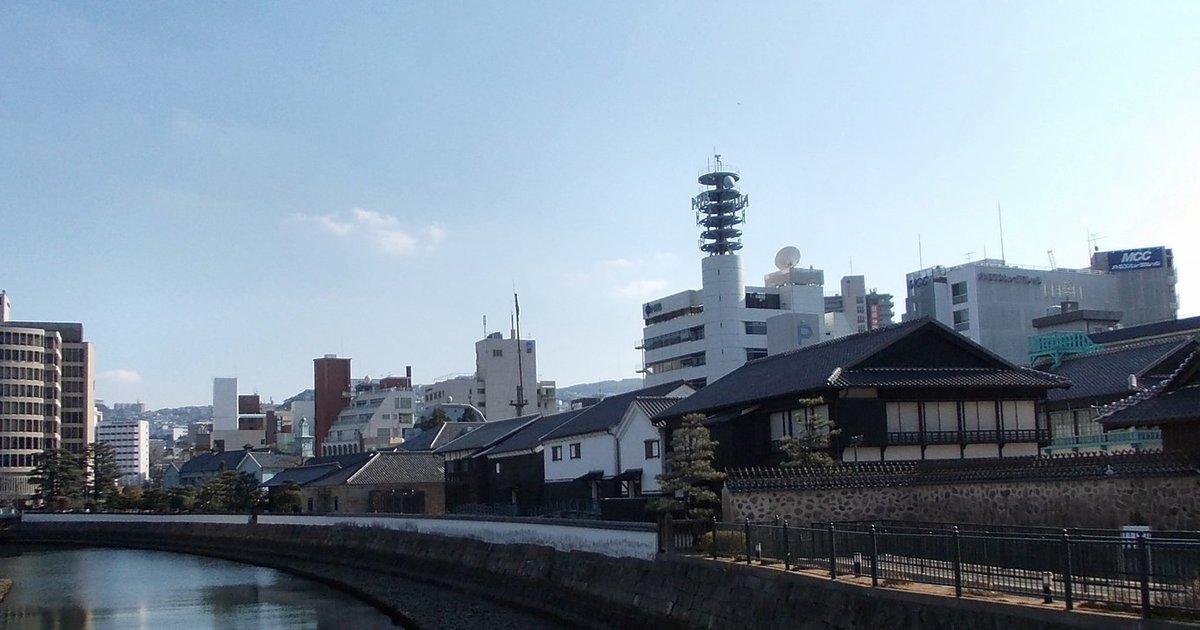
Why did Nagasaki stage a voyage into the future in 1990 and a walk through its past in 2006?
Abstract
This article compares two recent expositions held in Nagasaki, Japan, in 1990 and 2006. Both expositions responded to structural economic changes related to deindustrialization that prompted reidentifications with the city’s history as a maritime trade hub in early modern Japan. To compare two temporally laced identities that emerged from this turning point, I distinguish each exposition’s dominant chronotope. The 1990 Journey Exposition is characterized by Tabi (Journey)-time, which departs from a distant past to transit through a disappearing present towards a utopian future where Nagasaki has once again become an international port. The 2006 Saruku Expo is characterized by Saruku (Strolling)-time, which introspectively rediscovers Nagasaki’s local heritage within the present while imagining a changeless future, erasing the temporal divisions formative of Tabi-time. If Tabi-time is national time derived from national expositions, Saruku-time is local time derived from heritage and memory. These chronotopes are characterized by different arrangements of exposition grounds and different mobilities that visitors were expected to perform on their fairgrounds. The Journey Exposition spatially delineated Nagasaki into future and past zones, whereas the Saruku Expo featured a series of wandering strolls that drew no clear temporal boundaries. Visitors in Tabi-time engaged in epic, romantic voyages across national borders, whereas visitors in Saruku-time displaced themselves locally in an inquisitive, slow-paced manner. The article draws from exposition documents like guides and official records as well as a local town magazine to argue that the formal organization of time can be practically utilized for economic and identity-building purposes as well as politically contested between different parties. It also develops recent scholarship in Theory of History such as Hayden White’s concept of the ‘practical past’ and recent theorizations on the disorder of postmodern time.
Keywords
- practical past
- Hayden White
- global history
- heritage
- Japan
- chronotope
- time
- identity
Full text
Scott Ma, “Global History in Two Chronotopes: Time, Identity, and the Practical Past in Nagasaki, Japan, 1990 and 2006,” Rethinking History 27, no. 2 (2023): 312–339, https://doi.org/10.1080/13642529.2023.2206727.
1. Introduction
This article compares the representation of global history in two recent expositions held in Nagasaki, Japan. It considers how the valorization of international and intercultural flows has become popular not only within the historical discipline, but also within popular culture, noting particularly how these popular interpretations of global history are used practically and politically for identity-making purposes. Here, Nagasaki is a prime case study for its unique history as an early modern international port. Founded by Portuguese Jesuits in the sixteenth century, the port city became a Christian hub until the religion was outlawed in the seventeenth century, beginning a period popularly known as sakoku, or ‘closed country’ (cf. Hesselink 2016). Between then and the mid-nineteenth century Meiji Restoration, Nagasaki was the only city in Japan where foreign trade with the Dutch and Chinese was officially authorized by the government, a period during which the city served as a window to European and Chinese learning. After the Restoration, Nagasaki became a foreign settlement and played an integral part in Japan’s industrial revolution (Burke-Gaffney 2009), the industrial heritage of which has recently been recognized as part of a UNESCO World Heritage Site. Though the city’s twentieth-century economy developed primarily through not trade, but tourism, coal mining, and heavy industry, Nagasaki’s maritime past remains an integral part of its urban identity, notably in its postwar rebuilding based on the idea of creating an ‘international cultural city’ (Diehl 2017). As the city deindustrialized, however, tourism became an increasingly important economic sector, causing an identity crisis that an appeal to global history sought to resolve.
To compare two responses to this identity crisis, I use the framework of the Bakhtinian chronotope. Mikhail Bakhtin defines the chronotope as ‘organizing centers for the fundamental narrative events of the novel’ (Bakhtin and Holquist 1981, 250), where ‘time, as it were, thickens, takes on flesh, becomes artistically visible; likewise, space becomes charged and responsive to the movements of time, plot and history’ (84). Each of the two expositions examined exhibits a different chronotope: the 1990 Journey Exposition (Tabi hakurankai) exhibited what I call ‘Tabi-time’, characterized by national, romantic, and rapid time, whereas the 2006 Saruku Expo (Saruku-haku) exhibited what I call ‘Saruku-time’, characterized by local, nostalgic, and slow time. Where Tabi-time voyages between a nostalgic past and a utopian future in which the present is transitory, Saruku-time is a leisurely, winding stroll in which there is no clear distinction between the past, present, and future. Where Tabi-time sought to reinvent Nagasaki’s future as a maritime hub in line with its imagined past legacy, Saruku-time seeks to preserve disappearing traditions as heritage. These organizations of affect, temporality, and space were materialized into each exposition’s fairgrounds, creating certain environments and moods that visitors were expected to experience.
Students of recent scholarship in Theory of History will note how this methodological apparatus joins together two recent bodies of scholarship, firstly on the nature of contemporary time and secondly on the practical, ethical past. This former body of scholarship builds upon Reinhart Koselleck’s theory of historical experience as limited by formal time structures that determine how the unexpected is assimilated into past experience (Koselleck 2004). More recent scholarship has sought to update Koselleck’s work on modern time to describe postmodernity (Hartog 2012; Gumbrecht 2014). One participant in this discussion, for instance, is Aleida Assmann, who writes of a ‘decoupling’ of ‘culture and modernity’ in which although the modern time regime remains relevant in the natural and social sciences, people have turned to other regimes in their ‘lifestyles and cultural orientations’ (Assmann 2020, 226–7). If the modern time regime is defined by a ‘now moment’ that acts as a ‘hiatus’ separating the past from the future (Assmann 2020, 99–100), contemporary time is characterized by either a positive ‘compensation’ of the past through either heritage or a negative ‘memory’ of past traumas (Assmann 2020, 173). My case study offers a concrete example of how this ‘out of joint’ nature of contemporary life, in which different notions of time coexist simultaneously, manifests itself in time, space, and affect. If the Saruku Expo involved both identification with local heritage and sorrow over atomic memory, the event was nevertheless inescapably interwoven with the economic management of City Hall. As my study makes clear, though chronotopes qualitatively differ, they coexist and can make mutual use of each other to fulfill their respective fantasies.
My second inspiration is Hayden White’s final book The Practical Past, where White distinguishes between the ‘historical past’ written by professional historians and the ‘practical past’ used in everyday life. White defines the historical past as a form of literary writing that takes the past as a referent, but which cannot claim to describe the past-in-itself because of natural limitations to the historian’s human capacity and imperfect archive. The practical past, in contrast, shares with professional history its reference to the past and its narrative form, while differing in the facticity of its content and its avowedly practical use. As in the case of a historical fiction, the practical past may intend to describe the same past as the historical one, and even symbolize a past era as successfully as historians. Oftentimes, these practical pasts also provide moral models and lessons for the present day, a function usually seen by professional historians as either taboo or irrelevant to the principal goal of objective description (White 2014). Later interpreters have seen the upshot of White’s collective work as advocating for a ‘liberation’ historiography that would relieve peoples of the ‘burden of history’ by showing them their existential capacity to ‘choose’ their own past (Domanska 2014; Paul 2011; Doran 2013). Such a historiography would premise itself upon a recognition of the insufficiency of not only the purely historical past, but also the purely practical.
My article advances through three side-by-side comparisons of the Journey Exposition and the Saruku Expo, showing how time regimes, analyzed through their respective chronotopes, have been practically used by Nagasaki’s officials and citizens to reckon with deindustrialization. It examines how temporality has a multitude of different aspects: political, ethical, material, imaginary, and even economic. The first comparison contrasts the abstract chronotopes of Tabi-time and Saruku-time, focusing on the organizing themes of the two expositions. It also doubles as an introductory primer to Nagasaki’s recent history. The second contrasts what I call the ‘affective mobilities’ of each exposition, that is, the affectively engaged ways in which participants were expected to move through the exposition grounds. The last contrasts how each exposition interpreted the atomic bombing of 1945, what White would call a traumatic ‘modernist event’. The conclusion summarizes my argument before returning to discuss the historiological implications of White’s practical past.
2. Time, National/Local and Progressive/Heritage: Two Chronotopes for Nagasaki
2.1. National Time at the Journey Exposition
Tabi-time is national time, in which Nagasaki serves as a stage on which Japan’s history is played out. Nagasaki’s past and its historical monuments are only understood insofar as they sustain a narrative that takes for granted the homogeneity of ‘Japanese’ tradition. Tabi-time is heroic, fast-paced, and future-oriented. It connects the past to the future while transiting through the present, similar to how Reinhart Koselleck describes the separation of experience and expectation in modern time (Koselleck 2004). It is furthermore affectively unique in comparison to Saruku-time, such that the visitor takes a romantic to a distant Other, whether a foreign country or a nostalgic past (Lowenthal 2013). As Marilyn Ivy writes, tabi in its contemporary manifestation is an image of the old and traditional, with a ‘departure and a return, a separation from “home” and a reincorporation . . . A word appropriate for describing the journeys of Japan’s famous spiritual poet-travelers, the monk Saigyō and the haiku master Bashō’ (Ivy 1995, 37). In Tabi-time, the spiritual ‘departure and return’ to the traditional are mapped onto the memory of international commerce in Nagasaki’s history, such that Nagasaki is seen as a stage for tabi rather than a subject in and of itself.
Tabi-time emerged from an identification with a desirable image of an advanced, international Japanese nation as presented during Japan’s high-growth period. According to its own post-event records, the Journey Exposition originated from two policies developed within Nagasaki Prefecture. One was an interest in Sakaiya Taichi’s (1935– 2019) idea of an ‘event-oriented policy’ (NTK 1991, 145). A former bureaucrat turned novelist and exposition producer, Sakaiya is known for his role in organizing the Expo ’70 Osaka. Sixty-four million visitors, 97% of whom were Japanese, visited this Expo, which, along with the 1964 Tokyo Olympics, symbolized Japan’s return to the international stage as a country recovered from the Second World War (Wilson 2012, 161). The 1970 Expo shared many similarities with the Journey Exposition. This included a silence towards the atomic bomb (165), the portrayal of Japan (or Nagasaki) as a meeting point between West and East (169), and confidence in scientific progress (167). The connections between the Expo and urban planning are furthermore explicit. As William Gardner writes, the Expo presented ‘a “science fiction” of the future city as a bureaucratically managed “information society”’ (Gardner 2011, 37).
Such a society would be precisely what Nagasaki Prefecture proposed through the ‘Nagasaki Urban Renaissance 2001’ (NUR) plan, the second policy from which the Journey Exposition originated.1 The Renaissance would redevelop the prefectural capital’s harbor district, and the Exposition would appeal to both municipal and national citizens as its ‘starting project’ (NTK 1991, 145). A document published by Nagasaki Prefecture in 1986 writes that the Renaissance should transform Nagasaki into an ‘information hub city’ or a ‘convention city’ that would involve a departure from primary industries like fisheries and shipbuilding into an ‘information’-oriented tertiary sector (Nagasaki Prefecture 1986, 11, 3). In this imagined city, ‘convention industries’ such as tourism, media, and shipping would gather people, goods, information, and money from outside Nagasaki into the city (15–16). The authors are careful to clarify that a ‘convention city’ is not a ‘tourist city’, which would not ‘collect and disseminate information’ (18).
Reflecting this vision, the concept ‘journey’ (tabi) at the Journey Exposition referred not only to abstract ideas of voyage, but also a particular historiographical interpretation of Nagasaki’s past and its consequences for the future. As the official exposition record writes:
Nagasaki Prefecture has in the past taken in culture that has traveled (tabi) to it, regardless of whether it originated from East or West of the ocean; additionally, it has welcomed many great figures who voyaged (tabi) from all over Japan out of a desire to receive Western culture . . . Even today, we inherit what was produced at that time, and are welcoming many travelers (tabito); and in the future, a vision of Nagasaki based on the idea of a ‘convention city’ (a core city for the exchange of information) is unfolding. In this sense, Nagasaki is a city that rises, flourishes, and walks alongside tabi, and as a main theme to advocate for an exposition befitting of Nagasaki, tabi is the most suitable.
(NTK 1991, 146)
Here, the authors begin by describing two forms of early modern tabi. Firstly, tabi is performed by foreigners from both Asia and the West to Nagasaki; secondly, tabi is enacted by Japanese who travel from all over Japan to Nagasaki, to learn from Western culture. This early modern history is used to provide a basis for the reorientation of Nagasaki’s economy towards that of a ‘convention city’ in the twenty-first century, even as the historical context of Nagasaki in the globalized world has differed substantially. The notion of tabi and the chronotope of Tabi-time are used practically to argue that a major urban development project predicated on significant change is in fact a ‘renaissance’, that is, the rediscovery of an urban identity that Nagasaki possessed all along.
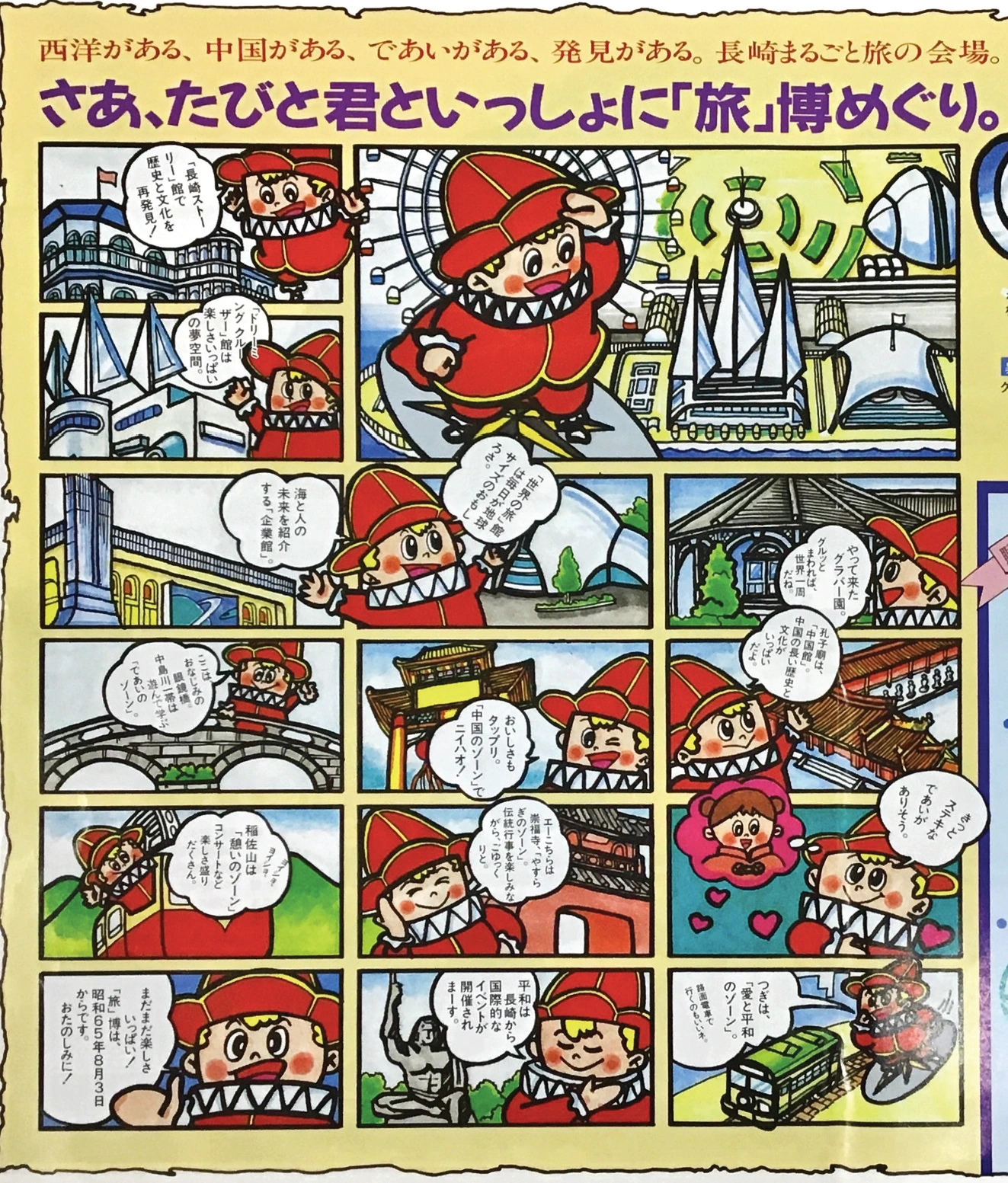
The notions of tabi and the ‘convention city’ were pervasive in the event themes and merchandise. The exposition’s sub-theme was ‘Ocean, Heart, 2001’: ‘Ocean’ to represent what had brought and would bring fortune to Nagasaki; ‘Heart’ to represent the cosmopolitan hospitality of Nagasaki’s citizens; and ‘2001’ to represent this future itself, in the form of the coming millennium (NTK 1991, 146). In other words, the exposition imagines a past-future in which foreigners cross the ocean and are welcomed by Nagasaki’s hospitable citizens, in which the present is fleeting. The exposition mascot also played on these historical tropes: Tabito was a boy holding a telescope while standing on top of a compass, modeled after an early modern Portuguese traveler (see Figure 1). Lastly, to advertise the event, prominent artist Nagaoka Shūsei designed three posters depicting Nagasaki’s past, present, and future through the images of three women: a Japanese Christian, a Western woman in evening dress, and a veiled woman in science-fiction style. Here we see a clear division between a nostalgic past, a fashionable present, and a utopian future, such that the past is distant, the future is unknowable, and the present is in a state of permanent change.
The remembrance of Nagasaki’s premodern history as a basis for the future is selective, in that it elides over Nagasaki’s post-Meiji history, characterized by the decline of merchant trade and the tragedy of World War II. Though this positive evaluation of Nagasaki’s global history reflects ideological assumptions, it is likely that organizers were not in denial of this past, but rather simply felt no obligation to remember all of it at the Journey Exposition. For the narrators of the Journey Exposition’s story, this uninteresting past served no practical purpose. As we will see, this contrasts with the Saruku Exposition, in which the invisible traces of memory overflow from the past into the present, rather than being selectively chosen by those leading the city forward today.
2.2. Local Time at the Saruku Expo
In Saruku-time, Nagasaki becomes a subject in itself that is distinct from Japan. Where Tabi-time recounts global history by looking at how Japan and foreign countries congregated at the site of Nagasaki, Saruku-time recounts the same history by turning internally to observe how it has left scars and traces within Nagasaki’s present. The chronotope proposes a radically different temporal regime: no longer is the past selectively remembered by present actors to further future goals, but rather, the past overflows into the present and imposes upon citizens the duty to remember. If Tabi-time involves a departure from home, Saruku-time never leaves; if Tabi-time is a romantic epic, Saruku-time is easygoing and even traumatic. There is a continuity between past, present, and future in the Saruku that is not found in the Journey Exposition. This connection is made through the belief that the heritage of the past must be preserved in the present so that it may continue to exist for future generations. If Tabi-time made use of abstract concepts like tabi to create a cohesive narrative that accounts for historical change, Saruku-time looks towards the particular rather than the universal, material rather than the ideal, seeking to identify and preserve what is culturally unique to Nagasaki in contrast to the rest of Japan.
Saruku-time likely dates back as early as Tabi-time, but only in the late twentieth century did municipal politicians begin to identify with its chronotope. Though the idea of public memory, or kioku, became prominent only in the 1990s, much of what is remembered derives from private memories formerly excluded from the public sphere (Diehl 2017, 5). If this rediscovery of memory is one part empathy, however, it also had strong political and economic rationales. The NUR ultimately lived up to neither its promised infrastructure projects nor its claim to reinvigorate Nagasaki’s economy. Seen from today, the NUR can be seen as a partial success, manifesting itself in land reclamation, a seaside park, a prefectural art museum, and commercial complexes like the ‘Dejima Wharf’ and the ‘Dream Town’. Its development was hardly smooth, however. Plans to build hotels and an international convention center soured after the collapse of the economic bubble. Though the authorities went forward with land reclamation, they had left land use primarily to private developers, who failed to concretize plans and eventually bailed following the economic downturn (Nikkei, 9 April 1993). Small businesses also protested, fearing losing clients to department stores, whereas citizens expressed concern about redevelopment’s effects on the environment and scenery (Nikkei, 15 January 1993). One local commentator described the NUR as a ‘typical product of the economic bubble era’ created by Tokyo consultants giving cookie-cutter advice to local leaders ‘drunk on dreams’ (Mainichi Shimbun, 28 October 2000).
In December 1999, the Nagasaki Chamber of Commerce and Industry set up a working group to reconsider the NUR, spending the following four months gathering opinions on how to best revitalize the port district. Among these ideas was the creation of a ‘Strolling Route’ to capitalize on contents tourism related to Nakanishi Rei’s popular 1999 historical fiction Ballad of a Nagasaki Stroll (Nagasaki burabura-bushi) (Nakanishi 1999). The Chamber formally presented this ‘Nagasaki Strolling Strategy’ (burabura sakusen) to the City of Nagasaki in May 2000 (Mainichi Shimbun, 19 May 2000). By September, the tourism bureau had already created four walking routes around Maruyama, where Nakanishi’s novel takes place, with the courses averaging two kilometers and introducing visitors to over seventy locations (Mainichi Shimbun, 25 September 2000). The Saruku Expo’s official record dates its origins several years later to a ‘Nagasaki Tourism 2006 Action Plan’, established in February 2004 to reverse falling tourist numbers (Nikkei, 21 January 2004). In August 2004, the committee charged with advancing this plan renamed itself to the ‘Nagasaki Saruku Expo’06 Promotion Committee’ (NSS 2007, 4). The Saruku Expo was advertised as a paradigm shift in tourism for the central role of local volunteers, who would plan, operate, and lead its walks (Nikkei, 12 June 2004).
This shift of identification by local politicians away from the nation-state and towards its local citizens finds parallels throughout the rest of Japan. It originates from a collapse of older forms of public protest and a shift to activism over daily life after the failure of the Anpo protests (Kapur 2018, 174). As historian Jordan Sand notes, the closure of ‘monumental public space’ around 1970 (Sand 2013, 23) marked the development of a new public history of everyday life grounded upon the idea of ‘“heritage” as historical identity’ (114). Similarly, Timothy George writes of how in the 1990s, a newly elected mayor of Minamata ‘rebuilt’ his village by confronting its history of environmental pollution head-on (George 2012, 41). Japan’s ‘Lost Decades’ following the economic crash only accelerated this introspective turn, as nostalgia for the bygone Shōwa period (1926–1989) became a memory of hope and collective unity to be recalled into the less optimistic present (Leheny 2022). This perceived lack of national unity is mirrored by a reidentification with the local as the site of personal belonging.
As the time of heritage, Saruku-time denotes the strangeness of Nagasaki itself rather than its identification with the nation. The word ‘Saruku’ itself is not standard Japanese, but Nagasaki dialect, translating to a ‘leisurely walk’. The local customs, traditions, and citizens of Nagasaki were repeatedly brought to the forefront. Visitors could choose between 42 thematized walking tours around the city, with or without a local guide. They could also participate in a large number of educational experiences, such as listening to lectures by local scholars and participating in hands-on activities such as sampling traditional foods. Twenty-four rest stations gave walkers opportunities to meet with locals while taking a break, and local artisanship was exhibited at nineteen kenbunkan, where visitors could chat with and understand the work of these craftsmen. The sites included stores, restaurants, and museums that showcased local products such as incense, kites, and gourmet like champon and castella.
Indeed, the Saruku was advertised as the ‘experience of a Japanese-Chinese-Western city (wa-ka-ran machi)’ (NSS 2007). If the Journey Exposition saw exotic nations congregate at Nagasaki, the selling point of the Saruku was the discovery of the strangeness of Nagasaki itself, as a city that was not quite Japanese.
Saruku-time is the time of heritage, and calls forth a different attitude towards the past: an attention to detail rather than abstraction, and a belief that identity is built upon temporal things like local festivals, crafts, and foods rather than transcendental ideals like international peace. Saruku-time cares little about Japan and even less about foreign countries. It holds not the grandiose vision in which Nagasaki becomes a maritime core city, but rather the somewhat banal hope that the Saruku Expo will help citizens preserve Nagasaki’s current form for future generations, by increasing tourist numbers and promoting citizen activism. As Mayor Itoh Iccho wrote, Nagasaki’s heritage was a raw ‘mountain of jewels’ that citizens needed to ‘dig up, polish, and make shine’ to pass on to future generations and tourists (Nagasaki keizai, April 2006, 8). This ‘polishing’ of what had been immanent in Nagasaki all along, yet which had never been recognized as valuable rediscovers local identity while commodifying its culture.
2.3. A Comparison of Chronotopes
This article argues that these two chronotopes are both practical uses of global history and the sites of political contestation between visions of Nagasaki as a part of the Japanese nation and as a subject for itself. Where Tabi-time is closer to the heroic time of the nation-state, Saruku-time is more closely related to the slow-paced, local time of postindustrial Nagasaki, which sees the future as a continuity of heritage rather than a space for radical change. This conflict between Tabi-time and Saruku-time can be seen in a 4 January 1991 article in The Nagasaki, a fortnightly town paper that regularly covered local gossip, news, and events. This article, however, published in the first issue the year after the Journey Exposition, struck a rare, serious tone in a feature titled ‘What is to be done, Nagasaki?’
Featuring a conversation between the editorial department and the editor-in-chief, Tajima Kenji, the feature commented on problems such as the shrinking population, decline of traditional industries, lack of cultural facilities, and whether Nagasaki could really become a new economic hub in Asia. The article concluded on a somber, if poetic, note:
Owing to the pretext of ‘peace’
With the smell of rotting money
Nagasaki, covered with defects
What is to be done from now on?
The editors of The Nagasaki do not believe a peripheral city like Nagasaki could actually become a maritime convention city. Perhaps the quips about the ‘pretext of “peace”’ and the ‘smell of rotting money’ are indirect critiques of the exposition, which uses Nagasaki’s ‘peaceful’ history of international cooperation to mask purely financial motivations. Saruku-time is one alternative to Tabi-time’s ideological use of the past, namely, its selective choosing of past events to legitimate grandiose future goals, while ignoring the immediate needs of the present.
Though the Saruku Expo explicitly proposed an alternative style of tourism to that of the Journey Exposition, there is strangely virtually no reference to the earlier event in documents ranging from the event’s planning to its post-event recollection. This conspicuous absence may be caused by normal processes of forgetting; but it may also be the result of an unwillingness to remember. The Journey Exposition, after all, was tainted by the NUR, generally recognized to have been a failure. Documents left by the Saruku Expo referred to the Journey Exposition implicitly, but never by name. In an interview, Matsufuji Satoru, president of the Nagasaki Chamber of Commerce and the Saruku Promotion Committee, for instance, says that the Saruku Exposition is ‘a useful mechanism’ for developing, among citizens, ‘a consciousness that Nagasaki is a tourist city’ (NSS 2005, 45). This open admission of the centrality of tourism to Nagasaki’s identity opposes, consciously or not, the municipality’s earlier plan to convince citizens to recognize themselves as belonging to a ‘convention city’.
Indeed, though the editors of The Nagasaki may have lambasted how Nagasaki smelled ‘of rotting money’, the Saruku Expo was nothing if not financially motivated, even despite its valorization of citizen participation and cultural pride. To what degree can the chronotope truly be considered as a victory for local memory? In their evolving relationships to time, citizens of Nagasaki remembered and forgot different ways of imagining their city. In the next section, we will explore how the erasure and non-erasure of temporal divisions affected the affectively-informed mobilities experienced by visitors at each exposition.
3. Space, Romantic/Pensive and Fast/Slow: Affective Mobilities in the Exposition Grounds
3.1. Rapid, Romantic, and International Mobility at the Journey Exposition
If the Journey Exposition was built around a chronotope that emphasized the disconnect between past, present, and future, the affectively-influenced mobilities with which visitors were expected to traverse the fairgrounds reflected a spatialization of this temporal organization. The main fairgrounds were located at Matsugae, a cruise ship terminal located in the harbor and at some distance from the city, and serve as an example of this affectively and temporally laced mobility. Matsugae featured industry pavilions, an event stage, and the Sky Tower, an observation tower that let visitors take a panoramic view of the city. Industry pavilions included Mitsubishi’s ‘Future Pavilion’, which screened an original 3D animation by Matsumoto Reiji telling the story of two young men, living in the distant future, who travel from a space colony to their ancestral Nagasaki to witness the city’s future development (Miraikan 1990). Also present was the Hitachi Pavilion, where a magical genie in Middle Eastern dress named Pinto took visitors on a ‘wondrous journey’ into a ‘dream world’ mediated by the company’s new 4D vision technology (Hitachi gurūpu-kan 1990). These and other pavilions made little reference to Nagasaki’s past, advertising instead fast travel, sensual excitement, and ultra-modern technologies.
In contrast to the central area of Matsugae was a reconstruction of a portion of Dejima, the long-disappeared Dutch trading port in early modern Nagasaki. This island was attached to the terminal by connecting bridge and known as the ‘Nagasaki Story Pavilion’. Visitors could ‘time slip’ from the future embodied in Matsugae to the past represented by Dejima, which featured reconstructions of a chapel with stained-glass windows and a kapitan‘s room to represent Portuguese and Dutch merchants respectively. Another building housed exhibits on the city’s modern history, including the scenery of the Yamate foreign settlement; life-sized dolls of figures including Kusumoto One (1827–1903), Japan’s first female doctor; and photos and models illustrating the history of Mitsubishi’s shipbuilding industry (NTK 1991, 175). There was also a ‘Time Tour with Everyone Pavilion’ in which visitors could compare two visions of Nagasaki, one from the Edo period (1603–1867) and another in an imagined future, both bustling centers of maritime trade (NTK 1991, 174–6). The future, represented in Matsugae, is contrasted with a past located in the Dejima annex, a distinction visitors would have experienced through a nostalgic ‘time slip’. At the same time, the linear historical time progressing from Nagasaki’s Portuguese roots through its modernization into the present concludes with the exact same future as Matsugae, such that the historical excursion represents a period of movement rather than stasis, imperfection rather than plenitude.
The movement between the port terminal of Matsugae and Nagasaki proper is characterized by a similar affective mobility. Nagasaki was divided into two secondary fairgrounds and seven thematized zones: Foreign (West), Foreign (China), Bustling, Tranquil, Romantic Encounter, Love & Peace, and Restful. The two secondary fairgrounds, the Glover Garden, a collection of foreign settlement-era buildings, and the Confucius Temple, overlapped with the Foreign (West) and Foreign (China) zones respectively. Most zones were thematized around a particular aspect of Nagasaki’s past, generally contributing to the theme of international cultural exchange. The Tranquil Zone, for example, called on visitors to take ‘a brief moment of rest’ while thinking of how Japan and China ‘lived together’ at Nagasaki (NTK 1991, 190). Like the relationship between Massage and Dejima, the visitor engages in differentiating, affective tabi from the futurity embodied by the fairground in Matsugae to the nostalgic past in Nagasaki. This is best shown by a comic featuring the mascot Tabito that suggests how the visitors were expected to experience the event (Figure 1). In each frame, Tabito performs tabi to different zones or pavilions. He begins at Matsugae, where at the Dejima annex, Tabito ‘rediscovers’ Nagasaki’s history and culture, and in the main area, he visits an industry pavilion teaching him about humanity’s future with the ocean. He then moves on to different urban zones, enjoying Chinese food in the China Zone and dreaming of romance at the Romantic Encounter Zone, before ending at the Love & Peace Zone. This whirlwind of fast-moving tabi begins and ends with a universalist sentiment, whether embodied in technological utopia or world peace.
At the Journey Exposition, Nagasaki became a metonym for the universe of nations, whose national characteristics are reproduced throughout Nagasaki’s various zones. Nowhere is this more apparent in Glover Garden, a collection of historic buildings in the former foreign settlement. Each building was transformed into a national pavilion, showcasing France, Britain, the United States, and the Soviet Union. The France Pavilion, for example, was composed of two rooms, one showcasing 19th and 20th century French couture and another featuring Art Nouveau glassware. The British Pavilion held a recreation of an English pub and a Victorian room, whereas the American pavilion featured record players and movies from the early twentieth century (NTK 1991, 182). Like movement from Matsugae to Dejima or the city zones, visitors to the Glover Garden could go on tabi to a nostalgic, foreign past. This voyage was at the same time representative of Nagasaki’s global history and largely unrelated to the actual facts of Nagasaki’s past as a trading port. In short, at the Journey Exposition, a representation of Nagasaki’s former role as a place where foreign countries congregated is used as a practical tool to orient the city’s future, but in a way that treats empirical content as holding secondary importance.
Tabi-time can be understood as a relative of Bakhtin’s adventure-time, whose origins he locates in classical Greek romance. Adventure-time is characterized by two points of time separated by an ‘extra temporal hiatus’ of ‘empty time’ (Bakhtin and Holquist 1981, 91). Between these two definitive moments of beginning and end, the plot develops through a combination of chance, fate, and prophecy; these ‘nonhuman forces [. . .] take all the initiative’ (Bakhtin and Holquist 1981, 95). As Bakhtin writes, the seventeenth-century appropriation of this chronotope integrates the ambition to settle ‘historical destinies’ to this extratemporal space (Bakhtin and Holquist 1981, 96). Like these early modern novels of which Bakhtin writes, the narrative of Tabi-time connects between two differential, temporally distinct periods of time through an adventure within a third space. If the visitor begins in the unremarkable world of everyday Nagasaki, she is taught that the city’s end goal is a flourishing international city, a goal prophesied by visions of its past. The particularities of the various epic travails that the city undergoes to fulfill its destiny are unimportant; what matters is the confident assurance that the city will overcome an unlikely fate to become its historical destiny.
Like the Tabi-time’s trip through the exposition’s different zones, furthermore, adventure-time moves through an ‘abstract sense of space’ that is only lightly and never essentially bound to where they take place (Bakhtin and Holquist 1981, 99–100). Similarly, in Tabi-time, zones representing China and the West served primarily as emotional triggers for excitement, calm, and other affects rather than as the bearer of historical details about these countries. These abstract, emotional spaces are dissimilar to adventure-time, however, in the absence of a series of ordeals that the visitor must undergo before reaching its conclusion. There is no discussion in the Journey Exposition of the substantial barriers Nagasaki would face before becoming a convention city; rather, in Tabi-time, the element of nostalgia is strong, nostalgia that presents the narrative’s closure as all but assured. If the visitor to Tabi-time embarks on adventure, it is a light-hearted adventure without any serious challenge.
3.2. Slow, Pensive, and Introspective Movement at the Saruku Exposition
Where Tabi-time is fast-paced, exciting, and national, Saruku-time is slow-paced, inquisitive, and local. Though participants were given a choice between guided and independent tours, the vast majority of participants chose the latter. According to post-event data, the 7.1 million self-guided tours accounted for nearly all participants in the exposition (NSS 2007, 42). Each of the 42 tours were structured around a different theme, and though the themes and tour locations varied significantly, all followed a similar form of mobility. A map would display a pre-planned route around the city that included a start point, end point, and any number of stops in between. Each stop generally featured a site of some historic or aesthetic significance, at which the walker would stop and read the description provided on the guide map. The maps themselves were designed in a lighthearted manner, sometimes featuring hand-drawn cartoons or pointing out local curiosities.
A popular route titled ‘Where even literati and artists pondered?’, which took walkers through the former red-light district of Maruyama, will serve as a fine example (Figure 2). Maruyama was unique among Japanese pleasure quarters as it was originally built to service foreign clients, with only a minority of courtesans catering to Japanese (Miyamoto 1984, 20). These courtesans were among the few Japanese permitted to enter the gated communities built to house Chinese and Dutch traders, resulting in predictable difficulties such as illegal trade and care for mixed-blood children. Maruyama declined after the Second World War, but enjoyed a rebirth of interest after the publication of Nakanishi’s novel, which inspired the 2000 tours that likely became the basis of the later Saruku. In Nakanishi’s story, Aihachi (1874–1933), a Maruyama geisha, and Koga Jūjirō (1879–1954), a founding scholar of Nagasaki’s local history, embark on a search for Nagasaki’s old songs, upon which they come across the almost-forgotten folk song burabura bushi. Both the characters and the song itself exist in reality, and there exists a recording of Aihachi singing the burabura bushi from 1931. Nakanishi’s novel received the prestigious Naoki Prize in 1999 and premiered as a movie in 2000, a television drama in 2001, and a theatre piece in the same year.
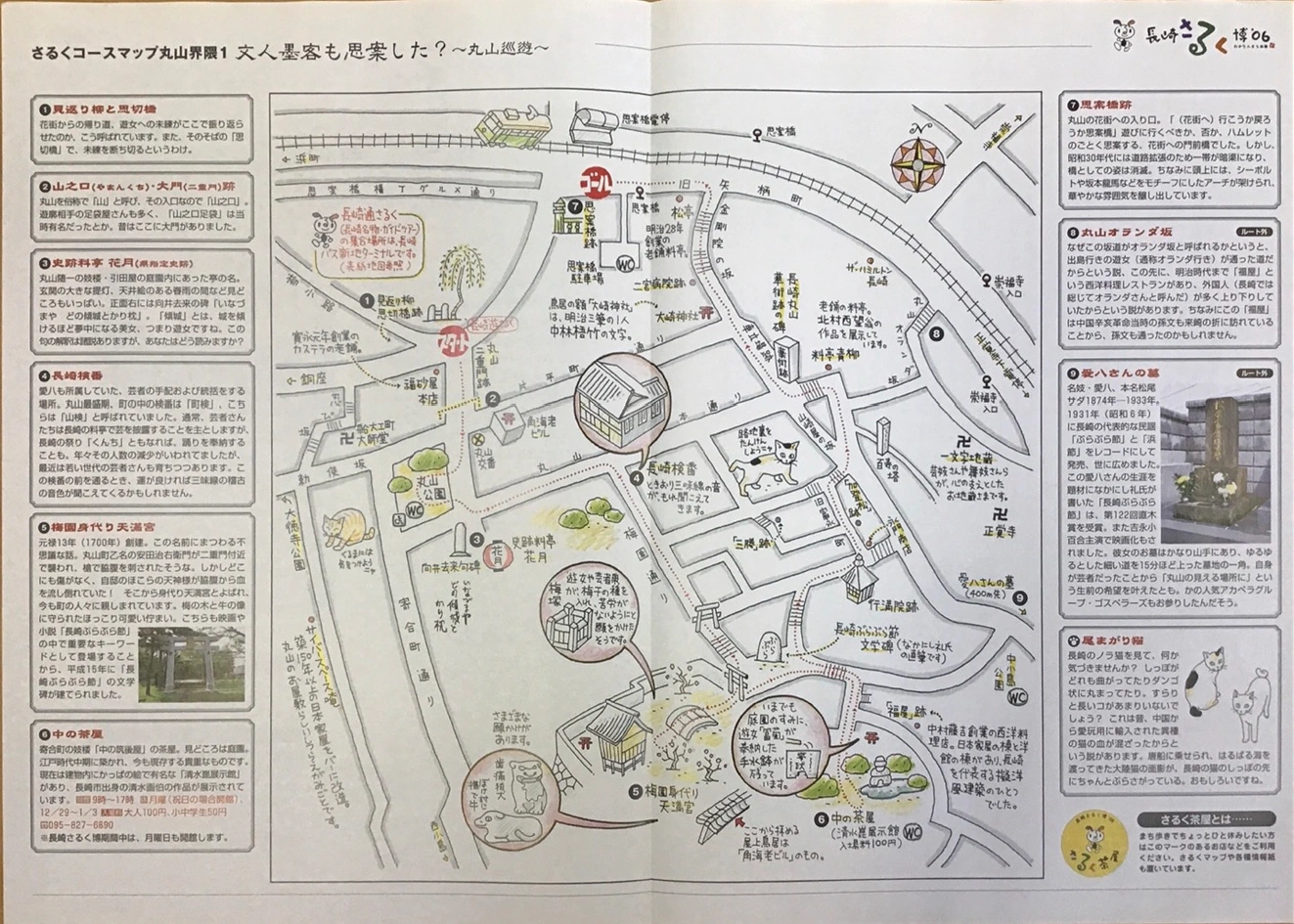
Though Ballad of a Nagasaki Stroll was a fictional work, elements of the novel were incorporated into the Saruku walk. The route overview asked walkers to ‘aimlessly wander through the narrow alleyways, old stone pavement while humming to themselves the famous song burabura bushi’. Consistent with the mobility of a stroll, the map also included useful information such as walk duration, guide stations near the route, and an estimate for calories burnt. The map was hand-drawn and mapped nine main historical sites in Maruyama. At each site, visitors could stop and read a description of its significance. Local trivia unrelated to these main sites were also scattered around the map. A tablet that adorned the Shinto gate at Ōsaki Shrine, the map notes, was written by famous Meiji calligrapher Nakabayashi Gochiku; in the corner of the garden of another shrine, visitors could see a water bowl once offered by a courtesan named Tomikiku. The leisurely, attentive walk of Saruku-time allows for an attention to historical detail not found in Tabi-time’s fast-paced, national movement.
Of the nine stop points, seven connected to form a looping circle through Maruyama and two were located outside this route. The route begins at the ‘Looking-back Willow’ and the relics of the ‘Bridge of Forgetting’, where men leaving Maruyama would look back with lingering attachment that they let go of before returning home. They then stopped to ponder at the site where the entrance to the quarters once stood. Other stops included a historical restaurant, the geisha call-office, a Shinto shrine, and a teahouse. The shrine, the map notes, was featured in Nakanishi’s Ballad of a Nagasaki Stroll and a stele had been built within it to celebrate the novel. The last stop was the former site of the ‘Bridge of Consideration’, a bridge marking the entrance to Maruyama but which had been demolished in 1955. There, visitors to the district once wavered between entering or returning home. The two additional stops on the map were the Hollander Slope and Aihachi’s tombstone, both located within walking distance. As participants strolled through the neighborhood, the map also called on them to observe the twisted tails on stray cats in Nagasaki. One theory, it writes, has that this is the result of a mixing of blood with cats from China (NSS 2006, 26–7).
Saruku-time finds resonances with what Bakhtin calls ‘biographical and everyday time’, characterized by the cyclic repetition of everyday events with ‘no advancing historical movement’. It is ‘simple, crude, material, fused with the everyday details of specific locales’ with ‘no “meetings”, no “partings”’, a ‘viscous and sticky time that drags itself slowly through space’ (Bakhtin and Holquist 1981, 247–8). Like the provincial novels of which Bakhtin writes, Saruku-time depicts Nagasaki not as the future center of Japan, but as a forlorn, even idyllic countryside that, left behind from economic advancement, comes to exist only via a nostalgia for what is left behind. There are also significant differences between Saruku-time and Bakhtin’s everyday time, however. Someone living in Saruku-time is not a passive figure engrossed in mundane affairs, but rather an active municipal citizen passionate about learning and teaching others about local history, preferably with the further goal of economic recovery. Furthermore, though hardly with the speed of Tabi-time, Saruku-time does valorize movement, and though this movement is not Tabi-time’s international adventure, Saruku-time does take pride in being not-quite-local, of discovering the foreign within one’s own hometown.
3.3. Tabi-time and Saruku-time in Dialectic Relationship
As Bakhtin wrote, chronotopes are ’dialogical (in the broadest sense of the word)’: they can be ‘mutually inclusive, they co-exist, they may be interwoven with, replace or oppose one another’ (Bakhtin and Holquist 1981, 252). If Tabi-time and Saruku-time were the dominant chronotopes of the Journey Exposition and the Saruku Expo respectively, this dominance does not preclude their coexistence. At the Journey Exposition, visitors were encouraged to take walking tours around Nagasaki’s historical monuments, and there is an entire section of the official guidebook dedicated to showing visitors the routes they should take. The guidebook recommended that a visitor to the Foreign (West) Zone, for instance, visit important monuments like foreign settlement buildings, the Ōura Cathedral, and the Dutch Slope. At each step, the book explains important events and peoples related to the monument (NTK 1990, 102–5). These leisurely walks were odd fits with the futurism, technology, and adventure that discursively characterized other exposition documents, and suggest the proleptic presence of Saruku-time. It is unclear how many visitors actually completed these tours, as they were clearly not the Journey Exposition’s primary attraction, and in any event, they were framed as evidencing Nagasaki’s international past, which would herald the city’s glorious future. Indeed, where the Saruku Expo would include dozens of crisscrossing walks, the Journey Exposition only created one for each zone, thereby spatially distinguishing different stages of adventure for the traveling voyager. As Bakhtin writes of his adventure-time, considering the narrative’s holistic scope, walks at the Journey Exposition served only as an adventuring hiatus between the dissatisfactory present and the realization of historical destiny.
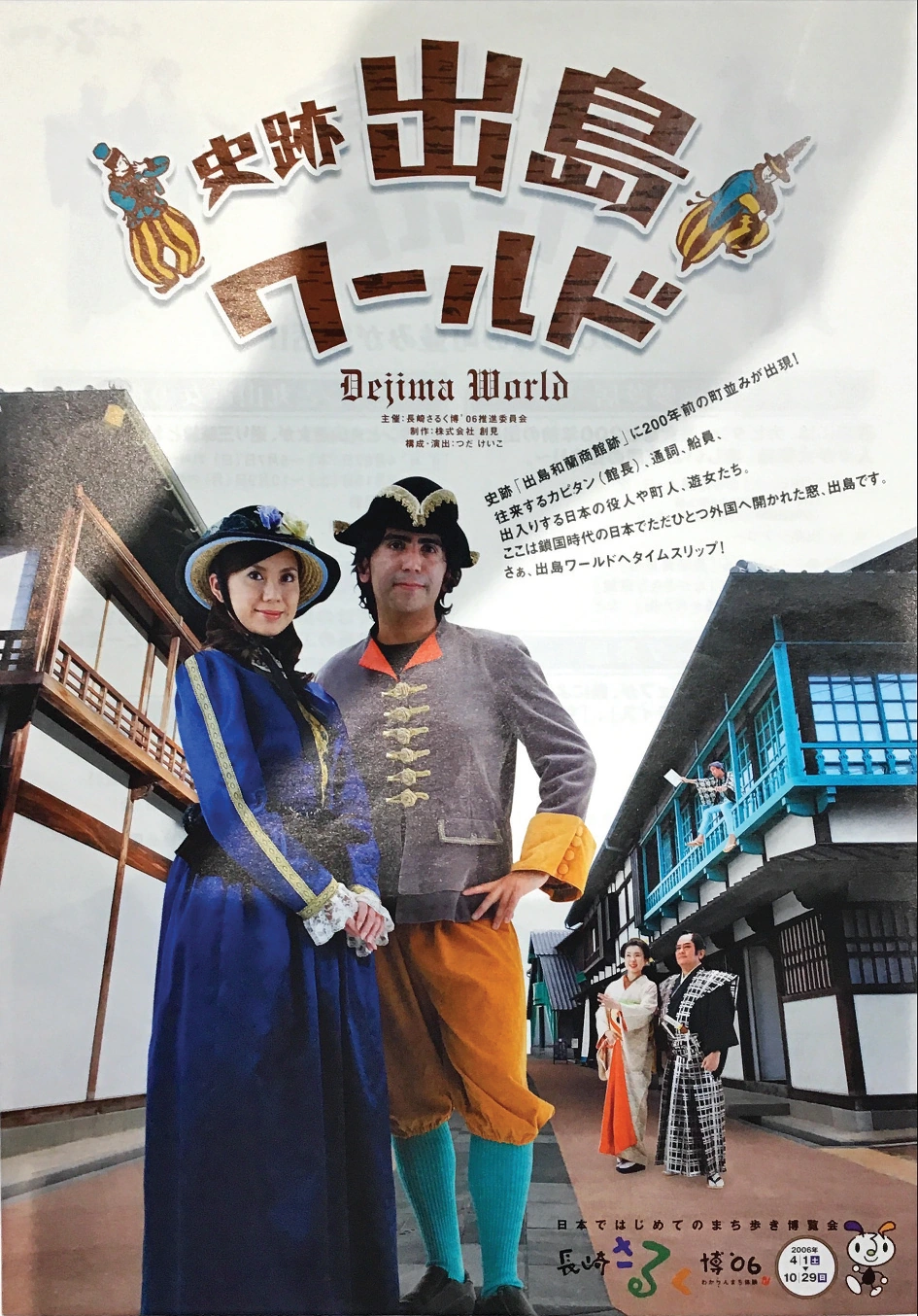
As we have already noted, Saruku-time, inversely, did not break away fully from the influence of Tabi-time. Though guided walks and not fairgrounds would be the Saruku Expo’s centerpiece, the Saruku Expo nevertheless had two minor fairgrounds located at Glover Garden and Dejima called the ‘Glover Garden Fantasia’ and ‘Dejima World’ (Figure 3). Similar to the uses of the Glover Garden and Dejima at the Journey Exposition, these Saruku Expo reproductions let visitors ‘time slip’ into nostalgic historical reproductions of an imaginary past. In Dejima World, for instance, visitors could watch a musical called ‘The Legend of the Discovery of Nagasaki’ and buy tortoiseshell and silver handiworks at an ‘ethnic-style bazaar’ (NSS 2005, 35). There were also substantial differences between the earlier and later reproductions of Dejima, however. If the Journey Exposition’s time slip emphasized its international element, the Saruku Dejima portrayed globalization through the lens of local actors and local heritage. On weekends, Dejima World held a theatrical piece about the relationship between Dutch kapitan and courtesans as well as a ‘Holland Teahouse’ where visitors could feast on not Dutch, but Nagasaki specialties like champon and Turkish rice (NSS n.d.). Nowhere in the Saruku Dejima, furthermore, was there any reference to a radiant future that would provide narrative closure, the fairground instead remaining entirely in the past. Just like the Journey Exposition could include meandering, walking experiences in dialogue with Tabi-time, the Saruku Expo could incorporate dreams of exotic international adventure while remaining true to its local element.
With the nuanced, dialectical relationship of these chronotopes in mind, let us shift to our final comparison, on the narration of the atomic bomb.
4. Case study: Urakami and the Atomic Bomb
One final way to contrast Tabi-time and Saruku-time is by looking at how each deals with trauma. The dropping of the atomic bomb on Nagasaki in 1945 is an example of what Hayden White calls a ‘modernist event’, an occurrence rendered possible only by modern technology such that it cannot easily be assimilated into the ‘normative narrative account’ of our times. Indeed, the imposition of a narrative on such an event at all ‘invites its projected audience to indulge in fantasies of coherence, completion, and fulfillment’ by providing a sense of closure (White 2014, 94). Where the Journey Exposition provides this narrative closure, the Saruku Exposition does not. In the Journey Exposition, the atomic bombing is located as an instance in the larger narrative of Nagasaki’s identity as an international city of peace. In the Saruku Exposition, in contrast, the event itself is given careful attention and even brooded upon as a memory that will not go away. Closure is denied and Saruku-time maintains the past’s continued haunting of the present. The contrast is similar to how Berber Beverage describes the time of nations and the time of victims: for the former, history is used as a tool against memory, whereas for the latter, the past remains in the present as ‘irrevocable’ (Bevernage 2012). In both expositions, the bombing was spatialized at Urakami, ground zero for the tragedy, though in radically different ways.
At the Journey Exposition, Urakami became the ‘Love & Peace Zone’, and represented Nagasaki’s wish for eternal world peace. The zone centered around the Peace Park and the Nagasaki City Peace Hall. The park served primarily as a guide and rest station, whereas the Peace Hall showed exhibits on the first floor and held events such as performances, film screenings, concerts, and symposia on the third. The official record lists three principal events. One was a two-day symposium about Japan’s war responsibility with the themes ‘Foreigner hibakusha and Nagasaki’ and ‘Forced Movement/Labor and Nagasaki’. Ten participants were invited from South Korea, including hibakusha and citizen groups that supported them. Second was a month-long book exhibition which displayed 500 children’s books centered around peace. At 2 pm in the afternoon every day, events such as picture-story shows and book readings took place. Third was a ‘sealing’ of nuclear weapons, which took place continuously throughout the exposition on the first floor of the Peace Hall. Participants wrote their names on model miniatures of nuclear weapons before sealing them within a larger container, and brought home a commemorative certificate afterward (NTK 1991, 207).
These events reflected the heroic, national, and future-oriented nature of Tabi-time. As scholars have noted, the postwar reimagination of Nagasaki as an ‘international Christian city’ represents the atomic victim as a Catholic hero identifiable with the resurgent Japanese nation (Diehl 2017). In the process, the historical presence of figures from Urakami irrelevant to this dominant narrative has been erased, notably that of the buraku, a traditionally discriminated caste in Japanese society (Otsuki 2016). All three primary events are concerned with a universal peace to arrive in the future, rather than Nagasaki’s suffering in World War II. This universal peace is furthermore imagined as one between nations. If the symposium about Japan’s war crimes uses Nagasaki’s local history to critique national narratives that ignore war memory, the idea of collective memory as a nation is not in itself problematized. Though the zone critiqued Japan’s treatment of its colonial subjects, it remains the nation tasked with performing the repenting.
Saruku-time’s treatment of the atomic bomb is radically different, and almost entirely rejects this national narrative. Though similar to Tabi-time in its call to remember the tragedy for future reasons, where Tabi-time sought to invoke in visitors the importance of an abstract concept of ‘peace’, Saruku-time asked participants to empathize with the locals who suffered and continue to suffer from the tragic event. As such, it turns towards the past-present as opposed to the future. Two Saruku walks were themed around the atomic bomb, both held in Urakami. One was simply titled ‘9 August 1945, Nagasaki’ (NSS 2006, 50–1). This walk had visitors walk around the southern area of Urakami, reliving the moment the bomb exploded. The walk began at the ‘11:02 Monument’, a clock marking the time the bomb fell on the neighborhood. The next stop was the Wakazakura Shrine, formerly a residential area within the bomb’s radius. The guide reminds visitors that almost all 8,000 residents died immediately, with the remaining losing all their wealth and suffering from the effects of radiation. Other stops on the journey included a pillar from the front gate of Nagasaki Medical University, which was tilted by winds from the blast; the residence of author Fukuda Sumako (1922– 1974), a hibakusha who died from complications involving radiation; and the one-legged torii at the Sannō Shrine, which had lost its other leg to the blast. The trail concludes at another torii from the shrine that had miraculously survived in whole, but which had been removed during the postwar period, which the guide describes as a ‘pity’. Like the Maruyama tour, ‘9 August 1945’ desired to remember something of which the traces no longer exist. Just as visitors to Maruyama paused at the site of the former gateway to the pleasure quarters, the Saruku’s participants remembered the presence of an invisible torii.
The other walk, ‘Visit the Hill of Angelus’s Bell’, recalls the voices of Christians living in Urakami, particularly the life of Nagai Takashi, famous for his work ‘The Bells of Nagasaki’ (NSS 2006, 48–9). Walkers visited everyday buildings such as shrines, graveyards, and the homes of common victims, stopping at historic relics such as a Buddha statue that survived the event and the Urakami Cathedral, which holds the eponymous bell. The walk began at Ground Zero and concluded with a chapel built in 2005 to hold a sculpture of the Virgin Mary that miraculously survived the blast. Like the former walk, there is a multitude of narrators, most of them normal men and women made exceptional through the modernist event. It is representative of the local, traumatic time of Nagasaki rather than the heroic, national time of Japan. There is no simple, clear narrative that provides a connection from past to future; rather, such a narrative is rejected as incapable of representing the fundamental incomprehensibility of the event, something to which the very act of comprehension would mean betrayal. Its memory is nevertheless selective: absent are references to foreign laborers, buraku, or locals’ employment for the Mitsubishi factories that underpinned its economy. This absence suggests that though local voices and repressed memories overflow Nagasaki in Saruku-time, there are nevertheless limits to memory in that which one does not even remember to have forgotten. Though Saruku-time is more considerate towards local voices than Tabi-time, it has hardly escaped from the lapses of memory that have characterized the postwar Nagasaki, which have been largely reworked through alternate frames of perception.
5. Conclusion
This article compared two recent expositions held in Nagasaki that tried to salvage the provincial economy from economic instability. In response to an awareness that the city’s traditional manufacturing and shipbuilding industries would not survive the coming century, the 1990 Journey Exposition manifested politicians’ optimism that Nagasaki could become an international trade hub, just like in bygone days. The chronotope of Tabi-time that they imbued into the exposition reflected this hope by encouraging visitors to take high-speed, epic, and international voyages as the future representatives of the Japanese nation. The failure of this plan following over a decade of economic depression and falling tourism revenues led to the 2006 Saruku Expo. This second exposition was more cool-headed, inspiring visitors to take slow, leisurely, and winding walks around local neighborhoods. Saruku-time involved a more careful engagement with local heritage than Tabi-time; where Tabi-time used the past as a springboard into a brighter future, Saruku-time located itself within the past, which was expected to continue into the present and be sustained into the future. Though these two chronotopes were dominant in their respective expositions, each was by no means inexistent in the other, but rather presented themselves in subtler but dialectical tones. That these chronotopes can be described as abstract temporal organizations or cultural exemplars, furthermore, should not take away from their economic element. Both expositions were organized intending to bring wealth into a city either poised to or in the process of decline.
Nagasaki is hardly the only provincial town that has undergone gradual decay over the past half century, though it may be particular in its good fortune to be able to turn to tourism as an alternative resource. Writing about Youngstown, Ohio, for instance, James Rhodes identifies two different perspectives held by those living in the city today. If some emphasize ‘elements of cultural continuity at a time of rapid social and economic change’, municipal officials worried about the city’s run-down image argue for the need for a ‘new identity’ through urban revitalization (Rhodes 2014, 71). These dual visions resonate strongly with Saruku-time and Tabi-time, suggesting similarly divided interests between local citizens and their political representatives. Jennifer Allen’s recent monograph on the contemporary German utopianism offers another fascinating contrast. Allen writes of an emerging notion of utopia among West German grassroots activists that valued not ends, but means, and not defined as the creation of a permanently harmonious state, but rather as a sustainable process whose ‘practices must be both enduring and adaptable’ (Allen 2022, 17). This distinction also parallels the difference between Tabi-time and Saruku-time: where Tabi-time proposed a clear end vision for Nagasaki’s development, Saruku-time did not; inversely, if Saruku-time desired to preserve heritage for the future, Tabi-time desired to reinvent the city anew. Though processes of deindustrialization differ significantly between places, the chronotope here can be useful as a comparative instrument between contexts.
The case of Nagasaki, lastly, has much to teach us about our role as historians. If historians tend to separate their politics and ethics from their professional work, for the citizens of Nagasaki, the narration of history is anything but neutral. If Nagasaki’s politicians respect historians’ empirical work, their interest in history does not limit itself to the factual. History is used at times economically, as in how the Saruku Expo sold heritage; politically, as in how the Journey Exposition advertised the NUR; identity-wise, in response to provincial decline; and ethically, by preserving local stories and role models for the future. The question, as White puts it, is whether historians should settle for their role as guarantors of the historical accuracy, or whether they ought to broaden their subject matter to include the effects of historical production on present life. Perhaps White would acknowledge that this involves a certain nonchalance towards minor empirical inaccuracies and an avowed presentism. He might argue that the best history would be one part practical and one part past, recognizing the conversational movement between the needs of the now and the desire for history’s burden. Even the historical past, after all, is implicitly practical – it is a matter of our willingness to acknowledge it as so.
Notes
- The idea of an ‘urban renaissance’ may derive from Prime Minister Nakasone Yasuhiro’s 1983 ‘urban renaissance’ plan, part of his neoliberalization of urban development. See Edgington 2012, 483. Back to text
Acknowledgement
I thank the staff at NOMURA Co. for welcoming me to their company archives in Osaka, as well as the librarians at the Nagasaki and Nagasaki Prefectural Library for their kind support. At Nagoya University, Nathan Hopson guided the project from start to finish; I also benefited from the advice of Frank Peddie and regular conversations with my peer writing group. Comments from the editors and peer reviewers at Rethinking History also improved my manuscript. An earlier version of this paper was presented in August 2021 at the 12th International Convention of Asia Scholars, Kyoto, Japan.
Disclosure statement
No potential conflict of interest was reported by the author.
Notes on contributor
Scott Ma, formerly Research Student at the School of Humanities, Nagoya University, is presently a Master's student at the Graduate School of Asia-Pacific Studies, Waseda University, Japan. He studies the postwar history of Japan, focusing on education and popular culture. From autumn 2023, he is a doctoral student in History at the University of Zurich, Switzerland.
ORCID
Scott Ma http://orcid.org/0000-0002-1511-1972
References
Allen, Jennifer L. 2022. Sustainable Utopias : The Art and Politics of Hope in Germany. Cambridge, MA: Harvard University Press.
Assmann, Aleida. 2020. Is Time Out of Joint? : On the Rise and Fall of the Modern Time Regime, Translated by Sarah Clift. Ithaca: Cornell University Press.
Bakhtin, M. M., and Michael Holquist. 1981. The Dialogic Imagination : Four Essays. Austin: University of Texas Press.
Bevernage, B. 2012. History, Memory, and State-Sponsored Violence : Time and Justice. New York: Routledge.
Burke-Gaffney, Brian. 2009. Nagasaki : The British Experience, 1854-1945. Folkestone, Kent: Global Oriental.
Diehl, Chad. 2017. Resurrecting Nagasaki : Reconstruction and the Formation of Atomic Narratives. Ithaca: Cornell University Press.
Domanska, Ewa. 2014. “Hayden White and Liberation Historiography.” Rethinking History 19 (4): 640–650. doi:10.1080/13642529.2014.959361.
Doran, Robert. 2013. “Choosing the Past: Hayden White and the Philosophy of History.” In Philosophy of History After Hayden White, edited by Robert Doran, 1–33. London: Bloomsbury Academic.
Edgington, David W. 2012. “Restructuring Japan’s Rustbelt.” Urban Affairs Review 49 (4): 475–524. doi:10.1177/1078087412463537.
Gardner, William O. 2011. “The 1970 Osaka Expo And/As Science Fiction.” Review of Japanese Culture and Society 23: 26–43.
George, Timothy S. 2012. “Furusato-Zukuri: Saving Home Towns by Reinventing Them.” In Japan Since 1945 : From Postwar to Post-Bubble, edited by Christopher Gerteis and Timothy S. George, 27–46. London: Bloomsbury.
Gumbrecht, Hans Ulrich. 2014. Our Broad Present : Time and Contemporary culture, Insurrections: Critical Studies in Religion, Politics, and Culture. New York: Columbia University Press.
Hartog, François. 2012. Régimes d’historicité: Présentisme et expériences du temps. Paris: Seuil.
Hesselink, R. H. 2016. The Dream of Christian Nagasaki : World Trade and the Clash of Cultures, 1560-1640. Jefferson, North Carolina: McFarland & Company, Inc., Publishers.
Hitachi gurūpu-kan. 1990. Pinto No Fushigi ryokō [Pinto’s Wondrous Journey].
Ivy, Marilyn. 1995. Discourses of the Vanishing : Modernity, Phantasm, Japan. Chicago: University of Chicago Press.
Kapur, Nick. 2018. Japan at the Crossroads : Conflict and Compromise After Anpo. Cambridge, Massachusetts: Harvard University Press.
Koselleck, Reinhart. 2004. Futures Past : On the Semantics of Historical Time, Translatedby Keith Tribe. New York: Columbia University Press.
Leheny, David. 2022. “The Loss of Nostalgia, Not the Nostalgia of Loss: Or, What Happens in Heisei Stays in Heisei.” In Japan in the Heisei Era (1989–2019): Multidisciplinary Perspectives, edited by Noriko Murai; Jeff Kingston, and Tina Burrett, 316–327. Abingdon: Routledge.
Lowenthal, David. 2013. The Past is a Foreign Country - Revisited. Revised and updated ed. Cambridge: Cambridge University Press.
Miraikan, Mitsubishi. 1990. “Mysterious Fantasy in Nagasaki.”
Miyamoto, Yukiko. 1984. “Maruyama yūjo no seikatsu: ‘Nagasaki bugyōsho hanketsu kiroku hankachō’ o hūshin to shite [The life of Maruyama courtesans: Focusing on the ‘Record of Judgments and Crimes at the Nagasaki Magistrate’s Office'].” Komazawa shigaku 31: 19–46.
Nagasaki Prefecture. 1986. Nagasaki āban runessansu 2001 kōsō : Nagasaki saisei no kagi : Nagasaki toshin rinkai chitai saikaihatsu kōsō [Nagasaki Urban Renaissance 2001: Key to Nagasaki’s Rebirth: Redevelopment Plan for Nagasaki’s Urban and Waterfront Area]. Nagasaki: Nakasaki-ken.
Nakanishi, Rei. 1999. Nagasaki Burabura Bushi [Ballad of a Nagasaki Stroll]. Tokyo: Bungei Shunjū.
NSS (Nagasaki Saruku-Haku ’06 Suishin Iinkai [Nagasaki Saruku Expo ’06 Promotion Committee]). 2005. Nagasaki Saruku-haku ’06: Kōshiki gaidobukku [Nagasaki Saruku Expo ’06: Official guidebook]. Nagasaki: Nagasaki Saruku-haku ’06 Suishin Iinkai.
NSS (Nagasaki Saruku-Haku ’06 Suishin Iinkai [Nagasaki Saruku Expo ’06 Promotion Committee]). 2006. Nagasaki Saruku mappubukku [Nagasaki Saruku Mapbook]. Nagasaki: Nagasaki Saruku-haku ’06 Suishin Iinkai.
NSS (Nagasaki Saruku-Haku ’06 Suishin Iinkai [Nagasaki Saruku Expo ’06 Promotion Committee]). 2007. Nagasaki Saruku-haku ’06 kirokushū [Nagasaki Saruku Expo ’06 Record Collection]. Nagasaki: Nagasaki Saruku-haku ’06 Suishin Iinkai.
NSS (Nagasaki Saruku-Haku ’06 Suishin Iinkai [Nagasaki Saruku Expo ’06 Promotion Committee]). n.d. Shiseki Dejima Wārudo [Historical Spot, Dejima World].
NTK (Nagasaki Tabi Hakurankai Kyōkai [Nagasaki Journey Exposition Association]). 1990. Kujū Nagasaki Tabi Hakurankai kōshiki gaidobukku: Nagasaki “Tabi” zukan [1990 Journey Exposition Official Guidebook: Nagasaki “Tabi” illustrated reference]. Nagasaki: Nagasaki Tabi Hakurankai Kyōkai.
NTK (Nagasaki Tabi Hakurankai Kyōkai [Nagasaki Journey Exposition Association]). 1991. Kujū Nagasaki Tabi Hakurankai kōshiki Kiroku [1990 Journey Exposition: Official Record]. Nagasaki: Nagasaki Tabi Hakurankai Kyōkai.
NTK (Nagasaki Tabi Hakurankai Kyōkai [Nagasaki Journey Exposition Association]). n.d. “Kujū Nagasaki Tabi Hakurankai [1990 Journey Exposition].” Guide Map and Comic.
Otsuki, Tomoe. 2016. “Reinventing Nagasaki: The Christianization of Nagasaki and the Revival of an Imperial Legacy in Postwar Japan.” Inter-Asia Cultural Studies 17 (3): 395–415. doi:10.1080/14649373.2016.1217631.
Paul, Herman. 2011. Hayden White : The Historical imagination. Cambridge, UK: Polity.
Rhodes, James. 2014. “Youngstown’s ‘Ghost’? Memory, Identity, and Deindustrialization.” International Labor and Working-Class History 84: 55–77. doi:10.1017/s0147547913000343.
Sand, Jordan. 2013. Tokyo Vernacular : Common Spaces, Local Histories, Found Objects. Berkeley: University of California Press.
White, Hayden V. 2014. The Practical Past. Evanston, Illinois: Northwestern University Press.
Wilson, Sandra. 2012. “Exhibiting a New Japan: The Tokyo Olympics of 1964 and Expo ’70 in Osaka*.” Historical Research 85 (227): 159–178. doi:10.1111/j.1468- 2281.2010.00568.x.
