What happens to fiction when a bookmark can land its author a book deal?
Abstract
This article studies the Japanese web novel, which, despite having come to represent a substantial segment of the Japanese market for literature over the course of two decades, remains almost unstudied in English-language academia. To analyze their case, the authors examine in turn the media history of Japanese web novels, the online platforms on which they are written, and the aesthetic elements of its storyworld. The article also closely examines the economic rationale underlying its success within the current Japanese culture industry, allowing a distinction between the auteurist, qualitative judgment characteristic of traditional popular literature and the audience-driven, quantitative judgment characteristic of industry trends following the ascendence of the web novel. It additionally introduces the concept of 1.5-ji sōsaku (1.5次創作) or “semi-original works” to describe how web novels exist between being original and derivative, and studies the history of the isekai (“other world”) genre as an example. Last, the article notes the similarities between the Japanese model and other models of web novel platforms in East Asia, calling for greater comparisons and theoretical exegeses of these cases.
Keywords
- web novel
- anime
- media platform
- transmedia
- isekai
Full text
Iida Ichishi and Scott Ma, “Japanese Web Novels: Media History, Platform, and Narrative,” Mechademia: Second Arc 17, no. 2 (2025): 150–167, https://muse.jhu.edu/article/960865. CC BY 4.0.
Introduction
Recent research in Japanese Media Studies has sought to locate contemporary Japanese popular culture within its media ecological context. Thomas Lamarre describes a complex and simultaneous concatenation of different platform ecologies, despite new technologies like mobile phones permitting greater heterarchy and interactivity.1 Similarly, Ian Condry writes that contemporary Japanese media franchises are platforms “for participation as much as an object of consumption,”2 and as Marc Steinberg notes, the logic underlying participatory platforms today treats consumers as “part of the production process” to be managed by their owners.3 Almost all of this research, though, focuses on animated film.4 This overlooks a crucial part of Japan’s media ecology, as these platforms are a crucial component in creating today’s platform economy. Many extremely popular anime-centered franchises, like Sword Art Online and virtually the entire isekai (“other world”) genre began as web novels. This article supplements this neglect in the scholarship while also, with respect to Jaqueline Berndt’s call for more interdisciplinary approaches, investigating web novel platforms along the three axes of history, platform, and literary aesthetics.5
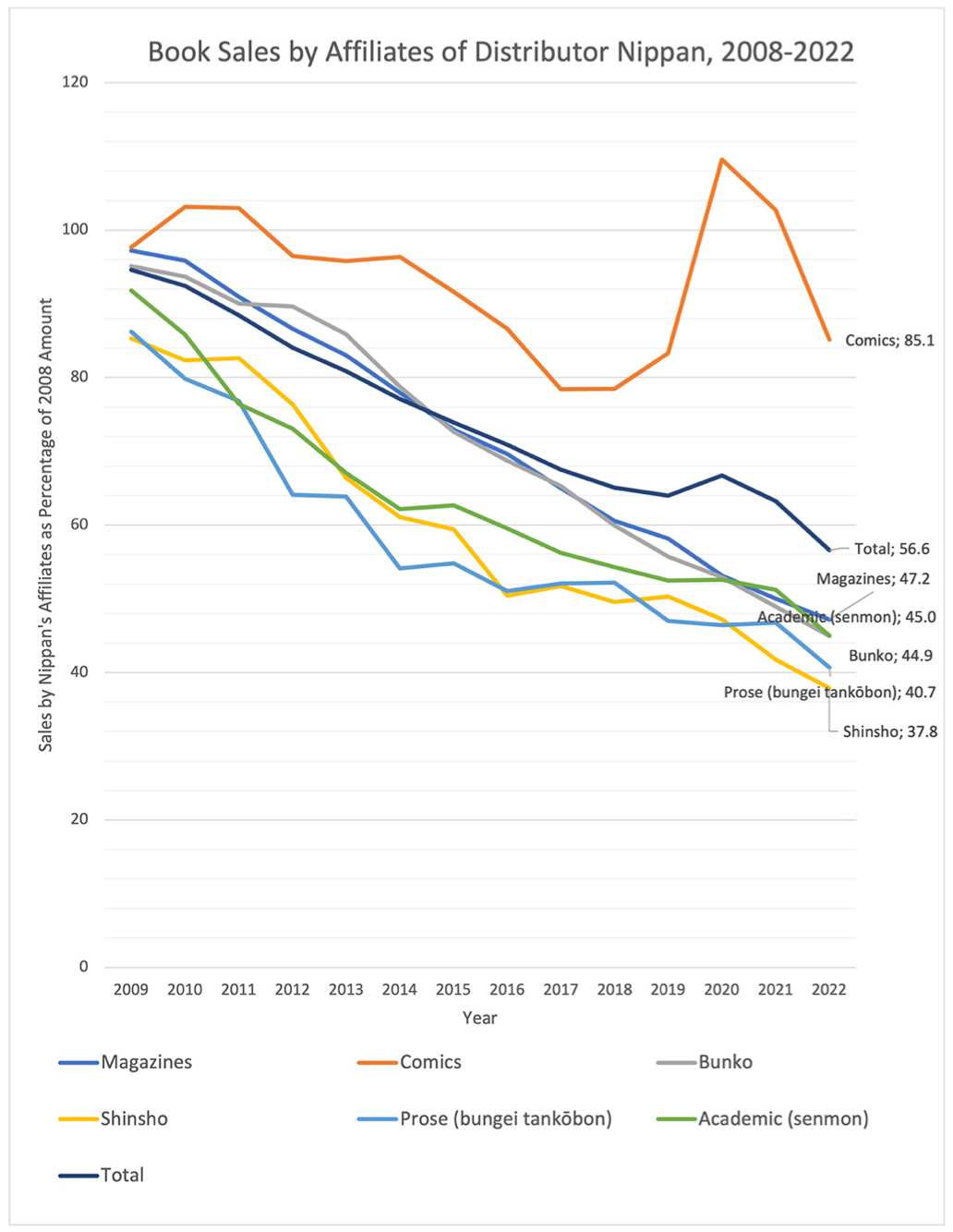
Web novels differ from older forms of Japanese media like literary fiction (bungei), manga, and anime because they are produced within a particular media ecology that lends itself to the creation of what is known in Japanese as “semi-original works,” or 1.5-ji sōsaku (1.5次創作). Semi-original works have narratives referring to story-worlds that are similar but not identical to each other, with variation produced by a combination of quantitative ranking systems and copyright restrictions common on web novel platforms.6 While being a recent phenomenon that traces its origins to early twentieth-century cellphone novels, this new media form has caused climacteric changes within the cultural industry while also integrating itself solidly within it. Numerical sales data for tankōbon (B6-sized “trade paperback”) light novels, virtually all of which are repackaged web novels,7 gives one heuristic for the web novel’s rapid rise in influence despite an overall downturn within the book industry. In 2020, readers bought an estimated 10.1 billion yen’s worth of light novel tankōbon from bookstores, accounting for 37.2 percent of their total revenues within the genre.8 This growth took place despite a 53.3 percent decline within the sales of tankōbon literature overall between 2008 and 2022, as reported by the book distributor Nippan (Figure 1). A successful web novel does not stop with its readaptation as prose fiction, however, but will also be repurposed as comic books and animated films, thereby producing a multimedia franchise. All this would have originated from a free-to-read work written by an amateur.
Our article demonstrates the crucial place web novels have within Japan’s media ecosystem today in three sections. We first historicize web novel platforms; then, we examine their function within Japan’s larger cultural industry; last, we discuss their formal character as semi-original works. Iida Ichishi founded and formerly edited a light novel imprint at one of Japan’s biggest publishers, and is now a freelance business journalist. The following data draws from his experiences and interviews with authors and publishers.
A Short History of Web Novel Platforms
To understand the popularity of web novels today, one must understand the history of their platforms. Web novels first appeared with the early Internet, where some users posted amateur novels on servers they bought or rented. Authors would then message and share links with other authors through email or bulletin board services (BBS). They also registered their sites on Yahoo! Japan, a directory-style search engine founded in 1996, and reference websites called “online novel link collections” (Google, which crawled sites with robots, would not exist until 1998). Examples of such collections, which appeared between 1995 and 1997, included “Hon-navi,” “Novel Search,” and “NOVELS WORLD.” The most important site for the development of today’s web novel platforms, though, was “Rakuen” (est. unknown).9 Rakuen quickly gained popularity by pioneering a ranking system, allowing users to vote on registered works. Rakuen also produced the first instance of a web novel being repackaged and sold in print owing to its public online appraisal, the standard industry model today. The novel in question, Ika ni shite sofuto kaisha wa hōkai shita ka! (2000, How the software company collapsed!) by Kubo Satoru, was published after reaching and long maintaining the number-one spot on Rakuen. Kubo’s debut work, based on his own experience, narrates the story of a software company’s hijacking by crafty lenders and a stubborn employee’s efforts to collect his salary.
This system of ranking novels was incredibly influential. Other link collections quickly copied Rakuen’s system, and from then on, web novel readers and writers both acted with awareness of what was, and what it meant to be, top-ranking. This ranking system was hardly the first time that audiences helped decide who got published: both prose literature and comics, for example, have long been serialized in magazines before the most popular were selected for repackaging as independent books.10 Rakuen, however, shifted the balance of power from magazine editors toward audiences. Because web novels circumvented literary magazines, editors lost their ability to preliminarily vet what audiences could read. Furthermore, as Rakuen let readers express their opinions through access and “Favorited” numbers, the traditional circuit of literary prizes awarded by an expert body became less influential. Where publishers in the past could know a work’s popularity only after its publication, with the advent of Rakuen publishers could decide to invest in printing only those works that had already attained some popularity online. This reversal in priority meant that quantitative judgment became relatively more important for publishers when determining a book’s feasibility. As literary scholar Ishii Masato noted in 2001, votes are “the unique criteria of evaluation for Internet literature”— a statement that remains true to this day.11 As the system evolved from one where “writers choose writers” to one where “readers choose works,” grassroots popularity, not top-down literary value, became the prime determinant of commercial publication.
The first publishers to recognize the profitability of this model, where novels already vetted by the public were repackaged as books, were Alphapolis and Starts. Alphapolis, established in 2000, began a crowdfunding service called the “Dream Book Club” the same year. Readers could fund books by preorder or investment. According to terms effective April 2001, Alphapolis would print the first 500 copies if a novel attracted either 100 advance buyers at 1000 yen apiece or enough investment, at 10,000 yen a share, to cover its first edition’s printing costs.12 Unlike web novel platforms today, though, Alphapolis set a deadline of ninety days for novels to reach this goal. Unsuccessful novels were removed from the website, but had the chance to be printed at the author’s expense. One popular work published through the Club was Separation (2002) by Ichikawa Takuji, adapted in 2003 as a television drama under the title 14 kagetsu (14 months).
Starts, unlike Alphapolis, was an older publisher that entered the cellphone novel publishing through the success of Yoshi’s Deep Love (2002). Deep Love narrates the story of a teenage girl who suffers a series of tragedies involving compensated dating, drugs, and illness, culminating in her death. Yoshi began serializing Deep Love on his personal cellphone website in May 2000. Buoyed by a positive reception, he self-published the novel in book form the following year, selling over 100,000 copies.13 Starts acquired publishing rights in 2002, though not without controversy from within the editorial board, many members of which found Deep Love’s content indecent.14 Furthermore, critics found Yoshi’s literary style odd, as it involved insertions of a lecturing authorial voice and excessive use of paragraph breaks and ellipses. As critic Saitō Minako wrote, “If this was [submitted to the contest for] the rookie award of a literary magazine, I think it would fail in the first round. But such procedures have now become unnecessary, and if one uploads something on the Internet, it will find readers.”15 Literary awards, in short, would not have recognized the explosive demand for Yoshi’s unique literary style.
A final major development in web novel platforms was the migration from link aggregators of personal sites to third-party websites. The most influential of the cellphone sites was Magic i-land (est. 1999). Magic i-land was a social networking service originally compatible only with DoCoMo’s i-mode. Magic i-land let users create personal webpages and gained popularity in 2000 after adding a “book function” through which users could post short chapters on their sites.16 In 2006, as its users increased, Magic i-land added a “Magic Library” function, later renamed “Magic i-land NOVEL,” that aggregated Magic i-land novels and added ranking, commenting, and sorting functions.17 By 2007, the platform boasted almost six million accounts and over one million novels, written primarily by women in their twenties.18 Magic i-land produced numerous hits including Koizora (2006, Love sky) and Akai ito (2007, Threads of destiny), both of which developed into multiple popular adaptations. Critics describe this as a “second boom” in cellphone novels, in contrast to the “first boom” triggered by Deep Love.19 By this point in time, popular novels on Magic i-land readily found commercial publishers, in contrast to the controversy surrounding Deep Love. By 2007, the three most-sold prose tankōbon in Japan were all web novels.20
Not all web novel platforms addressed an exclusively female audience reading on cellphones. Another important platform was Arcadia (mai-net .net), a privately managed BBS compatible only with computers, that opened in 2000 with a demographic of primarily adult men. Arcadia began a board exclusively for posting web novels in 2003.21 Notable works published on Arcadia include Carlo Zen’s Yōjo senki (The Saga of Tanya the Evil), Kawahara Reki’s Accel World, and Yanai Takumi’s Gate. Shōsetsuka, known today as home to the isekai genre, was founded in 2004, originally advertising itself as a PC-compatible cellphone novel website. Shōsetsuka attracted authors writing fantasy, romance, and fanfiction.22 Its parent company soon established further novel platforms including “Nocturne Novels” (2005) and “Moonlight Novels” (2005) for erotic fiction as well as “Love Novels” (2007), a mobile platform for romance stories.23 EVERYSTAR (estar.jp), another major platform, finds its roots in an early mobile SNS and game platform called Mobage Town (mbga.jp), launched by Internet services provider DeNA in 2006. A “Creator” function, added in 2007, allowed its users to post and comment on novels and poems, as well as become “fans” of authors.24 While the term “web novel” did not come into vernacular use until after cellphone novels were already in a process of decline, observing the longer trajectory of the systemic development of novels published online, we can both historicize the construction of its ecosystem and situate cellphone novels within it. The popularity of cellphone novels in the 2000s is therefore best understood not as an isolated, gendered occurrence, but rather as part of the larger historical development of online fiction platforms more generally.
Web Novel Platforms and the Media Mix
By the early 2010s, then, the key characteristics of the Japanese web novel had been established. Authors posted novels on third-party websites where users ranked them. Novels successful online were repackaged as print books. Before print publication, authors could revise and add content, and publishers edited the text and added illustrations. Upon publication, authors could be asked to remove their novel from open access online. Depending on the book’s success, the series may be renewed or expanded into secondary media like manga, anime, and games. This historical point marks the stabilization of the web novel’s situation within the Japanese media ecology as well as the diffusion of its vernacular appellation as a “web novel.” Drawing on Steinberg’s definition of platforms as “structures of relation, or the formalization of relations in varying degree of technological means,”25 this section therefore moves from diachronic historical survey to synchronic media analysis. We argue that though web novel platforms themselves are new, the media mix through which their novels are rendered profitable has older antecedents. In their adaptations of preexisting stories rather than inventing new ones, media franchises developing from web novels continue postwar traditions of simply reusing popular existing works while adapting them to the new modes of user-generated cultural production. What is curious about web novels, then, is how an entirely new ecosystem built upon decentralized power and new technology relies on traditional media pathways to sustain itself.
The media giant Kadokawa exemplifies how the culture industry has integrated open-access web novel platforms into systems of capital accumulation. Writing about the 2014 merger between Kadokawa and Dwango, operator of video platform Niconico Douga, Steinberg argues that Kadokawa desired to “harvest user-generated content and unfold media mixes across their various properties, from video to books to manga to anime.”26 Kadokawa’s attitude toward web novel platforms is similar. While the Dwango merger failed to produce any successful franchises, Kadokawa’s simultaneous inroads into repackaging web novels as books did. Early hits included Log Horizon (2011), an isekai from Shōsetsuka; Sakurako-san no ashimoto ni wa shitai ga umatteiru (A Corpse Is Buried Under Sakurako’s Feet, 2013), a mystery from EVERYSTAR; and Biri Gal (2013), the true story of a reformed delinquent from storys.jp. All three were later expanded into animated or live-action adaptations. In 2011, Kadokawa also acquired the publisher Media Factory, whose label “MF Books” would include numerous popular web novels like Tate no yūsha no nariagari (The Rising of Shield Hero, 2013) and Mushoku Tensei (2014), and in 2016 Kadokawa began its own web novel platform at kakuyomu.jp.
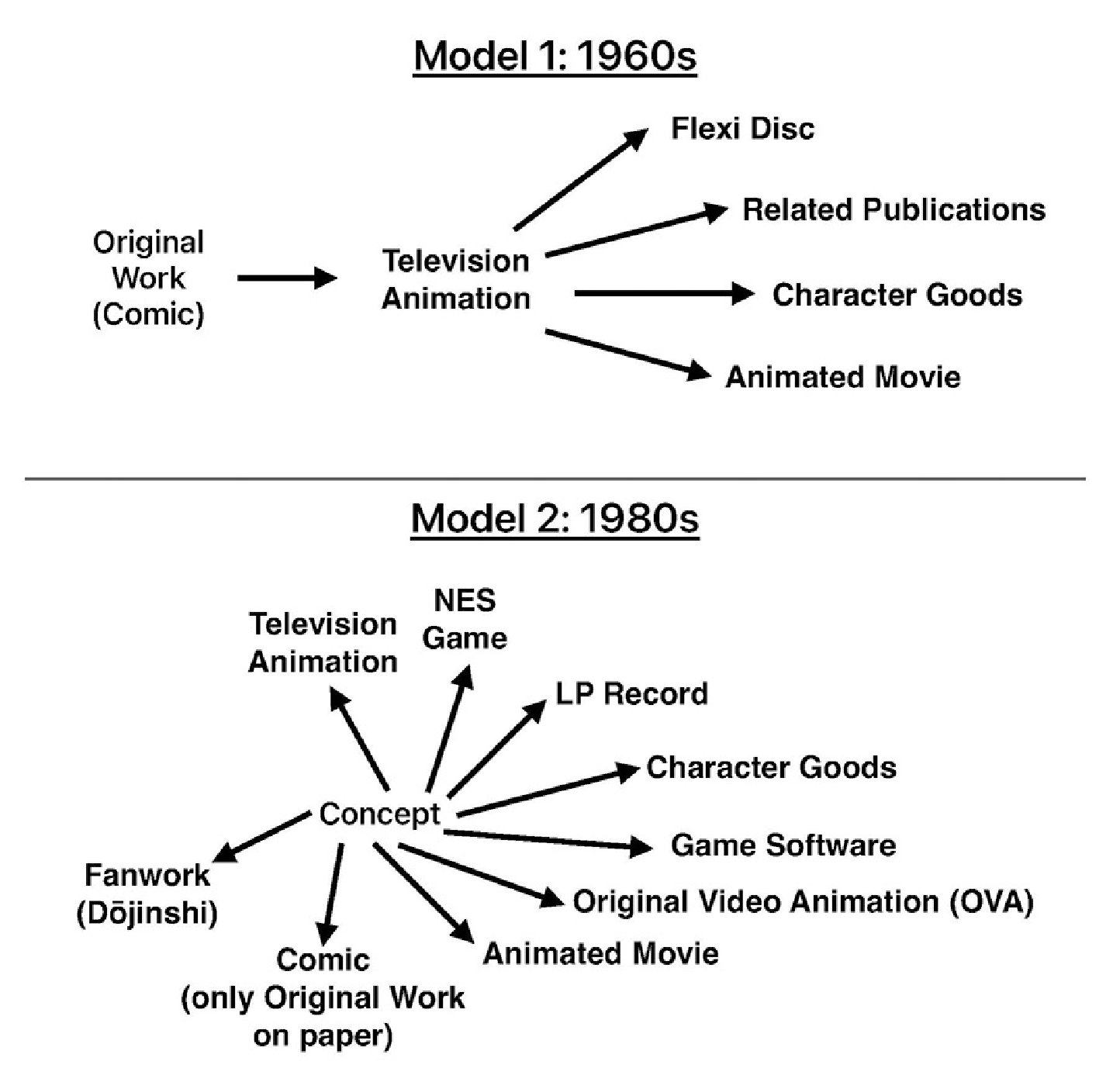
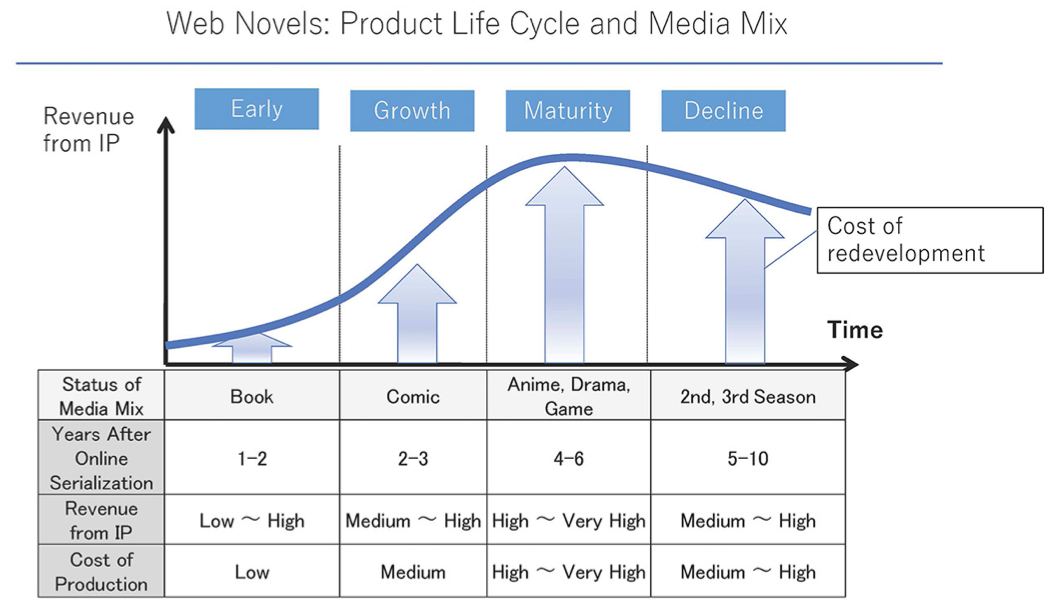
In his 1989 book Theory of Narrative Consumption, Ōtsuka Eiji distinguishes between two industry models. The first dates back to the 1960s. In this model, a popular original work, such as a manga, is turned into a TV anime, which then generates various brand materials. In the second model, which dates from the 1980s, in contrast, all products derive from a shared brand concept (Figure 2).27 Steinberg borrows this distinction when historicizing Kadokawa’s market strategy. Kadokawa Haruki, from 1970 to 1990, practiced a “repetition across media” of the same narrative, but Kadokawa Tsuguhiko, from 1990 to 2020, developed a “divergent series” held together by characters, with “gaps” “patched over” by fans.28 While this second model may apply to some of Kadokawa’s IP, we argue that it does not hold for web novels, which operate according to a variant of the first model, as shown in Figure 3. Because of increasing costs of production, only works receiving sufficient popularity in the preceding stage proceed to the next, where a publisher or studio adapts the same narrative.
Indeed, web novel platforms are run by companies that accommodate publishers and encourage the quantification of literary value. As Steinberg writes, “user-sourced books and crowd-sourced popularity” may “[render] the creative process even more precarious than it was and more dependent on unpaid and uncompensated activities.”29 This profit orientation is shared across web novel platforms, and exemplified by the following common elements:
- Users bookmark novels to receive notifications of updates. Bookmark and visitor numbers are publicized, helping publishers make offer decisions.
- Authors can view more detailed statistics of their works, letting them predict which publication time and lengths will attract the most readers.
- The platform lets authors respond promptly to readers’ demands. Readers can rate and comment on novels, and authors can solicit feedback on specific questions and post updates on future plans. They can also revise chapters after publication.
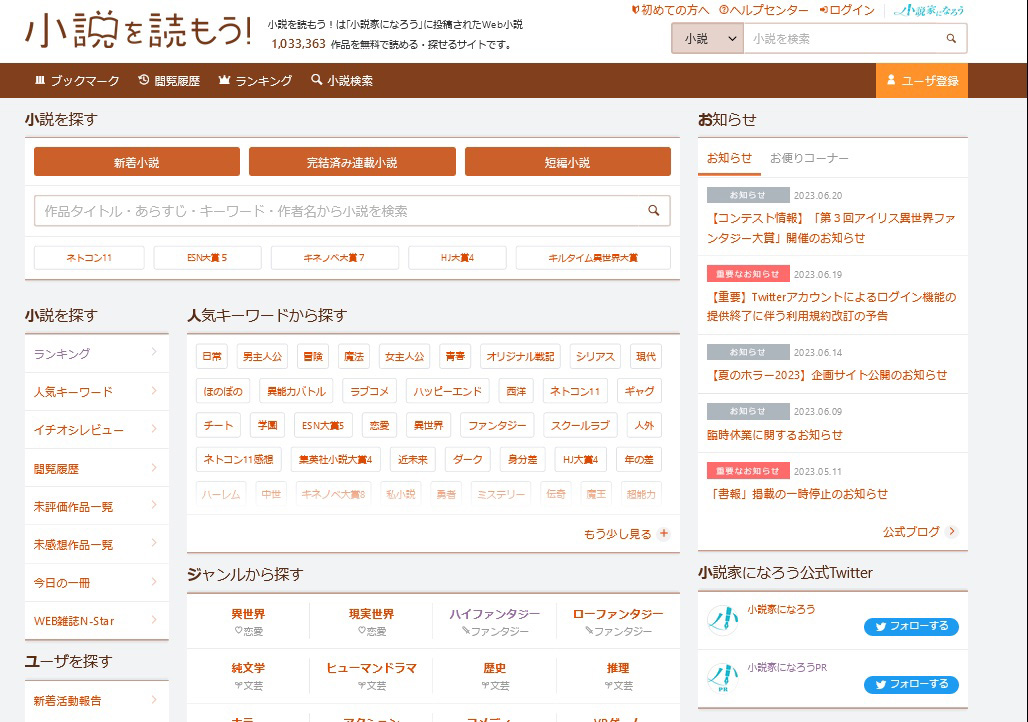
- The platform encourages authors and readers to categorize novels based on tags and microgenres like “slice of life,” “romantic comedy,” and “student council” that are listed on the platform’s homepage. Users click these keywords to see catalogs of the most popular and recently updated novels of each genre (Figure 4). Strategic authors will compose with popular keywords in mind.
In this manner, “original” web novels, written by amateurs and vetted by online audiences, let publishers hedge risks and slash research and development, a practice abetted by the owners of web novel platforms. Comic publishers and animation studios then follow suit, adapting popular novels rather than creating new stories. This strategy is also agreeable to the novel franchise, which reaches different audiences with each adaptation. The comic market is particularly lucrative. In 2020, for instance, 27 billion yen’s worth of literary fiction paperbacks were sold on Japanese bookstore shelves.30 In contrast, in 2022, the domestic market for comics was 677 billion yen.31 Industry leaders recognize the immense potential windfalls from a successful comic adaptation. In an interview with Michida Yōichi, Kadokawa’s Chief Publishing Officer Aoyagi Masayuki noted that comic adaptations of isekai novels sold 2.5 to 3 times more than the original works.32 The web novel platform Alphapolis now prints comics in addition to books, and as of May 2019, comic versions of novels bring in more revenue than the original repackaged books.33 The animation industry, even more hawkish toward profitability, only selects a minority of written works, such as manga and light novels, for adaptation.
Thus, in the domain of web novel IP, small- and medium-sized franchises that are adapted in novel and comic form are more prevalent than large franchises that are turned into animated or live-action film.
Platform and Narrativity
The unique environment of web novel platforms, with its reliance on quantitative measures of audience interest, results in a particular type of narrative that we call 1.5-ji sōsaku or semi-original works (literally, “one- and-a-half-stage works”), following Japanese Internet jargon. Semi-original works are those that exist between original works (1-ji sōsaku or primary works) and their derivative fanfictions (2-ji sōsaku or secondary works). The user-generated Niconicopedia, for instance, defines the concept of 1.5-ji sōsaku as a work “that is created under the influence of an existing work, but does not retain [enough elements] to be called derivative.”34 In illustrating the case of web novels, though, we develop a stricter definition of semi-original works, with three notable characteristics. First, semi-original works manifest storyworlds, implicitly shared among many authors, that remain within the bounds of copyright law. Second, works are enjoyed not primarily for their characters, but instead for tropes found in their settings and plots. Last, these novels are rendered possible only by the proximity and communication between users and writers characteristic of web platforms, where readers can easily become writers, and writers can revise their stories according to readers’ preferences. These patterns diverge from well-known narrative theories often applied to Japanese popular culture. Ōtsuka’s theory of narrative consumption, for example, argues that Japanese readers after 1980 consumed “the grand narrative or order (chitsujo) that [commodified objects] hold in partial form and as their background.”35 Semi-original literature diverges from Ōtsuka’s model on several important measures. Readers access this shared worldview, first of all, not through commodified objects, but through free-to-read narratives written by amateurs. Secondly, while web novel readers consume a shared universe, some of these readers may also believe, contradictorily, that this shared universe is not necessarily the same universe. This extra step of being able to stay between being different and the same— being “1.5-dimensional” or semi-original— is what makes web novels interesting, creative, and eventually profitable. The world within each semi-original work is fundamentally different, and characters, organizations, and settings of one world should not enter another. Another popular theory is Azuma Hiroki’s “database consumption,” where readers enjoy the collection of popular elements from which patchwork characters are produced.36 Azuma’s theory, however, also ill fits web novels. Popular tags include “schoolhouse” (gakuen), a setting; “vengeance” (zamaa), a plot; and “villainess” (akuyaku reijō), a common character in otome games, a genre of romance game tailored toward women. Only rarely do tags ascribe attributes to these characters. Even if “tsundere” and “overpowered” (ore TSUEEE) characters frequently appear in stories, they do not appear as search terms. Against Azuma, web novel readers do not seem to value characters’ personalities or appearances. As Satomi Saito perceptively notes in writing of the shift from Arcadia to Shōsetsuka, “stories do not attempt to describe a unique world or even characters in the common world,” but rather achieve variety “through unique interpretations of the common world setup, which are shared and updated through listed tags and rankings.”37 Semi-original works are created as interpretations of the same imagined universe, but not variations. That is, each story recreates the universe anew instead of replacing or adding individual elements.
The isekai genre is a good example of the literary style and cultural context of semi-original works. One of isekai’s origins lies with Yamaguchi Noboru and his well-received light novel Zero no tsukaima (The Familiar of Zero, 2004). Yamaguchi himself is a product of his time, becoming a game scenario writer and eventually an author only after receiving attention for humorous texts he wrote on his personal website. In The Familiar of Zero, a young Japanese boy named Saito is summoned into fantasy medieval Europe by a young mage named Louise. In this fantasy world, Saito defeats powerful enemies with an invincible superpower and builds himself a harem. Yamaguchi’s novel became a hit following its 2006 adaptation into an animated series, resulting in a tremendous number of derivative works being posted online. A trend eventually developed where fans wrote stories in which characters from works other than The Familiar of Zero became summoned into fantasy Europe and interacted with each other.38 Shōsetsuka saw increasing numbers of isekai novels posted in the last quarter of the 2000s. In August 2010, however, Hina Project, the company operating Shōsetsuka, split off derivative works into a separate website which it then deleted in December 2012.39 Following these copyright restrictions, users on Shōsetsuka began writing novels that appeared to be derivative without being entirely derivative works— treading a fine line between original work and secondary creation that we now know as semi-original works. Semi-original works are therefore slightly different from the “alternate universe” (AU) works common in Western fandoms.40 Where AU diverges an “alternative” from an unambiguous original, semi-original works refer to originals only obliquely, if at all. Most isekai stories take place in a version of fantasy medieval Europe only slightly different from one another. Japanese readers jokingly call this world “Naroppa,” a compound of “Narō,” the novel platform, and “Europe” (Yōroppa). This world has shared locations, notably an Adventurer’s Guild where characters can find work, receive rewards, and “rank up” as they progress. The stories also have frequently shared plots, like one where a protagonist, suddenly rejected from a Hero’s party, gradually overcomes and dominates his former aggressors. By adjusting characters, quotes, and events, authors alter story elements just enough to avoid legal repercussions. Examples of popular isekai stories that began on Shōsetsuka include KonoSuba (2013), Re:Zero (2014), and Tensei shitara suraimu datta ken (That Time I Got Reincarnated as a Slime, 2014), all of which take place in the fantasy Europe of role-playing games. Authors of these popular works begin as readers of the same web novel platform who later seek to repeat the success of their predecessors. This is not unique to Shōsetsuka, but common on all web novel platforms, where authors tend to write novels in line with trending keywords. Nor is Naroppa the only semi-original universe; another popular setting is the schoolhouse romance, which has spawned its own multiplicity of derivative works.
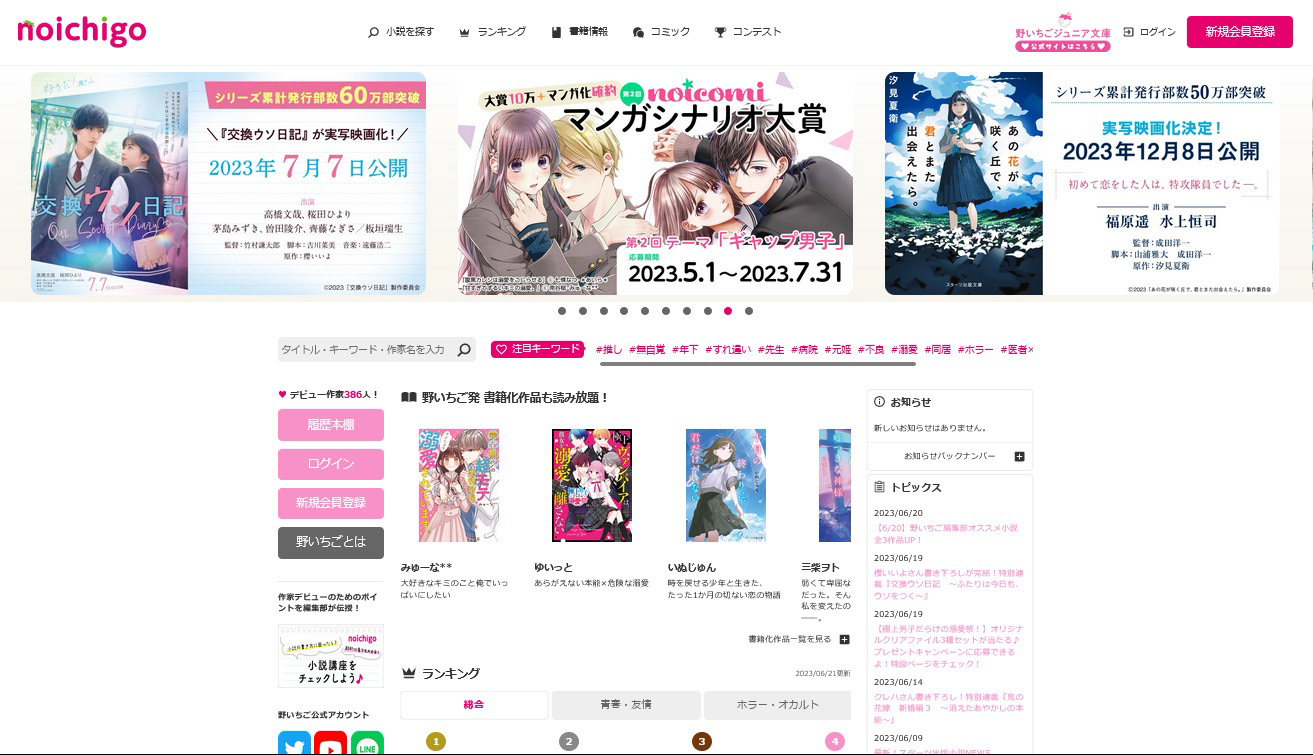
Semi-originality is not, moreover, unique to male otaku culture. The platform Wild Strawberry, for example, was founded by Starts in 2007 and is popular with teenage girls. Popular tags like “biker” (bōsōzoku), “chief” (sōchō), and “female chief” mark its homepage (Figure 5). Japanese biker gangs, often considered a nuisance by mainstream society in the 1970s and 1980s, were teenagers who gathered at nighttime to ride illegally remodeled motorcycles, consume drugs, and fight turf wars with rival gangs.41 Though largely defunct by the century’s end, romances between high school girls and biker leaders became a literary trope following Yū’s Wild Beast (2009), serialized on Magic i-land. Epigones quickly followed on Magic i-land and Wild Strawberry, and continue to this day. Authors today abstract biker gangs from their social contexts. Most feature law-abiding guys who rarely resort to violence, and who occasionally do not even ride motorcycles. Readers appear to enjoy the essential plot where the leader of a gang falls in love with a young girl feeling alienated in both home and school.42 Analyses of this narrative can inform us of a readership demographic’s collective fantasies.
Conclusion
Web novels are a new literary formation that has become an influential segment of Japan’s media ecology over the last two decades. Understanding the institutional and cultural groundwork for their production is necessary for making sense of Japan’s media mix today, as well as the genres of fiction, like isekai, which are produced from within it. Readers of isekai feel comfortable in its world because it is based on tropes well-known to them. This comfort is encouraged by the ranking system. To attract readers from within a particular cultural milieu, authors appeal to collective fantasies, reinterpreting the narratives of already-existing characters and plots. Neither the isekai world nor the use of hashtags infringes upon copyright; on the contrary, the presence of these limitations permits readers to enjoy the similarities and minor differences between works. Novels that become popular within this environment may develop into media mixes that refer back to web novels as their source works. The structural differences between cultural production within Japan’s traditional media mix and within web novel platforms may not be apparent to non-Japanese audiences, who consume genres like isekai primarily in the form of anime and manga. Its media ecological dynamics, however, are entirely different.
In our study, we have situated the web novel in recent history, arguing that its burgeoning popularity indicates a change within Japan’s traditional media mix that has not been fully recognized yet. We also introduced the concept of a semi-original work, which operates on the principles of fanfiction while being framed within a regime of copyright protection via their platforms, resulting in a form of creativity that may be more repetition than difference, but which nevertheless clearly has a positive market reception. In introducing the online Japanese slang term 1.5-ji sōsaku, we also complicate older, widely cited media theories. Where Ōtsuka’s “world” and Azuma’s “database” describe silent agreements within an otaku community, tag popularity on platform rankings is highly conspicuous. Though readers enjoy mutual recognition through an imaginary shared world, because this communal universe evolves along with the current popularity of its tropes and narratives, writers must keep to their feet to ensure that this imaginary does not leave them behind. Last, publishing houses’ decisions on who to publish are determined primarily by quantitative measurements of online readership rather than closed selection by a small group of mostly professional writers.
While some works from Western web novel platforms like Wattpad have become printed books and movies, the pipeline is far more accessible and prevalent in Japan. This is partly due to structural reasons. Unlike traditional publishers in the United States, Japanese light novel publishing houses do not typically sign serial contracts that bind publishers to printing more than a single volume. They also do not pay advances, or an upfront sum to authors in exchange for the right to publish their work. Japanese publishers therefore do not make substantial cash outlays when preparing a book for print, reducing their financial risk. Novels on Wattpad repackaged by North American publishers, in contrast, are integrated into the continent’s traditional transmedia business models, which require higher upfront costs. American authors can also choose, of course, to publish with self-publishing companies like Amazon’s Kindle Direct Publishing.43 Japanese LNs, however, are neither self-published nor primarily digital. Publishing houses like Kadokawa support authors with professional editors and manage print books’ distribution onto bookstore shelves.
If the repackaging of amateur fiction is rare in the West, it is common across East Asia in countries such as China, Korea, and Thailand. The reason behind this commonality is a potential direction for future research, and the intricacies of their respective media cultures deserves more attention than we could give it here. Indeed, perhaps, with Wattpad’s recent acquisition by South Korea’s NAVER, we may see a convergence between these two markets. Our hope is that this preliminary account offers a starting point for future analyses of industrial shifts in the cultural industries and their wider regional and inter-regional impacts. Such a nuanced discussion of the particularities of digital transmediality in East Asia has the potential to diversify the Eurocentric bent implicit in Anglophone academia.
Iida Ichishi is a critic and freelance journalist covering the Japanese publishing industry, focusing on the economics of web fiction, light novels, and comics in Japan and Korea. His published books include “Wakamono no dokusho banare” to iu uso: Chūkōsei wa dono kurai, donna hon o yondeiru no ka (The falsehood that “young people don’t read”: How much and what types of books are middle and high school students reading?) (Heibonsha, 2023), Uebu shōsetsu 30-nen shi: Nihon no bungei no “hanbun” (30-year history of web novels: “Half” of Japanese literature) (Seikaisha, 2022), Raito noberu kuronikuru 2010–2021 (Light novel chronicles: 2010–2021) (P-Vine, 2021), and Manga zasshi wa shinda. De, dō naru no?: Manga apuri ikō no manga bijinesu daitenkan jidai (Manga magazines are dead. So, what now?: The era of great change in the manga business since manga apps) (Seikaisha, 2018).
Scott Ma is preparing his doctoral dissertation at the University of Zurich, Switzerland, on the history of agricultural knowledge and colonial policy in modern East Asia, with a focus on the Japanese empire. His previous work on contemporary Japanese popular culture has been published in journals including positions, Rethinking History, and The East Asian Journal of Popular Culture.
Acknowledgments
We thank Jaqueline Berndt, Marc Steinberg, the editors at Mechademia, and the two anonymous reviewers for their advice.
Notes
- Thomas Lamarre, The Anime Ecology: A Genealogy of Television, Animation, and Game Media (Minneapolis: University of Minnesota Press, 2018). Back to text
- Ian Condry, The Soul of Anime: Collaborative Creativity and Japan’s Media Success Story (Durham: Duke University Press, 2013), 125. Back to text
- Marc Steinberg, The Platform Economy: How Japan Transformed the Consumer Internet (Minneapolis: University of Minnesota Press, 2019), 124. Back to text
- Stevie Suan, Anime’s Identity: Performativity and Form beyond Japan (Minneapolis: Minnesota University Press, 2021); Sandra Annett, Anime Fan Communities: Transcultural Flows and Frictions (New York: Palgrave MacMillan, 2014). Back to text
- Jaqueline Berndt, “Anime in Academia: Representative Object, Media Form, and Japanese Studies,” Arts 7, no. 4 (2018). Back to text
- Gabriella Lukács, Invisibility by Design: Women and Labor in Japan’s Digital Economy (Durham: Duke University Press, 2020); Marie Kim, “Girls Just Want to Have Fun: The Portrayal of Girls’ Rebellion in Mobile Phone Novels,” New Voices in Japanese Studies 9 (2017), https://doi.org/10.21159/nvjs.09.02. Back to text
- Shuppan kagaku kenkyūjo (Research Institute for Publications), Shuppan geppō (Publishing monthly) 63, no. 11 (2021): 5. Back to text
- Shuppan kagaku kenkyūjo, 5. Back to text
- Iida Ichishi, Uebu shōsetsu 30-nen shi: Nihon no bungei no “hanbun” (30-year history of web novels: “Half” of Japanese literature) (Tokyo: Seikaisha, 2022), 21–79. Back to text
- Alisa Freedman, “Thumb-Generation Literature: The Rise and Fall of Japanese Cellphone Novels,” in Introducing Japanese Popular Culture, ed. Alisa Freedman and Toby Slade (London: Routledge, 2018), 332. Back to text
- Ishii Masato, “Intānetto bungaku no genzai: Intānetto ni okeru semipuro amachua bungaku no genjō” (Internet literature now: Current state of semipro, amateur literature on the Internet), Minshū bungaku, no. 427 (2001): 116–18. Back to text
- “DreamBooksClub.com no arukikata” (How to use DreamBookClub.com), Internet Archive, 11 April 2001, https://tinyurl.com/47crpate. Back to text
- Yoshida Satobi, Keitai shōsetsu ga ukeru riyū (Why mobile novels are popular) (Tokyo: Mainichi Communications, 2008), 44–45. Back to text
- Matsushima Shigeru, “Keitai shōsetsu o shuppan suru toiu koto” (On the publishing of mobile novels), Kokubungaku: Kaishaku to kyōzai no kenkyū 53, no. 5 (2008). Back to text
- Saitō Minako, Godoku nikki (Diary of misreadings) (Tokyo: Bungei shunjū, 2009), 287. Back to text
- Freedman, “Thumb-Generation Literature,” 327. Back to text
- “Keitai shōsetsu o yonde kaite katareru sōgō saito: ‘Mahō no toshokan’ gurando ōpun” (Comprehensive site for reading, writing, and discussing cellphone novels: ‘Magic Library’ Grand Opening), Internet Archive, 16 March 2006, https://tinyurl.com/4bfy2jb3. Back to text
- Sugiura Yumiko, Keitai shōsetsu no riaru (Reality of mobile novels) (Tokyo: Chūō kōronsha, 2008), 21. Back to text
- Iida, Uebu shōsetsu 30-nen shi, 143–47. Back to text
- TOHAN, “2007-nen nenkan besutoserā” (2007 bestsellers). http://tinyurl.com/36cbkfw9. Back to text
- “Kono raitonoberu ga sugoi!” (This light novel is amazing!), in Kono Web shōsetsu ga sugoi! Intānetto-hatsu no zen Web shōsetsu besuto rankingu! (This web novel is amazing! Best ranking of web novels), ed. Henshūbu (Tokyo: Takarajimasha, 2015), 120. Back to text
- “Hajimete no kata e” (For beginners), Shōsetsuka ni narō (Let’s become novelists!), Internet Archive, 5 August, 2004, https://tinyurl.com/2hkhtrrb. Accessed 24 June 2023. Back to text
- “Shōsetsuka ni narō gurūpu” (Let’s become novelists! group), Shōsetsuka ni narō, https://tinyurl.com/4pdvb3n4. Accessed 24 June 2023. Back to text
- “Keitai gēmu & SNS saito ‘Mobagē Taun’ ni tōkō kontentsu o kaisetsu: Yūza ga kaita shōsetsu, shi nado no sakuhin tōkō ga kanō ni” (Establishing a contents posting function on mobile game and SNS site ‘Mobage Town’: Possible to post novels, poems written by users), DeNA, 23 March 2007, https://tinyurl.com/bt93uswu. Back to text
- Steinberg, Platform Economy, 92. Back to text
- Steinberg, Platform Economy, 200. Back to text
- Ōtsuka Eiji, Monogatari shōhiron: “Bikkuriman” no shinwagaku (Theory of narrative consumption: The mythology of “Bikkuriman”) (Tokyo: Seikaisha, 2021), 53–59. Back to text
- Marc Steinberg, Anime’s Media Mix: Franchising Toys and Characters in Japan (Minneapolis: University of Minnesota Press, 2012), 180–82. Back to text
- Steinberg, Platform Economy, 204. Back to text
- Profits of 2020 bungei tankōbon calculated by extrapolating the 10.1 billion yen light novel tankōbon market representing 37.2 percent of bookstore bungei tankōbon profits: Shuppan geppō 63, no. 11 (2021): 5. Back to text
- Shuppan kagaku kenkyūjo (Research Institute for Publications), Shuppan geppō 65, no. 2 (2023): 5. Back to text
- Michida Yōichi, “‘Narō-kei’ komikaraizu to KADOKAWA no senryaku” (Comic remediations of isekai and KADOKAWA’s strategy), Tsukuru 49, no. 5 (2019): 45. Back to text
- “2019-nen 3-gatsu ki kessan setsumei shiryō” (March 2019, budget explanatory material), Alphapolis, p. 5, https://tinyurl.com/yc5n6cux. Back to text
- “1.5-ji sōsaku” (1.5-stage creation), Niconicopedia, last updated 30 August 2010, https://tinyurl.com/mvxrda3x. Back to text
- Eiji Ōtsuka and Marc Steinberg, “World and Variation: The Reproduction and Consumption of Narrative,” Mechademia 5, no. 1 (2010): 107. Back to text
- Hiroki Azuma, Otaku: Japan’s Database Animals, trans. Jonathan E. Abel and Shion Kono (Minneapolis: University of Minnesota Press, 2009). Back to text
- Satomi Saito, “Narrative in the Digital Age: From Light Novels to Web Serials,” in Routledge Handbook of Modern Japanese Literature, ed. Rachael Hutchinson and Leith Douglas Morton (London: Routledge, 2016), 325. Back to text
- Scott Ma, “Fantasies of Europe, fantasies of Japan: Isekai and the narrative logic of Japanese Occidentalism,” East Asian Journal of Popular Culture 9, no. 2 (2023), https://doi.org/10.1386/eapc_00111_1. Back to text
- “Nijifan kōkai no oshirase” (Notification of start of Nijifan), Shōsetsuka ni narō, 11 August 2010, https://tinyurl.com/s4ewjz8m; “‘Nijifan’ ‘NOS’ sakuhin tori-atsukai ni kanshite no oshirase” (Notification on treatment of ‘Nijifan’ ‘NOS’ novels), Shōsetsuka ni narō, 11 December 2012, https://tinyurl.com/5n8mcd7f. Back to text
- Katharine Elizabeth McCain, “Today Your Barista Is: Genre Characteristics in The Coffee Shop Alternate Universe” (PhD Diss, Ohio State University, 2020). Back to text
- Satō Ikuya, Bōsōzoku no esunogurafī: Mōdo no hanran to bunka no jubaku (Ethnography of bikers: Rebellion of mode and strictures of culture) (Tokyo: Shinyōsha, 1984). Back to text
- Iida Ichishi, “Būmu-go no ‘keitai shōsetsu’ ga ima mo yomareru hitsuzen” (“Cellphone novels” post-boom inevitably still read), Tōyō keizai online, March 30, 2019, https://toyokeizai.net/articles/-/272269. Back to text
- John B. Thompson, Book Wars: The Digital Revolution in Publishing (Cambridge: Polity, 2021). Back to text